
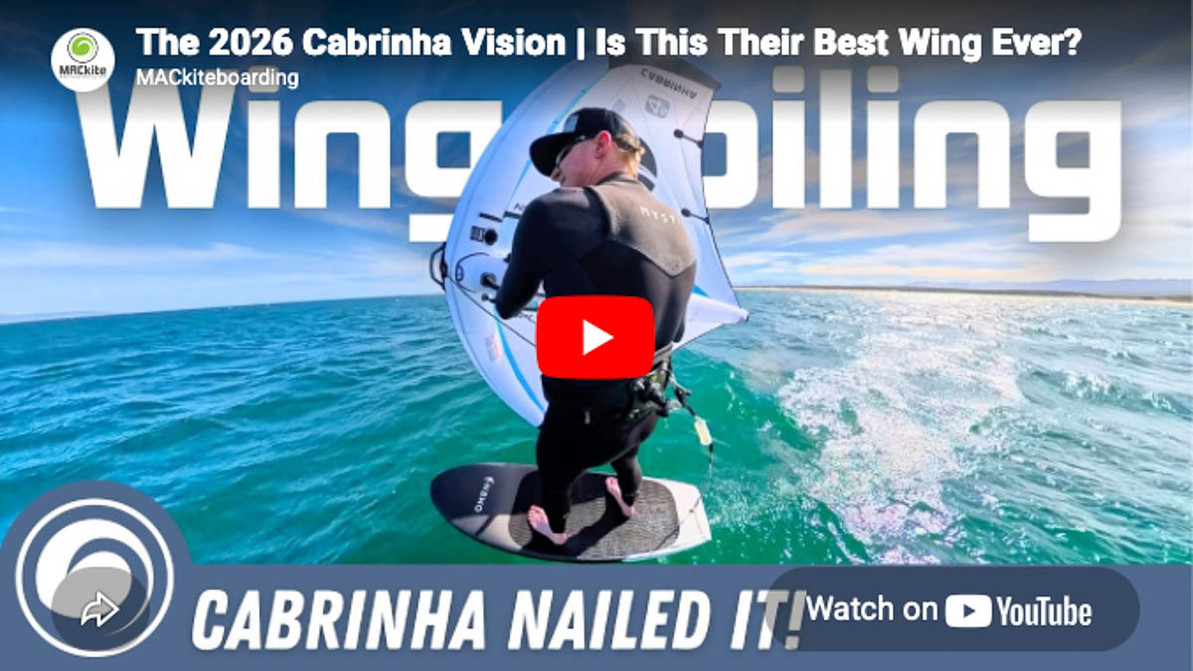
2026 Cabrinha Vision Review | This One's a Different Animal Entirely
The Cabrinha Vision has always had a loyal following, but if you've been sleeping on it because of how previous versions performed, it's time to wake up. The 2026 Vision is a ground-up redesign—and it's easily one of the most exciting wings we've had our hands on this year.
Tucker and Jeff from MACkite put the new Vision through its paces, including a full session in La Ventana, Mexico. Here's everything you need to know.
First Impressions | Build Quality and Aesthetics
Right out of the bag, this wing turns heads. The white and blue colorway is clean, sleek, and polished—though Cabrinha does offer additional color options if that's not your vibe. One small practical note: in gnarly conditions with a lot of whitewater, an all-white wing can be harder to spot from a distance. Just something to keep in mind on a crowded beach day.
Beyond looks, the build quality here is genuinely impressive:
- Premium Dacron construction on the leading edge and strut—the same class of material you'd find on wings like the Duotone SLS or Ozone Flux
- Kevlar reinforcement on high-stress seams for added durability and longevity
- 2x ripstop canopy panels with radial layout, aligning seams with load direction to keep performance dialed session after session
- Nano ripstop trailing edge that's stiffer and lighter than Dacron, keeping the back of the wing taut and flutter-free
- Fiberglass battens that flex, don't permanently bend, and are easy to replace (pro tip: chopsticks from your nearest Chinese restaurant work in a pinch)
This is a wing built to last, and the material choices reflect a thoughtful balance between performance and value.
Design Deep Dive | What's New and Why It Matters
The Hard Front Handle
Love it or hate it, the hard front handle is a Cabrinha signature at this point. It gives you a direct, locked-in feel for how the wing is rolling and pitching—far more tactile feedback than a soft leading edge handle. It's removable if you decide it's not for you, and with a little time on the water, most riders come to appreciate the control it offers. The key is a relaxed grip; fight it too hard and you'll feel every bump. Let it hang in your hand, and it's surprisingly intuitive.
Worth noting: the underside of the handle features a suede-like soft material that's easier on your hands than neoprene—especially in saltwater where neoprene tends to chafe.
Inflation System
Tucker is self-described inflation weenie, and his verdict here is positive. The Vision uses a Boston-style valve with a standard kite hose connection—no adapter needed. One-point inflation fills both the leading edge and strut simultaneously, which is quick and easy. For those who want independent bladder control, a pinch-off valve lets you inflate each separately. Deflation is also fast with both valves open.
One minor critique: Tucker would personally prefer a clean two-point system without the one-pump option, arguing it reduces weight and complexity. But for most riders, the flexibility is a feature, not a bug.
Canopy and Mesh Panel
The Vision includes a large, nearly seamless window up front that actually lets you see through it while riding—a small but functional detail. More interesting is the new mesh infill panel at the trailing edge. This is something no other brand is currently doing, and it serves two purposes:
- Provides a secondary visibility path from window to window
- Allows the canopy to breathe across both ends, equalizing pressure and producing more consistent, stable flight
Whether this becomes an industry standard remains to be seen, but it clearly doesn't hurt performance—and Tucker thinks it contributes meaningfully to the wing's stability.
The Boom
The Vision comes with a boom included—no upsell required. It's stiff, has solid pistol grip ergonomics, and features a subtle tactile texture where your hands naturally fall. Those grip zones double as a visual reference for hand positioning, including where the harness line should sit. It's a thoughtful detail that makes onboarding faster for new riders and keeps experienced riders consistent.
On the Water | Performance and Ride Feel
This is where the story really gets good.
Power and Low-End
The 2026 Vision has serious grunt. The combination of premium Dacron tension, deeper dihedral, and a larger foil section creates a big pocket of power. Tucker got up and riding in around 15 knots on the 4.5m—and then stayed on it when conditions cranked over 30 knots during a passing snow squall. That's remarkable range for any wing, let alone one in the Vision's price bracket.
For riders who've been sizing up to get on foil in lighter air, this wing may allow you to size down and still get the lift you need.
Upwind Performance
This is where the new Vision genuinely surprised both Tucker and Jeff. Previous versions were solid low-end wings, but upwind performance was middling at best and the top-end range got uncomfortable fast. The 2026 model is a completely different story.
The wing's dihedral and boom balance point—positioned further back than you might expect—give it a kind of arrow-like drive up the wind window. Tucker rode upwinders in La Ventana from the south end all the way to the hot springs, keeping pace with younger, seasoned riders. Onlookers commented on how efficiently it tracked upwind. That doesn't happen by accident.
Wind Range and Versatility
The Vision has historically been categorized as a beginner or light-wind wing. The 2026 version breaks out of that box entirely. It now belongs in the same conversation as wings like the Reedin Supernatural or Ozone Flux—wings with genuine high-end range that can carry an experienced rider confidently in a wide variety of conditions.
Key performance characteristics:
- Wide sweet spot makes it forgiving and accessible without sacrificing drive
- Balanced power gradient across both hands rather than heavy backhand bias
- Efficient slice through the air once you're up and riding—it doesn't just power you up, it keeps you moving smoothly
- Compact wingtip clearance thanks to increased dihedral—less chance of clipping tips during pumping, especially useful for progressing riders
Wave Riding
The Vision is marketed as a freeride/freestyle wing, but Jeff found it genuinely capable on the wave face—with the right technique. It's not a dedicated wave wing like the Mantis or the Air, and if you prefer flagging the wing out completely and letting it drift while you surf, those wings will serve you better. But if you like to ride the wing actively on the wave—using it to build speed, float over sections, leverage into turns—the Vision is fantastic for that. The pistol grip position works especially well in this context, keeping the wing ready to re-engage fast when you need that extra burst of power.
Tacks and Transitions
One useful tip from Tucker: before entering a tack or going into any upwind attack, slide your front hand forward toward the nose of the boom. Because the wing balances further back, leaving your hand in the standard position will result in slight nose-down pressure. Move that hand forward first, and the wing floats through transitions cleanly with minimal downward load on your arms.
Minor Critiques | The Honest Take
No review would be complete without the real talk. A couple of small things to be aware of:
- Hard handle feedback — Because there's no flex in the front handle, any play in the canopy or trailing edge transfers directly to your grip. In choppy or gusty conditions, you'll feel more of what's happening with the wing. This isn't a dealbreaker, but it's different from soft handle wings and takes some adjustment.
- "Locked in" feel when flagging — When transitioning the wing from one hand position to another during flagging, it can occasionally catch and produce a brief power pull. Jeff attributed this partly to how wide the sweet spot is—a characteristic that's mostly a benefit, but occasionally creates a moment you have to manage.
- One-pump system — As mentioned, Tucker's personal preference would be to drop the one-pump valve entirely in favor of a cleaner two-point setup. This is a fairly niche critique, and most riders won't mind the option.
Key Takeaways
- The 2026 Cabrinha Vision is a complete redesign—not an update, a rebuild
- Premium Dacron construction, Kevlar reinforcement, and radial panel layout deliver high-end durability at a competitive price
- Dramatically improved upwind performance compared to previous Vision models
- Impressive wind range: Tucker rode it comfortably from 15 to 30+ knots on the 4.5m
- The wide sweet spot makes it accessible for beginners without dumbing it down for experienced riders
- Hard front handle provides exceptional control—takes an hour or two to adapt to, but most riders come around on it
- New mesh infill panel is a unique feature that contributes to canopy stability and consistency
- Active wave riding is fully in play—it's not a dedicated wave wing, but it performs well with an engaged riding style
- Boom included—leash not included (bring your own)
- Strong value proposition: a lot of performance, build quality, and range per dollar
Ready to Get on the New 2026 Cabrinha Vision?
Tucker and the MACkite crew are stocking the 2026 Cabrinha Vision and have firsthand time on the water with it. If you have questions about sizing, how it compares to other wings in your quiver, or whether it's the right fit for where you're at in your progression, please reach out directly. We’re always happy to help.
Drop us a line at Kiteboarder@MACkite.com
Recent Posts
-

2026 Cabrinha Unify Control Bar Review
The Brazilian Brothers are in windy Brazil to provide a thorough review of the brand-new 2026 Cabr …23rd Oct 2026 -
Naish Hatch V2 Parawing Overview
Jeff takes a few minutes out from the KoGL event to chat with Adam Carr from Naish about the Hatch …22nd Oct 2026 -

Flysurfer Soul 4 vs Sonic 5: Which Kite is for You?
Jeff is on the beach at KoGL with Marie-Eve from Flysurfer to discuss the growing excitement surro …20th Oct 2026