
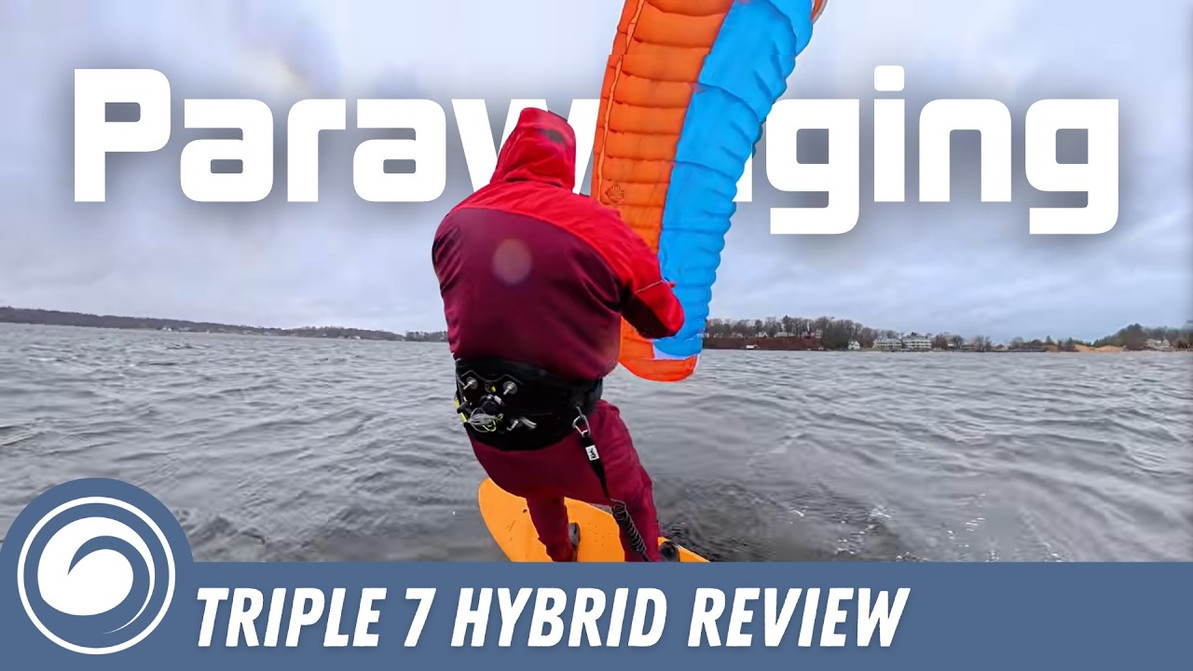
Triple Seven PT Hybrid Parawing Review
If you've seen Tucker's videos before, you know that he's been a huge fan of the PT single skin parawings, and Triple Seven has a long history of making really great parawings. When the PT Hybrid came out, he were naturally really interested. It features a nice blend of features that give a lot of versatility and ease of use.
The PT Hybrid is a hybrid dual-skin/single-skin parawing. Most of the wings out there in the market are single-skin parawings, meaning the canopy is only one layer deep, like an inflated kiteboard kite. When you get into the front half of the PT Hybrid, you have a dual-skin. You have air ports with two layers of material that create a full wing shape, rather than just the outer section of the foil. It creates an inner foil section which gives you a bit more stability on the wing, generally a broader speed range, and some advantages in terms of power per size. The front half fills with air and creates its own shape like a ram air kiteboard kite.
Canopy Construction and Details
Pointing at some details on this wing, the PT Hybrid has some nice big open ports for the dual skin. The D-ribs are really well reinforced, so they hold their shape and don't collapse on themselves. It's obvious that Triple Seven took the extra time to make it extremely lightweight but also reinforced all the little details where they need to be to make sure they keep their performance and require less maintenance.
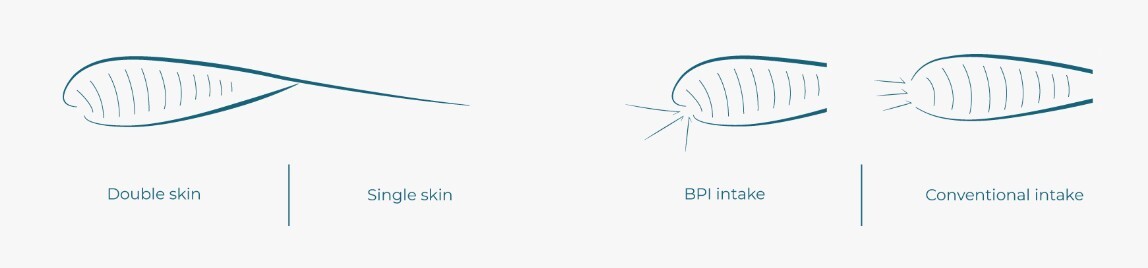
The canopy material itself is crazy light. It almost feels like a shopping bag thin, but it's really high-quality stuff. It stays light, it stays stiff, and it's reinforced in the ways that it needs to be where it's not just going to bag or blow out with a short bit of use. Triple Seven did a nice job using the right materials where they can go crazy light so it packs up nicely and flies lightweight in the sky, but you don't have those durability issues.
Getting into the back part of the canopy where it transitions into the single skin, you've got some holes. On a kiteboard kite, you wouldn't really have holes — you might have drains — but not to the level of the PT Hybrid. Every one of these cells has big gaping openings to drain the extra water and help bleed out some of the air so that it doesn't become too stiff. When you go to pack it down, it packs down incredibly quick. If you had to force it all out the entry, it would take longer, and if you ended up collapsing the leading edge first, you'd end up with trapped air. This one packs down as easily as a single skin in most cases, and the air evacuates almost immediately. So far, Tucker hasn't seen any issues with packing, which is a testiment to Triple Seven's intuitive design.
Essentially, Triple Seven has created a hybrid dual-skin wing that, in many ways, has improved the overall riding experience. The ride is smooth, more predictable, and avoids the common pitfalls of a dual-skin wing that's been noticed in the past (i.e., difficult to collapse and launch while also requiring a significant amount of wind).

The Bar and Harness Line
As compared to other wings in the market, the bar is a touch on the longer side. This is a 5.6 meter, so it's a big wing, and naturally, you're going to have a larger bar. On average, the Triple Seven bars are going to be maybe an inch to an inch and a half longer per size than a lot of other wings.
That's not necessarily a huge thing; as the bar can get stashed in the stash pouch quite easily. It might bow out a little bit, but we don't find any huge disadvantage to the larger bar. The control and the stability that the slightly larger bar gives you is really good and is a greater advantage than having a bar that's a little shorter and stashes a little cleaner. Control and stability are key, especially for riders that aren't at that pro level yet.
This bar is a color-coded bar — you're going to fly off the blue side, not the orange side. Orange is emergency; break it to the water, and it's going to fall backwards out of the sky.
The bar does come included with a harness line. This is a poly-coated, non-stretch harness line. That said, the way that it integrates into the bar is smart, clean, and avoids the negative effects of harness lines like gripping or knotting issues. Overall, the intergration and thought process behind the bar is solid.
One downside of these stiffer harness lines is when they come from the factory, they can be a little twisted up. You can just dip it in some boiling water to straighten it out.
The bar itself is carbon and straight. It does have a nub or knob ahead of the A-lines, so it's really comfortable to fly in neutral when you're just hanging out. You really don't need to death-grip the bar. It flies really strongly off those A-lines, so you're often flying it with that nice pivot ability, but it's also really easy just to lean on the main part of your hand.
Bridle Set and Yoke System
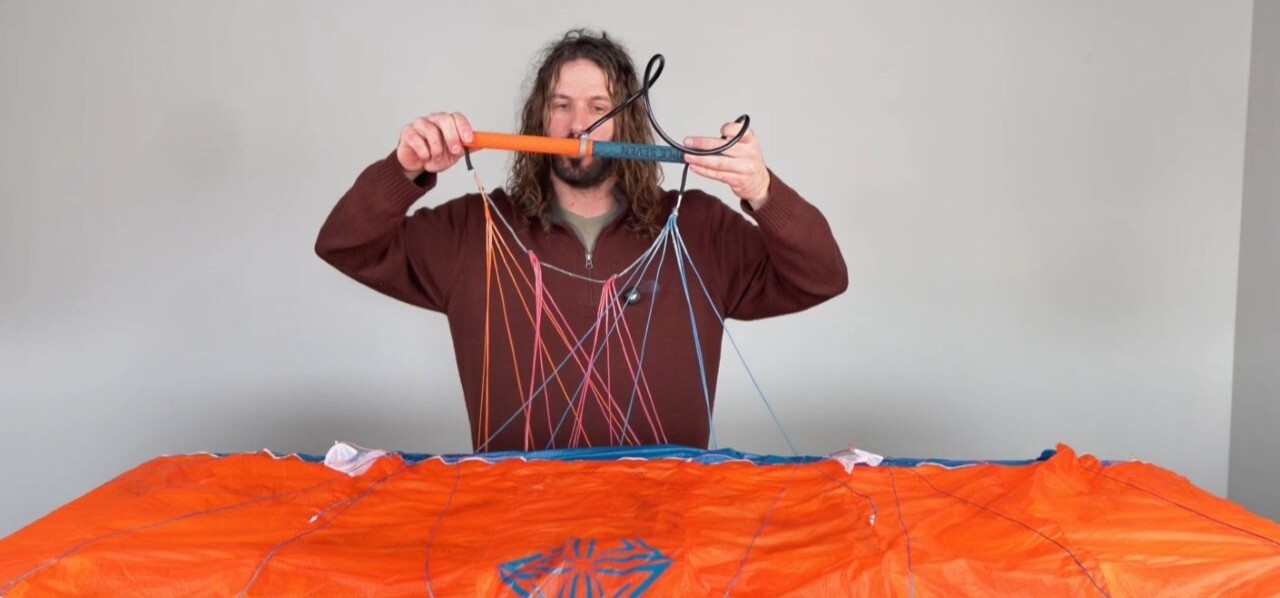
It does have a yoke system, so you have no B and C lines connecting to the bar — it's just the A and the D that connect to the actual bar. You can just slide your hand along the bar, especially in the cold riding with thick lobster mittens. In those conditions, it's really nice to be able to slide your hand to find an easy flying position and switch hands without being encumbered by another layer of lines getting in your way.
The bridle set itself is simple with just two points, then there's yoke system like a lot of brands are doing today. These work great; they tend to have a smoother transition through the power rather than on-off, on-off. It's less technical to fly generally. You can also choke the wing out pretty quickly if you need to by pulling on the centers, and that kind of flags the wing out to a certain amount if you need to kill the power quickly and can't pull in the A-lines.
From there, there are three line stages: A's, B's, C's, and D's. The lines for this are very fine, very smooth, low drag. The splices are super smooth; you can barely even feel them. You feel the diameter change more than the actual line braid, which is unique. A lot of brands have a rougher feeling edge termination, but this one is actually braided right in. In addition to being softer lines, they're also stiff enough where they don't just loop around themselves and create knots. There are quite a bit of bridles on this one, but they are not prone to tangle.
Personally, Tucker might like to see the four A's in front grouped up a little bit, which is more common from some of the surfier wings nowadays. You can do that simply by wrapping some electrical tape around them for the first two or three inches, and that makes them just a little easier to identify when you're grabbing them. If you're grabbing all the A-lines, it's not going to collapse and concertina quite as nicely as when you're doing a four-A type collapse with just the front bridles.
Water Relaunch and Draining
The dual skin comes all the way out to the wingtip and all the way out to the trailing edge in the wingtip section. That gives the whole leading edge some structure, almost like an inflatable wing — the tips aren't flapping in and collapsing on themselves, especially when you're pointing a wing hard into the wind.
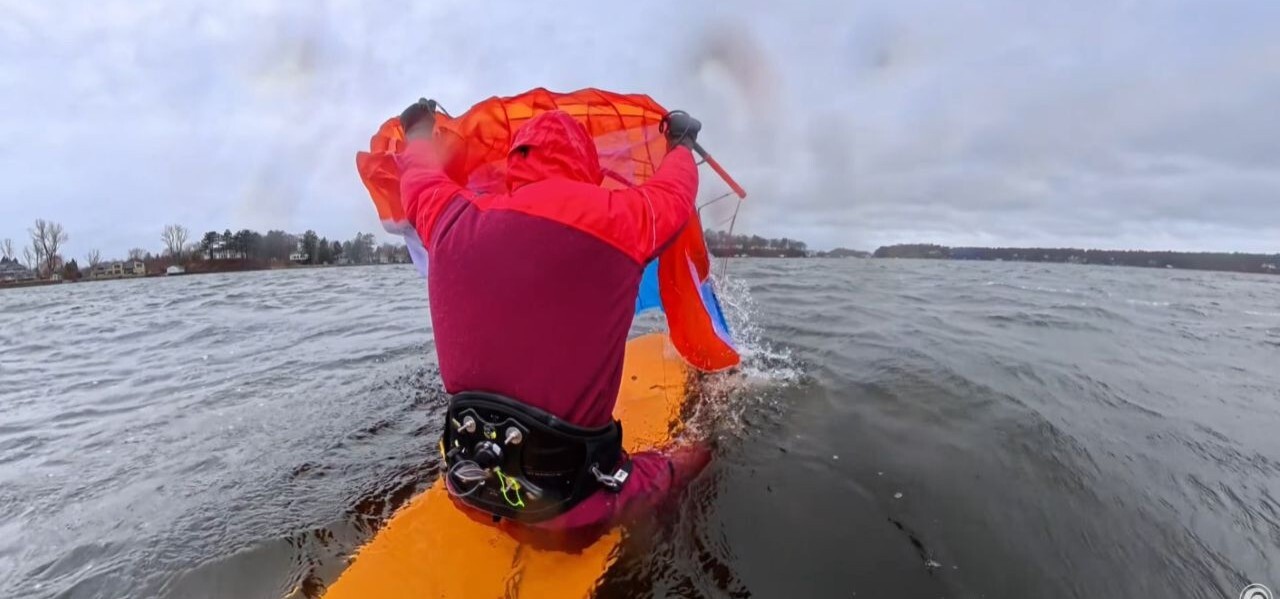
The pitfall of the PT Hybrid is that, since it's a dual skin, water gets in the cells. When you crash the wing, if you're in breaking waves, the waves are going to make the water migrate into the cells a little bit. You are going to have to empty those out before you can relaunch.
Word of caution to those people in breaking waves, especially real critical areas if it's big and nasty, if there's reef, you might want to consider a single skin. But we play in breaking waves all the time, out in bigger conditions all the time. We feel comfortable with it, just knowing that we've figured out how to deal with that parawing situation beforehand.
Water Drainage Techniques
Being dual-skin in the front, there are a couple of techniques needed to get the water out of the cells:
- If you crash the wing and you're in breaking waves: you'll need to empty the cells before relaunching by dropping the A-lines, grabbing the wing by the leading edge, slowly lift the wing, and let it drain.
Performance and Wind Range
To be able to cover a range of two parawings, to go upwind harder than other parawings, as hard as a wing, to ride as smooth and as easy and comfortable as this wing does, it's the tradeoff that's worth it for us. Most of our sessions, we are riding in a bigger wave situation. We're going to go way upwind first and then downwind a long ways back.
The hybrid blew Tucker's mind. The first session he went out on it, and every other session after, he's just liked it more and more. It does the things that we've known from dual skins in the past: it does smooth the ride out, the bar pressure is lower, you have a broader range. Dare we say: twice the range of most other wings in a single skin? Tucker noticed fantastic upwind ability on the PT Hybrid, similar to a wing. Hands down, it's one of the best upwind parawings he's flown, including other dual skins.
Where it really got us was the ease of use. Dual skins are often thought of as highly technical and built for higher-level riders. The PT Hybrid is one that has great low-speed lift, incredibly easy to fly, and is very stable. The power transmission and the power gradient are smooth and easy. In Tucker's opinion, he would definitely put a first parawing rider on this one, because of its smooth and predictable riding.
Tucker has been flying primarily the 5.6m. At 190 pounds, an effective range on this 5.6 is somewhere around 14 to 28 miles per hour sustained. We've flown this in gusts up to about 35, and it starts to get pretty uncomfortable at that point; a smaller size would definitely be more appropriate. You could certainly push the high end of this wing and expand it if you feel comfortable holding down a lot of power, but high 20s in terms of sustained is where it sits.

Who Is the PT Hybrid For?
The PT Hybrid quietly breaks the rule that dual-skin parawings are only for advanced riders. It brings the range, stability, and upwind performance we'd expect from a dual skin, but pairs it with the kind of smooth, predictable, low-pressure handling that usually belongs to a single skin. Add in the lightweight-but-reinforced construction, thoughtful drain ports, clean bar integration, and yoke bridle, and you end up with a parawing that's as confidence-inspiring as it is capable.
In Tucker's opinion, this wing lands well across a wide range of riders:
- First-time parawing riders: Great low-speed lift, a smooth power gradient, and stable flight characteristics make this a legitimate option for a very first parawing — which is unusual for a dual skin.
- Intermediate and advanced riders: The broad wind range (potentially covering what two single skins would), strong upwind ability, and smoother bar pressure make it an easy quiver consolidator.
- Riders doing long upwind-downwind sessions in bigger waves: If you're the kind of rider who goes way upwind first and rides a long way back, the PT Hybrid's upwind ability alone is worth the price of admission.
Where we'd steer riders away is in really critical conditions — big, nasty breaking waves over reef or other unforgiving features. The dual-skin front does take on water in heavy surf, and while the drainage technique is simple once you've figured it out, a pure single skin may be the safer tool for those worst-case days.
For pretty much everyone else, the PT Hybrid is about as close to a true do-it-all parawing as we've flown — easy enough for session one, capable enough to keep growing into.
MACkite Subscription Links:
YouTube | Instagram | Spotify Oddcasts
Contact MACkite Below:
800.622.4655 | Kiteboarder@MACkite.com | LIVE Chat Messenger
Recent Posts
-

2026 Cabrinha Unify Control Bar Review
The Brazilian Brothers are in windy Brazil to provide a thorough review of the brand-new 2026 Cabr …23rd Oct 2026 -
Naish Hatch V2 Parawing Overview
Jeff takes a few minutes out from the KoGL event to chat with Adam Carr from Naish about the Hatch …22nd Oct 2026 -

Flysurfer Soul 4 vs Sonic 5: Which Kite is for You?
Jeff is on the beach at KoGL with Marie-Eve from Flysurfer to discuss the growing excitement surro …20th Oct 2026