
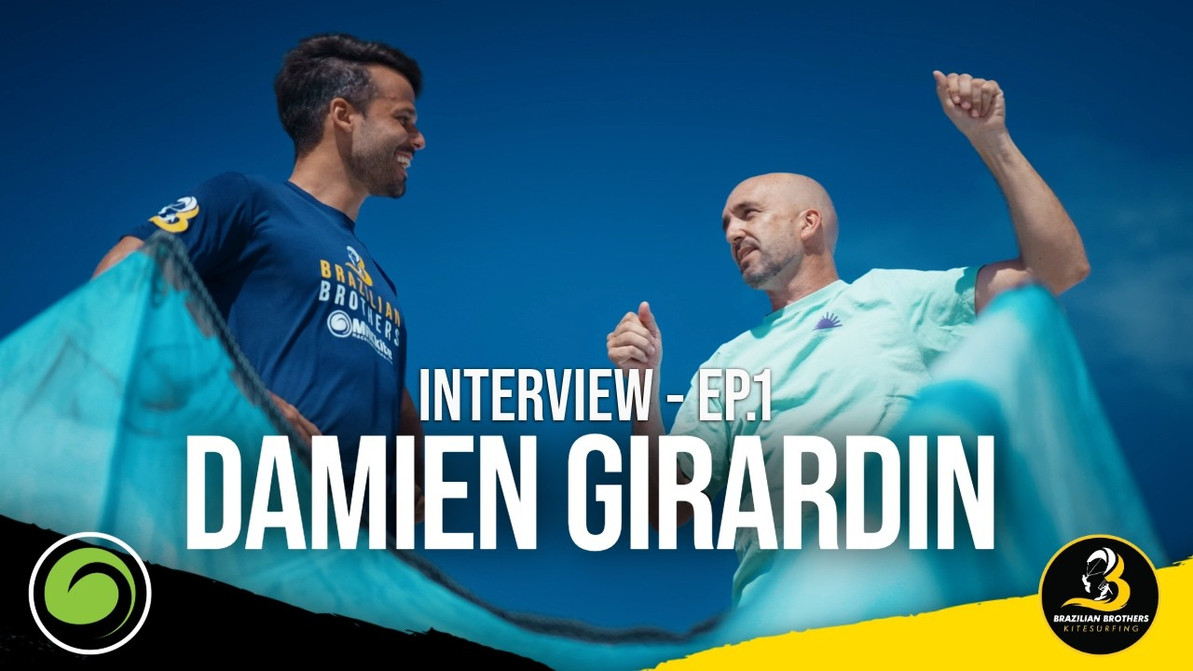
Brazilian Brothers Interview With Reedin's Lead Designer, Damien Girardin
The Brazilian Brothers met up with kite designer legend, Damien Girardin, at the Kite Beach in Blouberg, South Africa. Here, the Brazilian Brothers pick Damien's brain about his background and years of experience, the foundation of Reedin Kiteboarding, and highlights of the new 2026 Reedin gear.
How Did You Start Designing Kites?
Damien grew up windsurfing in the South of France in a city called Montpellier, where all the very first kiteboarders started in the mid-90s. He saw guys like Raphael Salles, the F-One owner, and other pioneers right in front of his house. He used to make fun of them because they could barely make it work, but he got to experience their growth hands-on, right away.
At the same time, Damien was going to school for engineering. An avid windsurfer, he kept on windsurfing at a high level. Eventually, he started kiting himself.
After engineering school, Damien had a normal engineering job for about two months and realized it was boring. A friend was starting a brand with a bunch of guys, and Damien asked if they needed an engineer. So off he went, becoming employed at a little French kiteboarding company for about two years.
Eventually, he got a phone call from a bigger brand in Hawaii, becoming the brand manager and head of design for 16 years on Maui. He was able to test, design, and travel all while learning about the sport as it evolved.
How Did You and Kevin Start Reedin?
Kevin met Damien when Damien was a kid — Kevin was 26 and Damien was 16 — at King of the Air in Maui. What started as a meeting as competitors led to greater respect within the industry. Kevin was very focused on his freestyle, getting as good as he could, focusing on his personal skills. Damien, on the other hand, was always all about designing products, making kites more fun, easier, better — better chicken loops, better bars, better boards. Kiteboarding gear is responsible for so much of the fun riders have, so Damien has always looked at how he can help others have more fun on the water.
Eventually, King of the Air came back to Cape Town. Kevin won the first competition, and he and Damien already knew each other pretty well by then, so Kevin stayed at Damien's house. For his second title, Damien had been telling Kevin he had to get on a bridle kite because Damien had been riding bridle kites and wasn't going back to a C-kite. Kevin was, more or less, brushing it off.
Eventually, Kevin went to a contest in Tarifa; it was blowing 60 knots and all he had was a 9m C-shaped kite. After borrowing a 7-meter bridle kite from the local shop, Kevin called Damien that night and said, "Dude, you're right, it is so much better for big air."
That's when Kevin got the spark that working on the gear could actually make him get better, and their relationship grew. Kevin looked at Damien with more respect for what he was telling him, and Damien looked at Kevin with more respect for the fact that he was finally becoming someone who believed gear could change his riding.
How Do You See Reedin's Success So Far?
As Damien admits, it's been a lot of work. The first six months before launch was just Damien working in a little shed on Maui, 20 hours or sometimes even more a day, nonstop, on top of being in China for weeks on end. Eventually, he got his hands on the new bar and saw first-hand the auto-twist feature that took 20 years to conceive — something that no other brand had figured out yet.
After that, they figured out the SuperModel design. Damien tested it in secret while Kevin was in South Africa, running quiet test sessions on Maui. Eventually, Kevin got to try the SuperModel, and the stoke continued.
Since those first few products, it's still been a lot of work, but Damien considers himself lucky because it doesn't feel like work. There is some stress, but he loves every part of what they're doing. They're doing photoshoots with team riders, helping Parker get better at competing, working in China, traveling the world, designing, and being in Europe with the rest of the company — but it's easy to work hard when it's mostly play.
One of the things driving Damien's approach to product design is his intuition. He doesn't strive to copy brands. His theory is that if there's already a product out there, he doesn't need to make the same thing. Instead, Damien wants to have something unique — because it's unique and he likes it, Kevin's going to like it (and usually other people like it too). Reedin doesn't look at the trends; they just see what they believe in and go for it.
What's Your Style of Kite Design?
Damien's style of kite design is probably similar to his style of kiteboarding — he doesn't like to stay on just one discipline. Being on Maui, you get waves for six months out of the year, and you get a lot of wind all year long, so you can kite all the time. Damien might be on a wave board one day, a twin tip the next, and foiling when it's really light.
He likes to ride all conditions and all kinds of wind, and he likes to test kites in gusty winds because he grew up in the South of France with very gusty wind. He always keeps in mind that his kites have to be as good as possible when it's bad wind. Maui is good for that; they get a lot of gusty winds there. Damien doesn't like testing in Brazil because the wind is way too good and everything works there. If you have it working in gusty, bad conditions, then it works in good conditions.
Damien likes kites that are engaging, that make you feel alive when you're kiting. He wants a kite that is quick, reactive, and yanks you out of the water fast. He likes a kite that turns quick because it's going to be fun for kite loops — and he loves doing kite loops. He likes fast kites, and he likes to jump as high as he can. He also likes riding waves, so he wants a kite that he doesn't have to change. That's something that's always been in all of Reedin's kites — to be as versatile as possible. It's okay to switch boards, and actually, in the future, riders might not be switching boards anymore. One board is going to do it all.
Reedin started with one kite, the SuperModel, and the goal was to be as versatile as possible. It still does it all now. You can take that kite in any conditions, give it to Parker to do all his King of the Air tricks, and then give it to a less advanced rider and he's still going to have fun.
Then Reedin expanded the range to the HyperModel, a high-performance version of the SuperModel. It's still very versatile but faster and even more engaging.
Next came the Whisper. Damien had been spending a lot of time in Southern California, in San Diego, and he needed a kite there too. He wanted a kite that was fun for light wind. It's a different category, but you can ride waves on the Whisper in San Diego, or ride flat water. The kite does everything you want, but it's dedicated to light wind.
Recently, Reedin added the MasterModel to the range. They kept the versatility in it, but spending time in Cape Town, you look at people kiting and obviously the focus is on big air. Riders are breaking close to 30 meters, going over 20 meters all the time.
The idea at first was that Reedin needed a kite that's going to be easy to jump for the average rider. You don't need to be a pro to jump 25 meters or as high as you can and stay in the air. At the same time, Damien knew Parker was going to King of the Air that year, and his mind was set and his level had grown. They needed a kite that would let him perform as high as possible.
You want a kite that's for everybody, so it has to be easy, but the pros also need an easy kite. When an average rider does a kite loop, they might not be head upside down, but the pros doing it head upside down need that same level of control. They need to know exactly what the kite is doing and believe the kite is going to catch them.
Whether you look at a rider who is really good or one who is pretty good, they need the same thing in the kite. Looking at Parker at King of the Air, Damien thinks they succeeded because Parker got fourth place in his second participation, and you could see the kite was performing so well. The MasterModel is pretty versatile — Damien can ride waves on it too — but the bar feel is quite connected, so you still have that snappy feel and quickness in the turns. All of Reedin's kites have that in their DNA.
MACkite Subscription Links:
YouTube | Instagram | Spotify Oddcasts
Contact MACkite Below:
800.622.4655 | Kiteboarder@MACkite.com | LIVE Chat Messenger
Recent Posts
-

Ride Engine Air Box Mini Review
The Brazilian Brothers are back to bring you a review of the brand new Ride Engine Air Box Mini. T …30th Sep 2026 -

Foil Drive MAX+ Review
Ryan and Hunter have been testing the all-new Foil Drive MAX+. This new unit is officially replaci …24th Sep 2026 -

Foil Drive MAX+ Overview: 650Wh Battery and V3 Remote
Ryan has an exciting delivery from Foil Drive: the all-new Foil Drive Assist MAX+. He is unboxing …23rd Sep 2026