
What Size Board and Foil Do I Need for Foil Drive?
Ryan and Hunter get a lot of questions from people wanting to pick up a Foil Drive unit who aren't quite sure if the board they have might be a good one to start with, if their current foil will work, if they need to upgrade, or really just where to start sizing-wise.
Here are the answers to a few of those questions, along with a good idea of what you may be looking at for your first time out there on the Foil Drive.
Baseline Rider Weight
Starting out, the guys want to note that this guide references someone in the 170 to 180-pound (lbs) range. If you are heavier than that, you might want to go for slightly larger sizes or stick to the large end of the range. If you are lighter than that, you might want to look at the lower end of the range or even go a little bit smaller. Just take note that 170 to 180lbs is the baseline.
Rider Skill Levels Defined
Ryan and Hunter split this up into three categories: beginner, intermediate, and advanced foiler.
Beginner
A beginner is someone who has never foiled, up to maybe a couple of hours on an eFoil. Maybe you've tried it behind the boat once or twice, but you're still in that beginner learning phase. You could be getting as far as getting up on the foil for a bit and then falling, but you aren't up and riding consistently.
Intermediate
An intermediate rider is someone who is up and riding.
- If you're wake foiling: you're up and riding, you can ride with no problem hanging onto the rope, pulling into the wake behind the boat, and dropping the rope.
- For wing foiling: you're up and proficiently riding in both directions, maybe starting to pull into swell and starting to do some of your jibes.
Advanced
If you're in the advanced category, you've done a lot of foiling and are likely doing multiple disciplines of foiling.
- If you're wake foiling: you're dropping the rope, riding that first wake, and pumping to the second wake.
- If you're a wing foiler: you can ride the swell however long you want, or maybe you even do some prone foiling. You can also pump around and do wake-to-wake transfers pretty easily.
Board Sizing Guide
Beginner Board Sizing
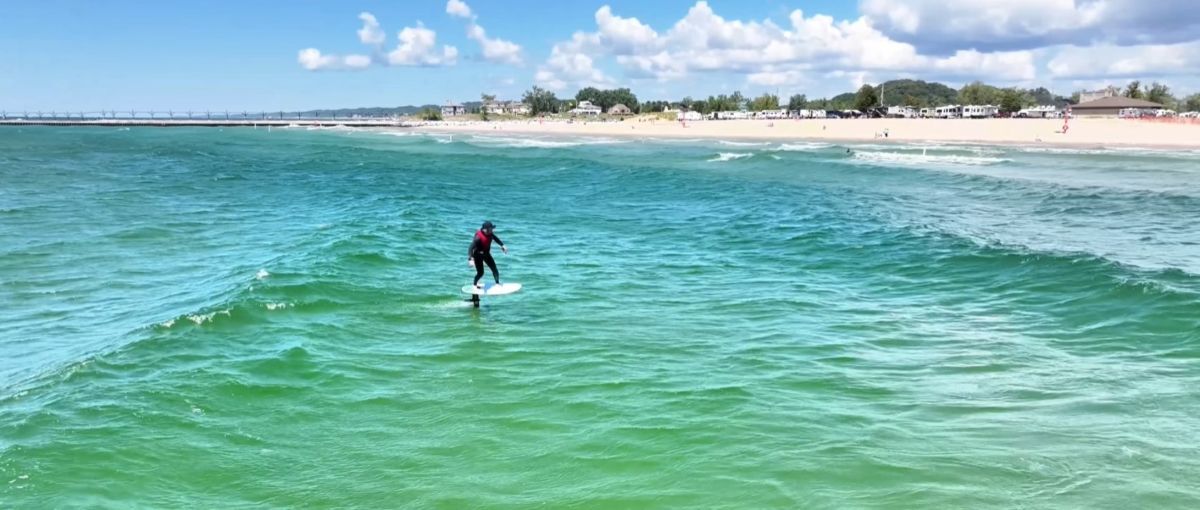
For a beginner rider, the target is around 90 liters (L) at the minimum, up to 120L. That 90L to 120L spot is the secret zone where you want to stay. That can be anything ranging from a downwind board, your chicken nugget wing board, or larger mid-length boards. Any board in that range will give you enough float to make it easier to learn.
The longer and skinnier the board is, the more efficient it's going to be, and the quicker it's going to get up to the speed you need for foiling. However, skinnier boards are sometimes a little more difficult to balance on than those wing boards, so just keep that in mind.
Intermediate Board Sizing
You could go anywhere from 50L to 70L as the sweet spot — that's typically going to be a mid-length board. A lot of brands have them nowadays in those typical sizes. This size will be a little more playful than the bigger sizes, but it still has enough liters to help you get up on foil a little easier.
A lot of the trench or channel boards that are coming out are also found in that range. Maybe not all the way up to 70L, but there are quite a few in that 50L range. The big advantage of those trench boards is that it puts the foil closer to your feet. You have a lot greater feel on the foil when you're putting only an inch or two of foam between your foot and the top of the Foil Drive, versus three, four, or sometimes even a little more.
Advanced Board Sizing
For an advanced rider, you can go pretty small on the board. Obviously, a little bit of volume is going to help you progress through those early stages because there is a lot of timing with the Foil Drive. It's nothing like hopping on an eFoil, hitting the button, and just going: it's a little bit more like a slow surf pop-up.
The sweet spot in size there would be around the 40L mark. That's on the smaller side for mid-length boards, somewhere around 5'0". That size will help you still progress, and you aren't jumping too small where it becomes really difficult to get up. Ryan and Hunter don't recommend jumping straight down to those 30L, really small boards — if a board is that small, you really need to have your timing down ahead of time. Otherwise, you'll be stuffing the nose every time and spending your time swimming.
As an example, Hunter weighs around 155lbs. He started on a 110L board because he already knew how to foil, but this was just learning on the Foil Drive. He progressed from there pretty fast and quickly went down to a 75L board (5'5"). That was great for learning to connect waves with the Foil Drive and pumping out to another wave. Then he jumped down to a 38L trench board (5'0") and has been loving it ever since.
Foil Sizing Guide
Beginner Foil Sizing
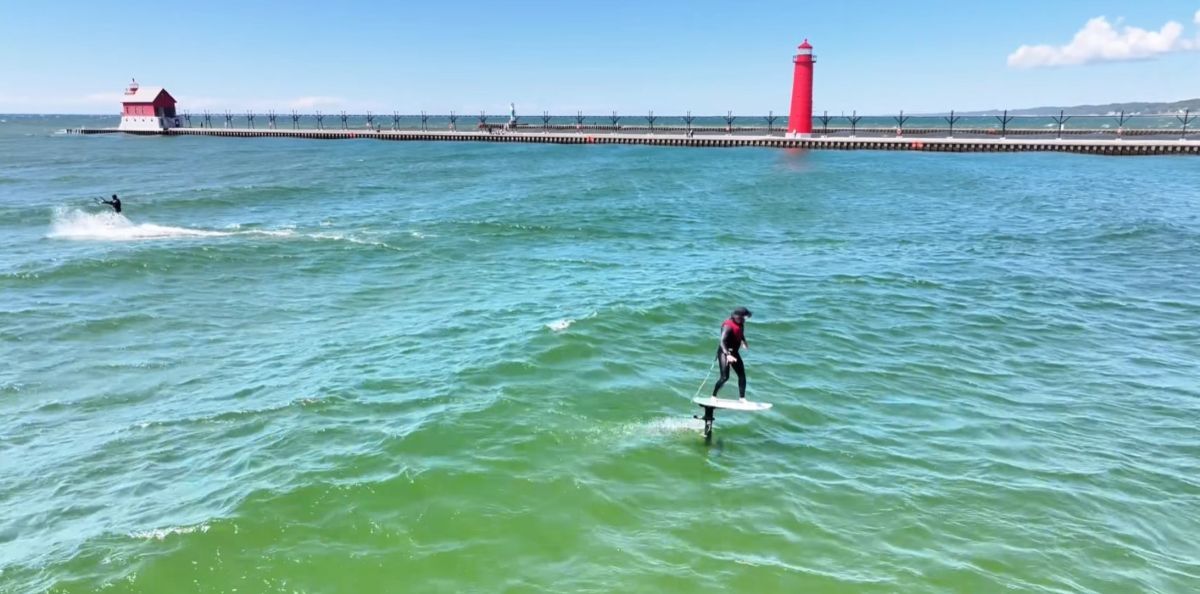
A lot of different brands make beginner setups, and typically it's around that 1500 square centimeter (cm2) area. Anywhere from 1400 to 1700 or 1800cm2 is a really good size. There is a lot of crossover with learning to wing foil or learning to wake foil. Those are really common sizes to learn both disciplines on, so if you've already done a little bit of foiling, those are real common sizes that will stick with you.
You don't want to get overly concerned about the specific foil when you're just starting out. You want to stick with something mid to mid-high aspect — you don't want any of those crazy long 16 aspect ratio downwind wings or a pump foil wing. You want something that's still going to be able to turn and carve a little bit to start with.
Intermediate Foil Sizing
For an intermediate rider, the guys recommend anywhere from 1100 to 1400cm2 — more surf-style wings. The smaller wing will feel a little looser, but they still has the stability to be nice and user-friendly.
Advanced Foil Sizing
For an advanced rider, choose whatever you feel comfortable with under 1000cm2. You can even play around with the high aspect wings at this point. Choose anything in that 800 to 1200cm2 range — ultimately, it just depends on the board combination you're putting with it.
If you're an advanced foiler and you're starting on a 60 or 70L board, you can go out on the 800 or 900cm2 wing. You're going to get that board speed to get up on the foil a lot easier than if you picked a 35 or 40L board — you just have to be more proficient on that smaller board and smaller wing combo. If you're going out with a board on the small side, upsize your foil a little bit. If you're going out with a board that might be on the big side, then drop down into smaller 800 or 900cm2 wings.
Final Thoughts
At the end of the day, sizing your Foil Drive setup comes down to matching your gear to where you're at — not where you want to be. Start with a board that has enough float to forgive your timing, pair it with a foil that's stable but still fun to turn, and let your progression dictate when it's time to size down. Ryan and Hunter have seen plenty of riders skip steps and end up swimming more than foiling, and just as many riders nail the pop-up timing on the right setup and never look back.
Shop Recommended Foil Drive Boards
MACkite Subscription Links:
YouTube | Instagram | Spotify Oddcasts
Contact MACkite Below:
800.622.4655 | Kiteboarder@MACkite.com | LIVE Chat Messenger

Recent Posts
-

Ride Engine Air Box Mini Review
The Brazilian Brothers are back to bring you a review of the brand new Ride Engine Air Box Mini. T …30th Sep 2026 -
Foil Drive MAX+ Review
Ryan and Hunter have been testing the all-new Foil Drive MAX+. This new unit is officially replaci …24th Sep 2026 -
Foil Drive MAX+ Overview: 650Wh Battery and V3 Remote
Ryan has an exciting delivery from Foil Drive: the all-new Foil Drive Assist MAX+. He is unboxing …23rd Sep 2026