
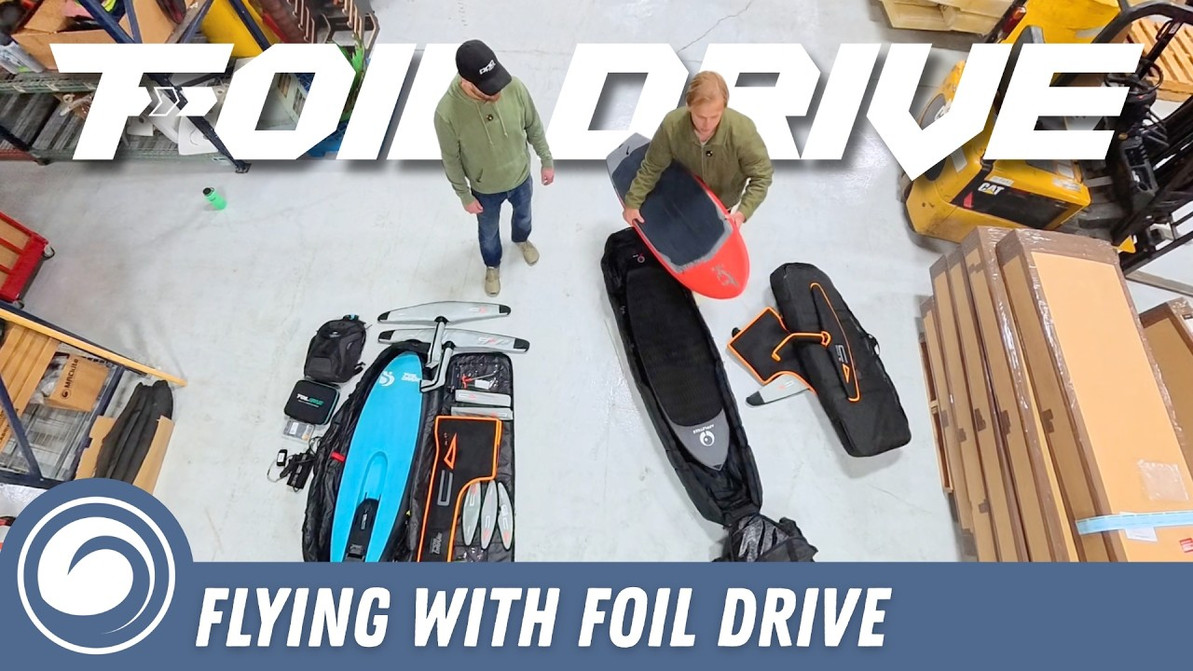
How to Fly with Your Foil Drive Setup
Ryan and Hunter have spent a lot of time on the Foil Drive, and they absolutely love it. After traveling and flying with it recently, they noticed there isn't a lot of great information out there on what a Foil Drive travel kit should actually look like. While kiteboarding and wing foiling setups are covered everywhere online, the Foil Drive-specific details are a bit lacking. Here's a full breakdown of how to pack your gear, handle your batteries, and navigate the airport.
Handling Foil Drive Batteries
If you're traveling with your batteries, they need to go in your carry-on — large lithium batteries cannot go in checked bags. The Sport, Max Power, and HP batteries are all too large to fly with at all, so you'll need specific travel batteries.
For the Max Travel battery, check with your airline. Some require prior approval, so sort that out before you show up. The Slim Travel battery segments are all under 100 watt-hours, so they generally fly without any issues or prior approval.
If you want to avoid traveling with batteries altogether — or if you don't own the travel batteries — check your destination. There might be a local shop or person renting Foil Drive batteries, which makes airports a lot easier and less stressful.
General Packing and Padding Rules
As a general rule, you want your gear to arrive in one piece and ready to ride. The most useful padding goes onto the gear itself, not the bag. Make sure to use the padded cases that most masts, foils, and fuselages come in, and keep them in those cases inside the travel bag.
For the board, it's always helpful to add a little extra foam. Wetsuits and towels can also wrap around your gear to add padding that's already going in the bag.
For Foil Drive-specific gear, focus padding around the rotor. Koozies are awesome for this. If the unit is going in checked baggage, take the props off so they don't get bent under the airplane. For carry-on, you can generally leave the props on with no problem. It's also worth padding the battery charger.
The Minimalist 1-Bag Setup
If you're trying to go really minimalistic and fly with just one checked bag, you need to stay mindful of the 50-pound weight limit most airlines have for sports equipment. Going over 50 pounds triggers an overage charge that can run up to $70 depending on the airline.
To pull off the 1-bag setup, you'll need a carry-on backpack. That backpack is the perfect spot for your battery, charger, remote, spare parts kit, and accessories like cameras. Squeezing everything into one checked bag gets heavy fast, so moving these dense items to your backpack is an easy way to get weight out of your golf bag, especially on the way home when wet gear is heavier than it was on the way out.
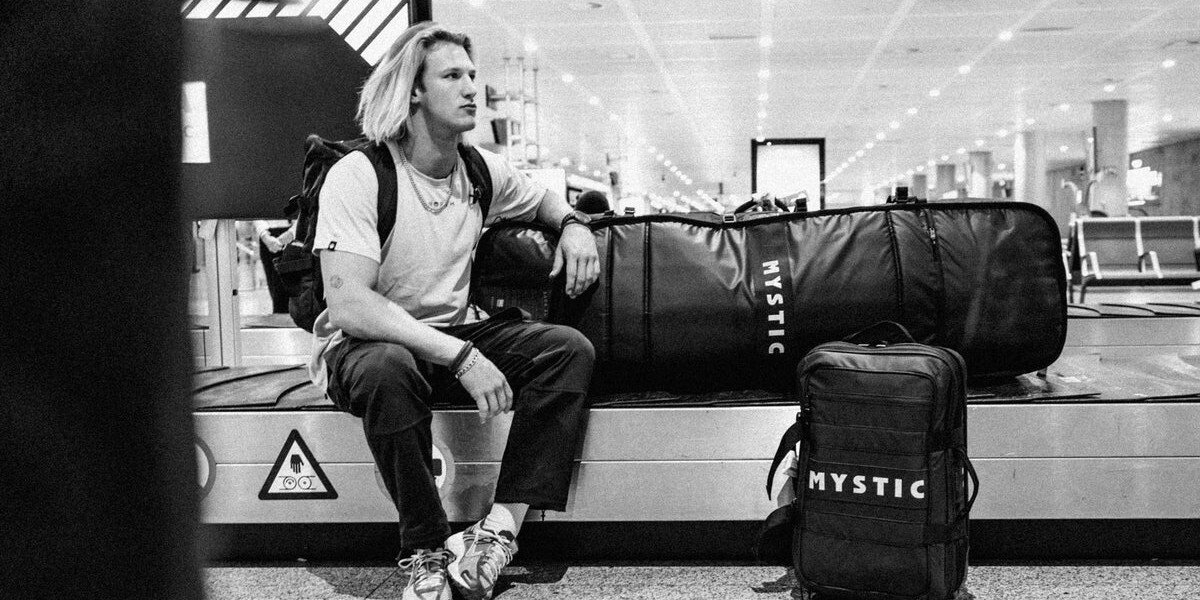
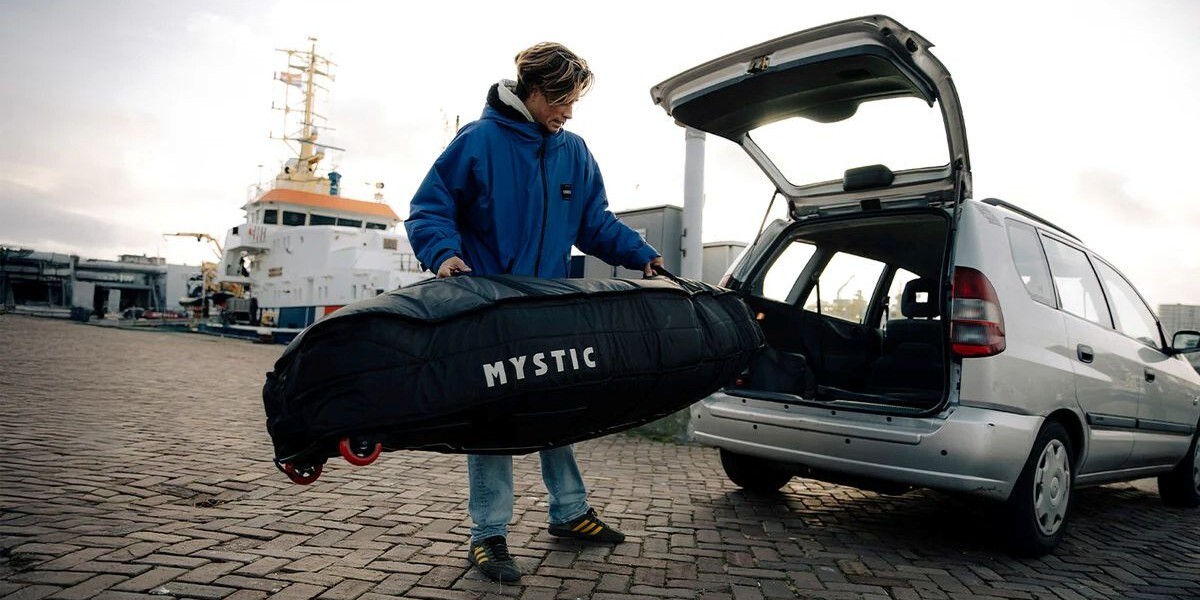
For the checked bag, Ryan uses the Mystic Saga bag. It has nice straps inside to keep everything tight, and it's stiff enough to wheel through the airport really well without drooping. Here's what fits inside a 1-bag setup:
- Ding All Repair Kit: Definitely don't travel without this. Despite everything you do to protect your gear, boards get dinged. Without a repair kit, you could lose a day or two finding something to make your board watertight.
- Top Pocket: Remote charger, tools, and spare parts.
- Mast: The Foil Drive integrated mast. Ryan leaves the stator on but takes the rotor off to save weight, moving the rotor to his backpack.
- Foils: Two front wings (like the A60R and 850S), two stabilizers, and two fuselages.
- Base Unit: Ryan pops the base unit onto the board backwards. That way, if TSA inspects the bag, they can get the nose cone off without issue and confirm there's nothing dangerous.
- Board: The Sunova Foil Drive Trench board (4'10", 40L) fits perfectly in the 4'9" bag, along with a leash.
The 2-Bag Setup for Extra Gear
If you're not looking for the minimalist setup, want to make your life easier, or simply can't decide what to bring, the 2-bag setup is the way to go. Hunter likes to connect his bags: a 6' coffin bag with wheels on the bottom, and a foil/mast bag connected on top, so he can drag both through the airport with minimal sweat.
For the foil gear, the Mystic Foil Gearbag is great. It has two window pockets up top for tools and hardware, and it'll hold the base unit, the charger, tails, and two masts (a full Foil Drive mast setup and a regular mast for a prone setup). It also fits two fuselages, with room to shove clothes and a towel in to pack things tightly. This bag holds the more durable gear, so you don't have to worry as much about packing it perfectly.
The second bag keeps the boards safe. In this setup, Hunter packs:
- A third front wing.
- A 4'8" KT board for his prone setup.
- A 5'0" Zapple Foil Drive board.
- Wetsuits, towels, and other clothes for extra padding.
Hunter also recommends putting cardboard over the nose and tail of the boards for extra protection against the harsh conditions of baggage claim — especially the "javelin throw" or "hammer throw" from baggage handlers. With this 2-bag setup, you can bring a full prone setup and a full Foil Drive setup, keep both bags under 50 pounds, and still have room to spare for a fourth wing or extra goodies on the way back.
Airport Expectations and TSA Tips
When navigating the airport, smaller bags are better — they're much more maneuverable. Some airports put you through zigzag lines, and trying to take those turns with a huge bag is like taking a semi-truck through a drive-thru. Smaller bags also keep you further away from the oversized dimensions that trigger extra charges.
When packing your bag, put most of the weight toward the wheels. If the weight is down low, the top end is lighter, and you won't feel the load nearly as much when wheeling through wide turns.
For TSA and security, be mindful of what's in your carry-on. On one trip, Ryan left the stator in his backpack without thinking about it, and once you imagine what a stator looks like on an airport security scan, you can understand why it got stopped. If you can, put the stator in your checked bag, or just be prepared to explain it.
Finally, buy a luggage scale. You can grab one on Amazon for under ten bucks — it's a simple string that pulls up to weigh your bag, so you can max out your weight and land right at 50 pounds with no surprises at the airport. This is especially key on the return flight, when your wetsuit, towel, and board pads are holding water and sand, making your bag significantly heavier than it was on the way out.
Dealing with Damaged Gear and Spare Parts
If your gear arrives damaged, that Ding All kit is going to save your trip. It's also important to check the fine print with your airline: most airlines won't do anything to cover damage inside a soft-sided bag. They usually require a hard-sided case for damage claims, so protect your gear at all costs, because it's typically on you if something happens.
For your spare parts kit, bring extra seals, battery charger grease, and extra screws. Extra screws are a big one because they're easy to lose, and some of this hardware is hard to find at a standard hardware store — especially off-size non-stainless hardware like M8x18s. Extra props are also unique and essential to bring along. If baggage handlers javelin your bag hard enough with the props still on the rotor, the props or the screws could actually bend, so having backups is crucial.
Summary
Traveling with a Foil Drive setup comes down to three things: handling batteries correctly, packing smart, and protecting the gear from baggage-handler abuse. Batteries always go in your carry-on — Sport, Max Power, and HP batteries are too large to fly, the Max Travel needs airline approval, and the Slim Travel batteries fly easily under the 100 watt-hour threshold.
If you'd rather skip the battery hassle, renting batteries at your destination is often a great option. For everything else, the rule is to pad the gear itself: use the included padded cases, koozie the rotor, take props off for checked bags, and use wetsuits and towels as bonus padding.
From there, choose your setup. The 1-bag minimalist approach (Mystic Saga checked bag plus a carry-on backpack for batteries, charger, remote, and tools) works well for solo trips — just make sure to leave room under the 50-pound limit.
The 2-bag setup pairs a coffin bag with a foil gearbag and lets you bring a full prone setup alongside your Foil Drive kit. At the airport, smaller and wheel-heavy bags are easier to maneuver, a $10 luggage scale prevents overage surprises, and watching out for confusing-looking parts (like the stator) in your carry-on can save you a security delay.
Always pack a Ding All kit and a small spare parts bag with screws, seals, grease, and extra props—because once you're at your destination, those small items make the difference between a great trip and a salvaged one.
MACkite Subscription Links:
YouTube | Instagram | Spotify Oddcasts
Contact MACkite Below:
800.622.4655 | Kiteboarder@MACkite.com | LIVE Chat Messenger

Recent Posts
-

2026 Duotone Rebel D/LAB Review: 30-Knot Test
The Brazilian Brothers are ready to provide honest feedback on the 2026 Rebel D/LAB by Duotone. Th …13th Oct 2026 -

2026 Duotone Jaime SLS Kiteboard Review
The Brazilian Brothers are back to bring you another product review. Today, their focus is on the …13th Oct 2026 -
Manera Pocket Wing Belt Overview
Jeff met up with Billy Ackerman from F-One on the beach at the KoGL Test Fest to take a look at th …9th Oct 2026