
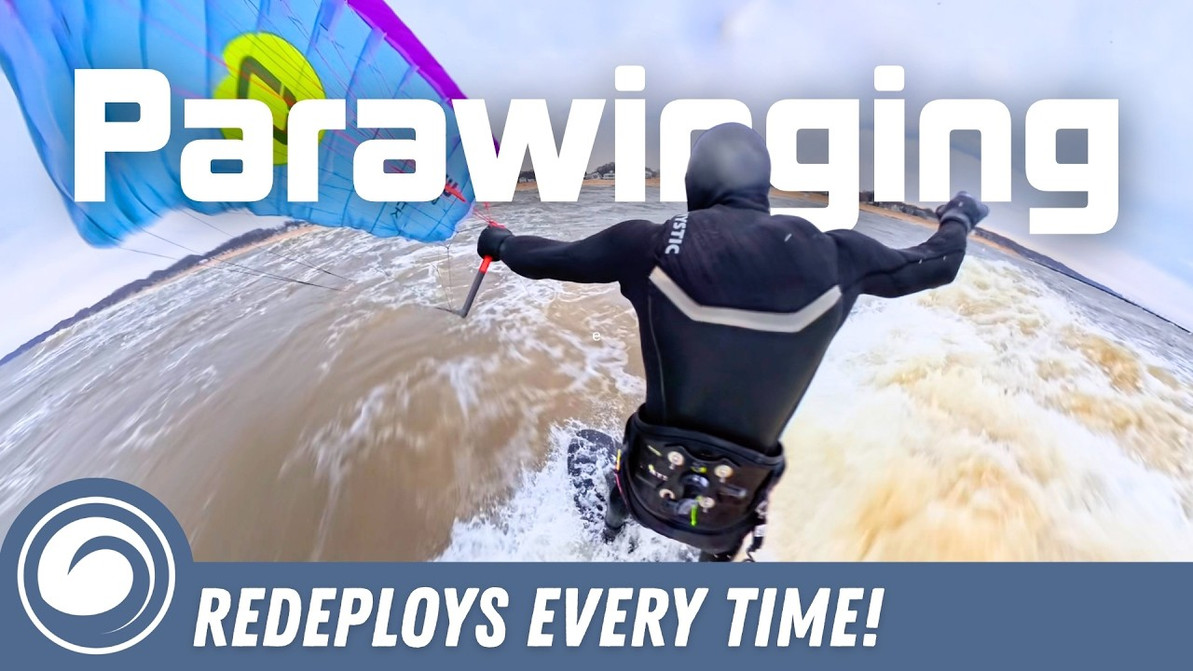
Ozone PowerPack Parawing Review: The Easiest Stow & Go Wing?
Tucker brings a long overdue review on the Ozone PowerPack. This has been a really fun wing for him this winter, as Tucker is a big fan of it for downwinding, bigger nastier swell, and any time there's some consequence if you can't redeploy accurately and easily. Overall, the PowerPack has been fantastic through a hectic winter season where conditions were all over the place.
New Bar and Bridle Updates
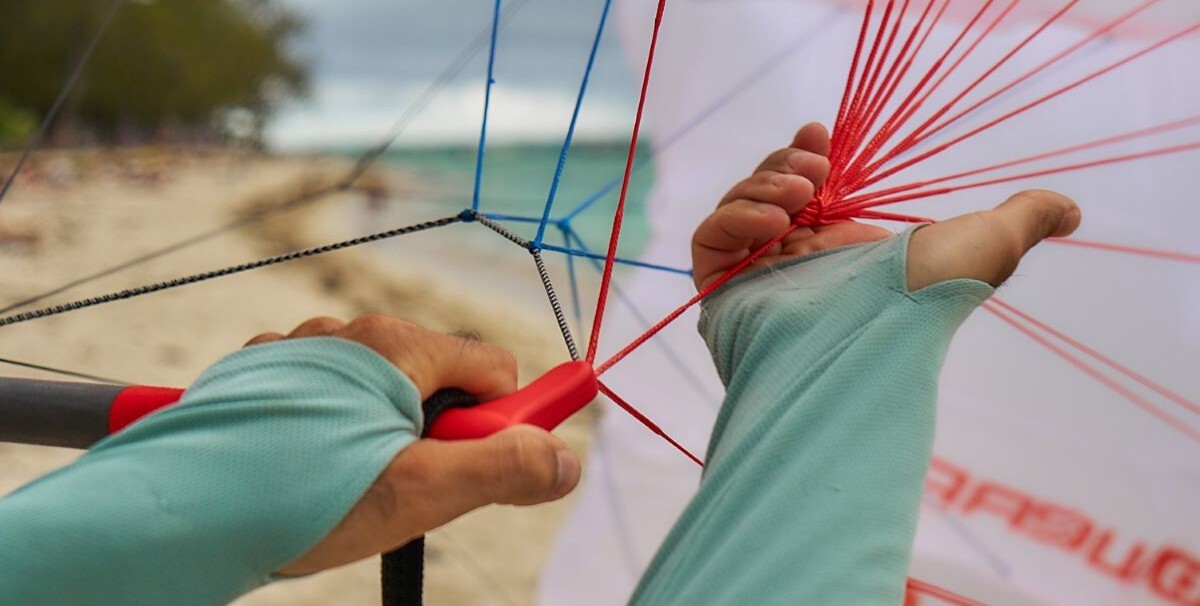
The PowerPack has a few things going on. First: a new bar. It's similar to the bar on the Pocket Rocket, but with some updates. The bar is a little shorter and also features a yoke that opens up the whole middle of the bar. There is no center B-line connected to the bar. It actually goes A, B, C, D in stages, with the predominant amount of bridles coming off the A-lines.
You'll also see the bridles are all direct. Once you get above the first connection, it's straight bridle lines all the way to the connection points — no splices and splits branching off. That makes it clean and nice when you're collapsing it; as Tucker puts it, it's "silky smooth."
Stiffer, Silky Smooth Lines
The lines appear to be a little stiffer than the lines on the Pocket Rocket V1, but just as still silky smooth. They're stiff enough to not wrap around themselves and get knotted and tangled, like sometimes happened with the Pocket Rocket V1. The lines are also soft enough on your hands where it's smooth — you can rip on the lines and it doesn't hurt your hand at all.
The splices are all woven in and sewn clean. On a lot of wings, you get a jagged edge or a rough thread that you feel. They're silky smooth — like putting your hands through wet spaghetti. They're comfortable and nice, clearly built for stowing and throwing.
Canopy Shape and Downwind Performance
Looking at the canopy, the PowerPack has a nice, round leading edge, helping it create a lot of power and lift off the wing. Compared to the Pocket Rocket, the PowerPack does have a more downwind pull. It also has a deeper position in the window, so it doesn't want to drive forward and upwind quite as much. By sitting deeper, it helps create that power and downwind pull.
The PowerPack wing is best utilized in positions where you're headed downwind, or a position where you're riding downwind and then back upwind. Because this wing does go upwind quite well — maybe not as good as the Pocket Rocket, but close — its performance is centered around riding waves. This is a wing that you're going to be packed up more often than not, and then easily redeploying.
Compact Size and Power Generation
The PowerPack creates a lot of pull for its size. It's very easy to fly and stable. Being a very compact wing, it utilizes as much canopy as possible. It's very flat, so it doesn't bend as much — it's more flat out at the tips, really showing a lot of canopy to the wind. For its size, it creates quite a bit of power. The specific one Tucker reviewed was a 3.6m, and with proper technique, it can almost be used like a 4m because it does have that downwind pull, especially with a little wave to help you along.
It's not going to build quite as much apparent wind as the Pocket Rocket because it sits a little deeper and has a bit more drag to the canopy. You might not be able to ride quite as small of foils when going upwind as you can with the Pocket Rocket, but you can size down quite easily to accommodate bigger foils and getting on foil easier.
Ribs, Packing, and Stabilizing Lines
The ribs in the front are really nice; they get a good shape to the wing, but also collapse well. There are minimal ribs, just where they need to be, so the canopy is simple and lightweight. It packs down tiny and is designed to pack down as small as possible and redeploy easily easily — without added bells and whistles.
One unique thing the PowerPack has going on, which was also on the Pocket Rocket, is a horizontal stabilizing line. That keeps the shape of the canopy, keeps the proper curvature, and helps to keep the wing from bagging out over time. It really positions the ribs in the right orientation. That's a small detail, but something Tucker has found very effective across a lot of different wings.
The Easiest Wing to Stow and Redeploy
Along the bridles, you'll see the red A-lines are grouped off in three separate groups. Essentially, you're capturing the center lines for an easily identified and easy-to-collapse stow and throw. If you're just collapsing this thing quickly, this is going to be the best way to do it.
- Rather than grabbing all the A-lines and trying to get the wingtips to fold in (which is often hard or creates a pocket in the front), you're grabbing the center, allows you to quickly kill the power, and then the wingtips fold in.
- When you redeploy, it's easy to drop it, grab the bar, get it ready, and throw it out.
- It redeploys perfectly almost every time.
In Tucker's opinion, this is the easiest wing to stow, throw out, and redeploy of any wing he's used. He gives it the highest marks for reliability — it stows and redeploys accurately without making your life hard. You don't need to sort through the A's and find the four A's and then collapse. You don't need to do all the bridles and then restring the lines every time you throw it back out. If you're going to ride a wave for a quick bit, you pull it down, hold it, and throw it right back out.
Winter conditions can get hairy, and Tucker often gets a little greedy riding on the inside where the waves are breaking in the break zone. You don't want to get caught in there, and you don't want to come off foil without a wing in the air because that could result in getting washed up and having to walk back, or struggling through the break water. In those situations, you need a wing that is going to be reliable in throwing it back out, creating the power you need, and then collapses quickly when you find that good wave to ride without causing any mistakes or tangles.
Custom Colors Available
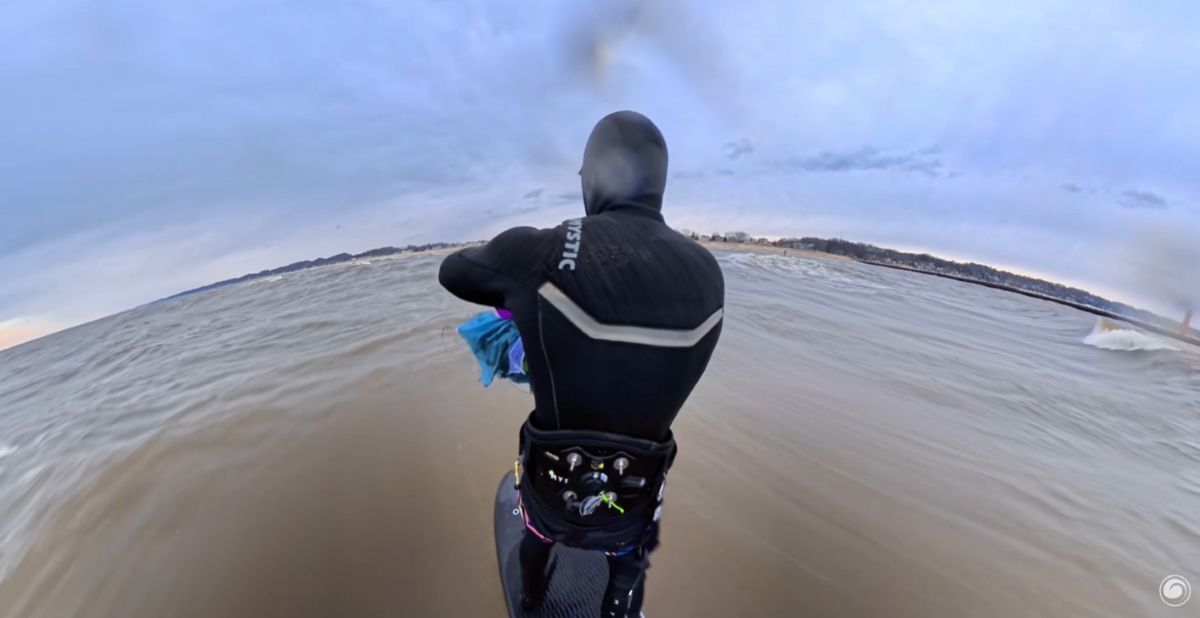
You'll notice the funky colors on this one — Tucker had it custom made. Luckily, we can place custom orders through Ozone for special colors. Maybe you have certain colors you like, certain designs, or you just want to be different from everybody else out there. Reach out to us to set that up; they can place a custom order through the factory to get your special colors on your wing. It really doesn't take long — in most cases just 3 to 5 weeks to get a custom wing with your colors designed.
Who is the Ozone PowerPack For?
If you're a rider who likes to ride waves, you're into downwind riding, or you just want a no-nonsense wing that's not going to give you headaches, it's really hard to go wrong with the PowerPack. Initially, given the way it's pitched as a downwind kind of wing, Tucker thought he wouldn't like it because he's usually going upwind and then downwind, but this wing is fantastic and still very impressive upwind.
In his opinion, Tucker would happily trade a little bit of upwind performance for the stowability and ease of use. Most days, if it's nasty out or he's is in the break zone, those are situations where you can't fail. You're going to waste a lot more time fiddling in the shore break trying to relaunch with things dumping on your head than you are just upwinding with a better upwind wing. The Ozone PowerPack is very comfortable, very easy to use, and takes the guesswork out of those hairy situations.
MACkite Subscription Links:
YouTube | Instagram | Spotify Oddcasts
Contact MACkite Below:
800.622.4655 | Kiteboarder@MACkite.com | LIVE Chat Messenger

Recent Posts
-

2026 Duotone Rebel D/LAB Review: 30-Knot Test
The Brazilian Brothers are ready to provide honest feedback on the 2026 Rebel D/LAB by Duotone. Th …13th Oct 2026 -

2026 Duotone Jaime SLS Kiteboard Review
The Brazilian Brothers are back to bring you another product review. Today, their focus is on the …13th Oct 2026 -
Manera Pocket Wing Belt Overview
Jeff met up with Billy Ackerman from F-One on the beach at the KoGL Test Fest to take a look at th …9th Oct 2026