
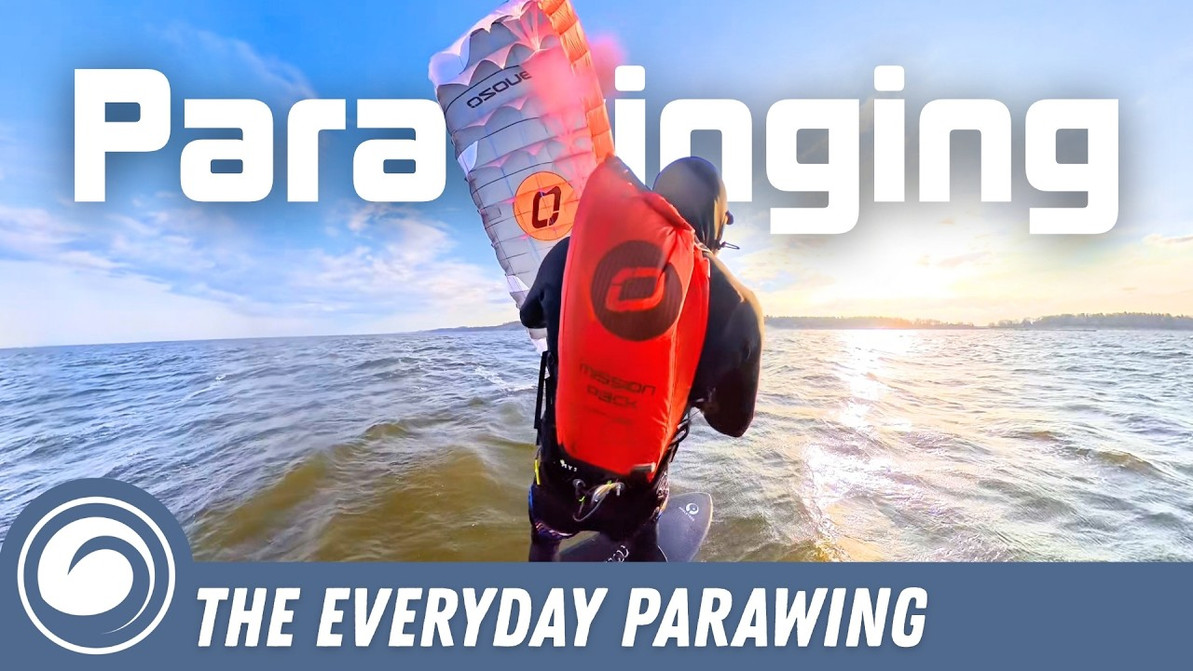
Ozone Pocket Rocket V2 Parawing Review
Tucker's back with a review of the Pocket Rocket Version 2 from Ozone — a follow-up to what was arguably the most popular parawing of last year. The V1 became a staple in our shop and in many riders' lineups, so when V2 was announced, we were crossing our fingers that Ozone wouldn't ruin the special attributes of the original. That said, there were also some changes we wanted to see as the sport progresses and we ask different things from our wings.
The Upgraded Bar System
Starting with the bar (and you can ignore the harness line Tucker shows, since it's not included — though you can buy the Ozone harness line loop alongside your wing, or use a two-point harness line if you prefer), the first thing you'll notice is that it's a little shorter than the Pocket Rocket V1, and the B-line connection is gone. The bar is now totally barrier-free, meaning you can move your hand anywhere along it. If you're wearing mittens, you don't have to worry about splitting the line. The bent-out ends shed lines nicely without snagging on anything for low maintenance, but you can still pop the pigtail off to service the lines when needed.
There are subtle finger bumps so your hands lock in ergonomically without sliding around — you don't need to grip the bar hard. Light and loose works great.
Bridle and Line System
The new bridle uses a yoke system. Where the V1 had a B-line connection, the V2 has a yoke handling the A, B, C, and D lines. You'll notice the front lines have a nice Y-split, which is one of Tucker's favorite features on the new Pocket Rocket: the collapsibility of the wing is significantly improved because of it.
Here's how it works: the outside lines run to the wingtips, and the inside red A-lines run to the center A-lines. Those center A-lines are exactly what you want when collapsing the wing — they pull the canopy into a perfect concertina, folding it into the wind without much pull on your hand.
The lines themselves are buttery smooth. They have a waxy coating made specifically for Ozone parawings, so they don't snag or cut at your hands the way some lines do. The terminations are equally clean: the ends are doubled back, sewn, and woven into the line itself, with no frayed ends and stitching that's nearly hidden. When you grab and pull, it's super smooth — low maintenance, easy to stow, and easy to redeploy. You can find that ball of lines without even looking.
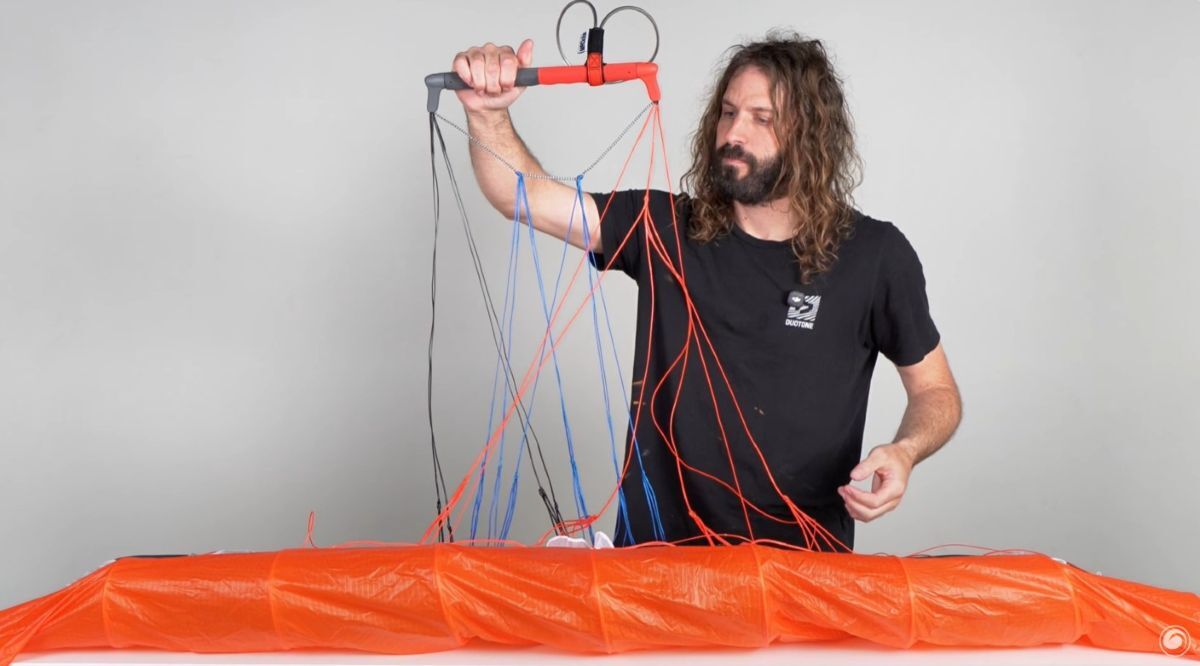
The middle lines are blue and the rears are black, and both are kept relatively minimal. The A-lines do most of the heavy lifting, covering roughly half the wing. Everything in the back half is light, packable, and simple.
The lines are also significantly shorter than previous years. One common complaint about the V1, even for a rider at 6'3", was that pulling in a 4.3m took nearly your full arm length. On the V2 4.3m, you're nowhere near full arm length, so the wing should be easily swipable for almost any wingspan. You can see how tightly that concertina collapses right into your hand. There are ears for easy wrapping, and redeploy is fantastic — you grab the wad of canopy, drop it, grab the A's again, throw it out, and it's ready. It's hard to botch a redeploy unless you do something really stupid like wrap it in a rat's nest.
PowerPack Bridle Comparison
For those familiar with the PowerPack, this configuration is essentially the same bar and bridle system, just fitted onto the Pocket Rocket. The Pocket Rocket is the faster-flying wing with bigger range and better upwind performance. If you want the stowability and easy packing/redeploying of the PowerPack but with more high-end range, better upwind, more total range, and a bit more performance overall, the Pocket Rocket V2 delivers exactly that.
Canopy Construction and Details
The canopy is Ozone quality through and through. The D-ribs are nicely built with extra supports to keep them upright, and the leading edge has thoughtful shaping — just enough to feel sleek, stay stable, and resist collapse, but not so much that it becomes hard to pack or redeploy.
The ribs themselves are well-considered, with unnecessary material cut away to keep things light and packable. The trailing edge is basic, lightweight, and packs down easily.
The canopy material is an extremely lightweight, pliable ripstop — a 2x2 weave, which is somewhat unique. That gives it a bit more tear resistance, longevity, and canopy stiffness than some other wings, and it doesn't seem to come at any cost to packability. Ozone has done a really nice job balancing durability and performance with packability and weight.
The coating is highly hydrophobic, so the wing isn't soaking up water or getting heavy, and it sheds water quickly on relaunch. Every connection is doubled back and reinforced with quality stitching. Even the batten terminations have extra reinforcement so they don't poke through. There's clear thinking about long-term performance and how to keep the wing from wearing out over time.
That's especially important on a Pocket Rocket, because it tends to be the wing riders choose when they're riding more powered up and pushing harder. This is the kind of rider who'll do a hard upwind followed by a downwind run, not just a downwind. Driving the wing upwind for miles at high speed puts more stress on the canopy and the connection points, so the reinforced construction matters.
Pocket Rocket V2 vs. PowerPack
The logical question is, how do you choose between this and the PowerPack? Honestly, most riders would be happy with either.
If you're primarily a downwind rider, go with the PowerPack. It pulls more downwind than forward, which is what you want when you're getting on a wave and then putting the wing away when you don't need it. The overpowered range and upwind ability take a back seat to stashability and downwind pull. The V2's low end is comparable to the V1, but the PowerPack still has an edge on the low end thanks to that downwind pull.
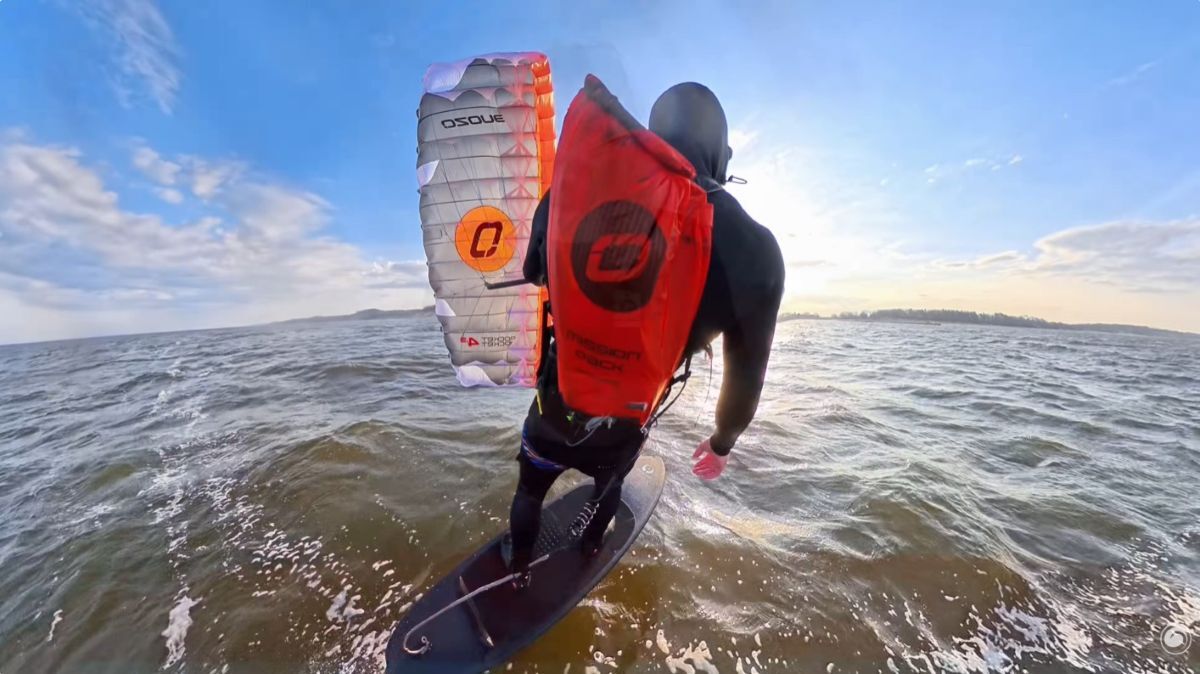
The Pocket Rocket is the opposite. It's for riders who want the wing out longer — mostly those riding upwind and then downwind, whether that's 20 miles or 500 yards back and forth. It handles a better upwind angle, it's happier being ridden overpowered, and it's more comfortable when you are. As you create apparent wind, drive upwind, sheet the wing, and compound your speed, you're not going to get overpowered immediately. It's simply less physical to hold and ride upwind with more power.
The Pocket Rocket pulls more forward in the window, creating more speed and forward drive off the apparent wind. So if you're crossing the wind and want to pop up a bit, the Pocket Rocket is great for that style. It also gives you more options when wind and wave are coming from awkward directions — you can use them together to your advantage.
The Riding Sleeve Backpack
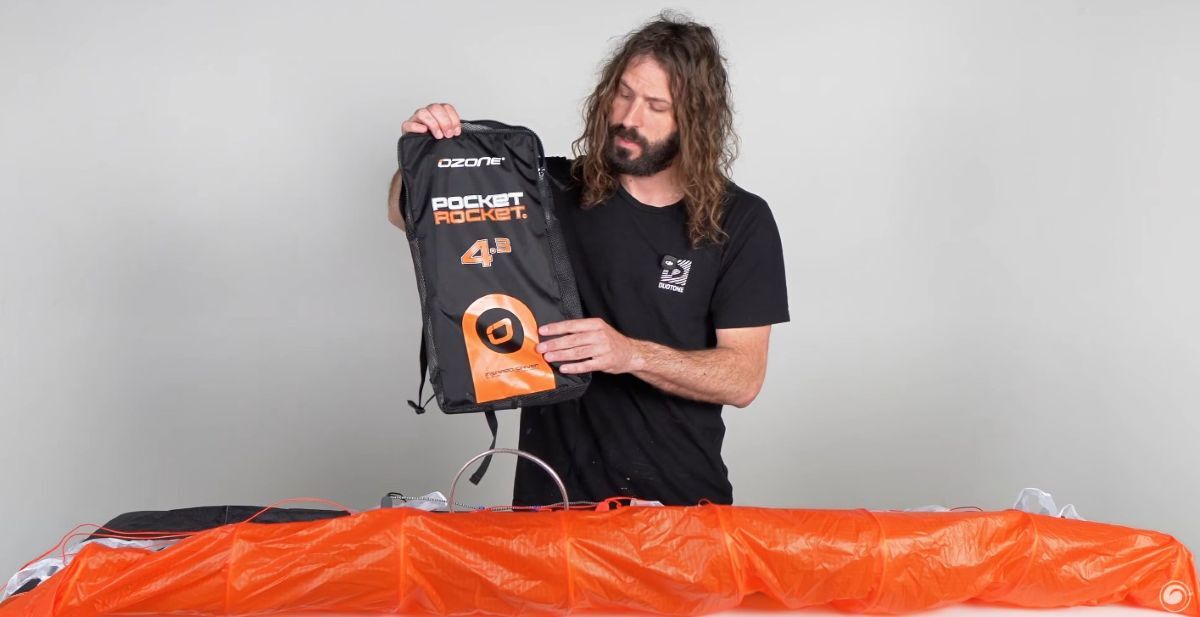
The riding sleeve backpack is a cool add-on. The riding sleeve folds up and fits in here easily, and it has vents all the way around to drain sand, moisture, and water. It also has backpack straps and a chest clip, so you can carry it on your back — walking to the beach, riding a different size wing with a spare in tow, or just bringing a backup for safety.
It's genuinely useful — not just a stuff sack to keep things from tangling, but a real backpack with a purpose. The all-around venting means if it gets wet, it drains rather than pooling. Ozone took something as mundane as a stuff sack and made it versatile.
One tip: once you find your sweet spot on the buckles, wrap some electrical tape around them and terminate the tails. Otherwise, the bridles can loop on them and cause issues. Refine where you like the buckles, cut the excess, burn the ends, and wrap them in electrical tape so they can't snag the bridles. It'll save you some headache out on the water.
Summary
The Ozone Pocket Rocket V2 takes everything that made the V1 a shop favorite and refines it for riders pushing harder and farther. The shorter, barrier-free bar and new yoke-style bridle (shared with the PowerPack) make collapsing and redeploying easier than ever, while the Y-split A-lines and shorter overall line length mean even riders without a long wingspan can swipe the wing in cleanly. The 2x2 ripstop canopy adds durability and stiffness without sacrificing packability, and thoughtful reinforcements throughout suggest a wing built to hold up under sustained, powered-up riding.
If you're a downwinder who values stashability and downwind pull above all else, the PowerPack is still the better pick. But if you want a wing that flies faster, points higher upwind, and stays comfortable when you're powered up — whether you're running 20 miles or just crossing back and forth — the Pocket Rocket V2 is the call. Add the included riding sleeve backpack into the mix, and you've got a high-performance parawing that's as practical to carry as it is fun to fly.
MACkite Subscription Links:
YouTube | Instagram | Spotify Oddcasts
Contact MACkite Below:
800.622.4655 | Kiteboarder@MACkite.com | LIVE Chat Messenger

Recent Posts
-

2026 Duotone Jaime SLS Kiteboard Review
The Brazilian Brothers are back to bring you another product review. Today, their focus is on the …13th Oct 2026 -
Manera Pocket Wing Belt Overview
Jeff met up with Billy Ackerman from F-One on the beach at the KoGL Test Fest to take a look at th …9th Oct 2026 -

Parawing Redeploy Tip: The Simple Trick for Clean Launches
Jeff caught up with Billy Ackerman from F-One on the beach, where they chatted about parawings. Wh …9th Oct 2026