
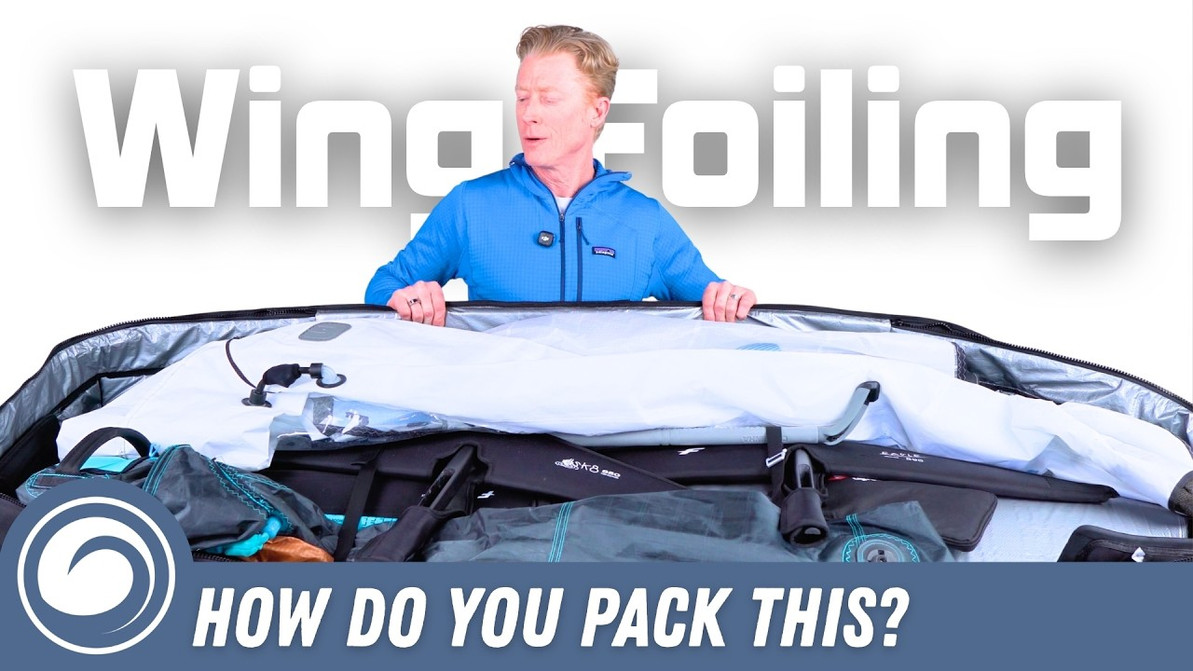
Jeff's Tips for Traveling & Packing Wing Foil Gear
Jeff gets asked a lot of questions about traveling with wing foil gear: What bag should you take? What are the airlines going to charge? What should you generally bring on a trip? Fortunately, he has had some experience packing his own gear over the last couple of years, and he's going to go over what he's learned through travel using the Manera 747 travel bag.
Choosing the Right Bag: Manera 747 vs. Wing Foil Bag
Manera makes two travel bags: the Manera 747 and the Manera Wing Foil Bag. Jeff has used both, but the 747 has some distinct advantages.
Where the 747 really shines is that it's traditionally a dedicated kite traveling bag. You could put your kiteboard, three kites, and maybe even a surfboard in it. But where it comes in handy for wing foiling is with midi boards. Midi boards are narrower and longer, and that's where the 747 bag has a leg up on the dedicated wing foil board bag. Because it is narrower and longer, it fits the profile of the board much better.
Jeff has traveled with boards that are the exact length of the bag. He generally doesn't like doing that, but he doesn't mind it as long as he can pad the nose. The board he has inside here is 5'9". The 747s come in 5'1", 5'7", 6'2", and 7'2". Jeff was forced to go to the 7'2" which gives him a little added room, which is not a problem. However, the specific packed bag shown in this walkthrough is a 6'2" bag with a 5'9" board.
Airline Charges and the 50-Pound Rule
Before deciding what to bring, the key question is: how much do you want to spend? Generally speaking, airlines will not charge you more than the standard checked bag fee of about $45 if the bag weighs under 50 lbs. That 50-pound mark is the absolute key.
If the bag is over 50 lbs and gets into the 60 or 70-pound range, they are going to charge you $100 on top of the $45 you already spent for your checked bag. You always hope to get a joyful ticketing agent who just says, "Yep, this looks good," and sends you on your way, but staying under 50 lbs is the best way to avoid those fees.
What to Pack to Stay Under 50 Pounds
To maximize your time on the water while staying under that weight limit, you have to be strategic. Here is exactly what Jeff packed in this 6'2" bag to hit 47 lbs:
- (1) 5'9" wing foil board
- (1) foil set (plus one extra front plane)
- (2) wings
- (1) harness
If you stick to those guidelines — your board, two wings, your foil set, and your harness — you should stay under the 50-pound mark without a doubt. At 47 lbs, you could even throw a beach towel in there.
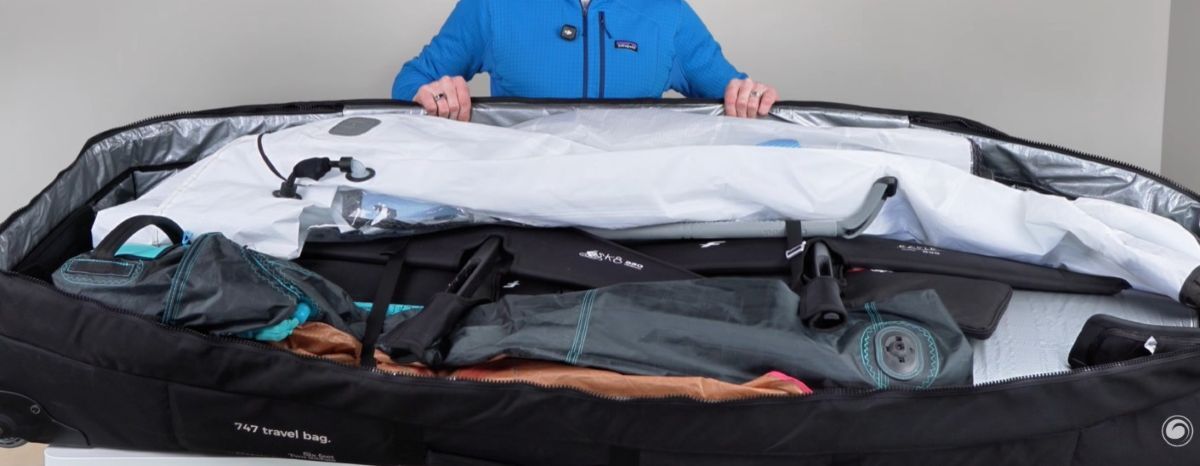
To save weight, Jeff doesn't suggest putting your wetsuit in the board bag. Wetsuits weigh way more than you think. Put your wetsuit in your carry-on bag, roll it up in a backpack, or put it in another checked bag.
Packing the Manera 747 Bag
Jeff has found real success with his gear arriving undamaged by packing it this specific way:
Ditch the Wing Bags
Another weight-saving trick Jeff has learned is that you do not need your wing foil bags. Those bags just add unnecessary weight. Leave them at home and pack the wings loose.
Packing the Wings and Booms
For Jeff's trip to La Ventana, he brought a 4m and a 5m wing, which worked perfectly for the conditions there. Depending on where you're going, you can generally do a meter or a meter-and-a-half difference between your two wings.
Jeff puts the wings on the sides and top of the bag to help protect the edges. The bag has really good protection on its own, but putting the wings in loosely, rolling them up, and shoving them down the sides adds extra protection for the rails of your board.
The wings Jeff uses have booms. He has traveled with the booms on the wings and off the wings — you can do it either way. In this case, he took them off the wings and placed them on top. The Manera bags have excellent interior load straps. You want to strap the booms in because things do slide around inside the bag when you are in transit.
Protecting the Nose and Tail
The two areas you need to be really aware of when packing a board are the nose and the tail. Generally speaking, bags have pretty good protection on the tail just from the way they are built with the wheels and bottom padding. The weak spot is the nose.
To protect the nose, Jeff places his harness right at the front of the board. That harness acts as excellent protection. Depending on how long your board is, the tighter the fit, the better it works because the harness won't move around.
He also puts the foil mast with the plate off the back. That plate actually helps add protection to the back of the board.
For extra security, Jeff adds some lightweight foam around the front and back of the board. He wraps it around the nose and secures it with clear tape. If you want to bring tape with you for the trip home, a great trick is to wrap the clear tape around the handle of your screwdriver.
Hardware and Tools
Jeff includes a small, soft hardware kit with all his screws and a tool inside his checked bag. The Manera 747 does have velcro compartments on the side, but he doesn't use them for hardware — you don't really want anything abrasive or sharp sitting right up against your board.
Note: You cannot be guaranteed that your tools will make it with you if you put them in your carry-on bag. Some security checkpoints will not allow hardware or screwdrivers through, viewing them as a potential weapon. This happened on Jeff's last trip to Mexico; the group got down there fine, but on the way back, security confiscated all the hardware and tools from their carry-ons. Always check your tools in your board bag.
What About the Pump?
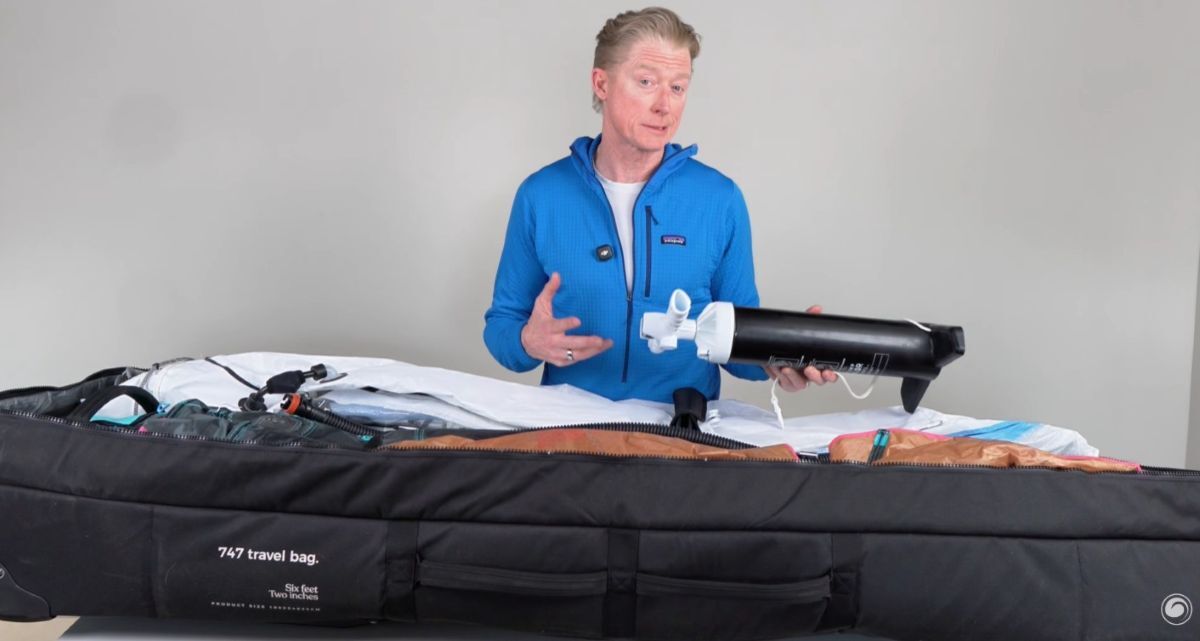
Jeff always brings an old-school manual pump instead of an electric pump. If the electric pump fails, or you can't get it charged right, the old faithful manual pump is going to work for you on your trip.
If you have to bring a pump, Jeff usually just sets it on top and snakes the hose in. A pump will add about 3 lbs to your bag. If you add that to the 47 lb setup, you are right at 50 lbs. If you need to save weight, you can take out the extra front wing, or if you're traveling with a group, you don't all need to bring a pump — just borrow one from someone else.
Final Thoughts
At the end of the day, traveling with wing foil gear shouldn't be the hard part of your trip — getting on the water should be the only thing on your mind. The Manera 747 is Jeff's ride-or-die for a reason: it hugs midi boards way better than a dedicated wing foil bag, the protection is there, and those interior load straps keep everything from rattling around while the baggage handlers do their thing. Stick to the short list — board, two wings, foil setup, harness — and you'll roll up to the counter at 47 lbs and breeze right through.
The rest is just little tricks Jeff has picked up the hard way. Skip the wing bags. Tuck your harness up at the nose and let the mast plate cover the tail. Wrap some clear tape around a screwdriver handle so you've got it for the trip home. And whatever you do, check your tools — that lesson cost the crew a full hardware kit in Mexico. Leave the wetsuit out of the board bag, toss in a manual pump as your backup, and you're set.
MACkite Subscription Links:
YouTube | Instagram | Spotify Oddcasts
Contact MACkite Below:
800.622.4655 | Kiteboarder@MACkite.com | LIVE Chat Messenger
Recent Posts
-

2026 Duotone Rebel D/LAB Review: 30-Knot Test
The Brazilian Brothers are ready to provide honest feedback on the 2026 Rebel D/LAB by Duotone. Th …13th Oct 2026 -

2026 Duotone Jaime SLS Kiteboard Review
The Brazilian Brothers are back to bring you another product review. Today, their focus is on the …13th Oct 2026 -
Manera Pocket Wing Belt Overview
Jeff met up with Billy Ackerman from F-One on the beach at the KoGL Test Fest to take a look at th …9th Oct 2026