
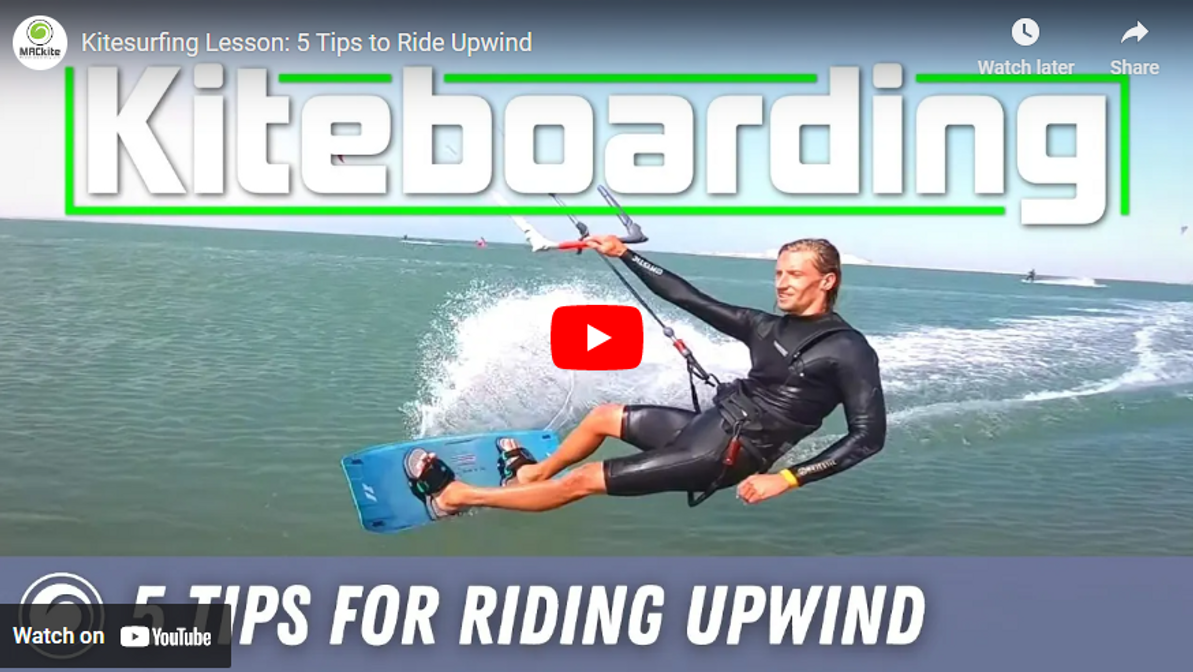
Kitesurfing Lesson: 5 Tips to Ride Upwind
This is Blake from MACkite here with 5 tips to help you ride upwind.
Tip 1 - Twist Your Body Upwind
Twist your shoulders and lean back over your back foot. This weights your back foot rather than both of your knees. This lets you get a stronger and harder edge.
Twist and lean back, looking upwind. Twist with your shoulders and your hips, with your feet, and even point your toes upwind, and all of those little things together will make it so much easier for you. If you instead close your shoulders and are looking at the kite, then that's where you're going to go... straight downwind.
Tip 2 - Pump the Bar
Rather than keeping the bar still and not moving it at all, you should be constantly adjusting the bar, whether you're pulling in for a little bit more power or sheeting out if it's too much. The more experience you get with flying the kite, the easier this becomes, but right now you're trying to fly the kite and keep it going. You always want to have a nice pull in and out of the bar.
You don't want to be pulled in all the way. This is going to pull you downwind. You'll always want to be sheeted out a little bit. But if you sheet out too much, then you're not going to have enough power and it's going to dump the kite. Pushing out opens the kite to allow you to ride upwind, so if the winds are strong, it's better to have it pushed out a little bit.
Tip 3 - Trim Your Kite
The trim line adjusts the angle of attack on your kite. If your trim is let all the way out and you're pulling in on the bar, the kite can backstall and fall out of the sky. So you always want to make sure your kite is properly trimmed.
Do this by pulling in an inch of trim, pulling in all the way on the bar, and seeing if the kite falls. Having your trim properly tuned can make all the difference in your ability to ride upwind.
Tip 4 - Ride a Big Enough Board
If you're struggling and you're not sure what it is, your board size could be the only thing holding you back.
As a beginner, you do need a larger platform to stay on top of the water, otherwise it could take you a bit longer to learn. If you have enough wind but you're sinking into the water a lot, try a larger board. The bigger the board, the easier it is to ride upwind.
Tip 5 - Create Movement in the Board and Don't Edge Too Hard
A common mistake is to edge too hard upwind right away. That kills all of the power. There's a fine balance between plowing through the water and getting going so fast you're skipping across it.
If you feel yourself starting to slow down to where you're going to plow in the kite, keep the kite moving, but you also want to bounce your body up and down on the board a little. It will relieve some of the surface tension with the water. If you wiggle your back foot, that also breaks the surface tension of the board on the water, and you'll take off.

Follow Blake:
YouTube | Instagram | Facebook | Olsen Adventures Instagram
MACkite Subscription Links:
YouTube | Instagram | Spotify Oddcasts
Contact MACkite Below:
800.622.4655 | Kiteboarder@MACkite.com | LIVE Chat Messenger
Recent Posts
-

Reedin SnackPack | Why Kiters Are Calling it the Funnest Board in Years!
At the 2025 King of the Great Lakes event on Lake Michigan, the MACkiteboarding crew got an early …20th Mar 2026 -

Airush Ultra Team V5 Kite Review
The Ultra Team V5 from Airush takes the concept of kite foiling efficiency further, introducing a …19th Mar 2026 -
2026 F-One UHM Mast, T2 Connection, SK8 V3, and Eagle V2
The 2026 F-One hydrofoil lineup introduces meaningful upgrades aimed at improving stiffness, effic …11th Mar 2026