
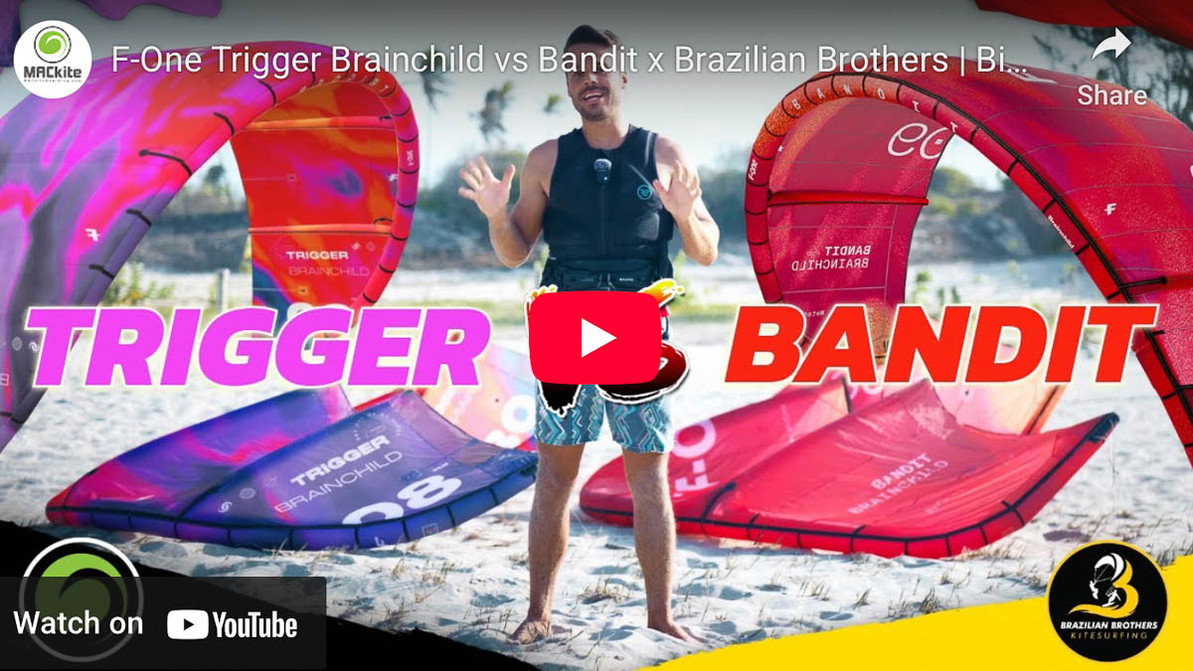
F-One Trigger Brainchild vs F-One Bandit Brainchild | Full Breakdown
The Brazilian Brothers are back with a comparison that many riders have been waiting for—a direct breakdown of the Trigger Brainchild versus the Bandit Brainchild. While both kites share the same design lineage and manufacturing DNA, they deliver drastically different experiences on the water.
This is not a subtle tuning difference. These are two kites built for different missions.
If you are deciding between explosive big air performance and all-around versatility, this breakdown will help you determine which Brainchild kite belongs in your quiver.
Shared DNA | What These Kites Have in Common
Before diving into differences, it’s important to understand what unites them.
Both the Trigger Brainchild and Bandit Brainchild:
- Are designed by Ralf Groesel
- Are built at the Brainchild factory
- Utilize ProWeld construction
- Feature advanced digital printing
- Represent the latest generation of F-One performance thinking
The shared ProWeld technology reduces weight and improves structural integrity by eliminating traditional stitching in key load areas. The digital printing platform also reduces waste and produces visually striking designs.
On paper, they share elite construction. In the air, they feel nothing alike.
Platform Design | 5-Strut Machine vs 3-Strut Legend
Trigger Brainchild | 5-Strut Big Air Platform
The Trigger is a dedicated five-strut kite built for:
- High-wind performance
- Big vertical lift
- Loop progression
- Stability at extreme load
The five-strut platform adds rigidity, particularly under load. This gives the Trigger its trademark vertical pop and dependable structure when sending hard.
It is unapologetically built for boosting.
Bandit Brainchild | 3-Strut Freeride Icon
The Bandit is now in its 18th generation and continues to evolve. The 2026 version features:
- Highest aspect ratio ever for a Bandit
- New bridle system
- Fixed front pigtails
- Floating pulley on the tip
- Improved loop speed
The Bandit remains a three-strut freeride kite designed to do everything well — surf, foil, freeride, and moderate boosting.
It is built for versatility.
Bar Feel and Steering | Direct vs Feedback
One of the biggest immediate differences between these two kites is how they feel at the bar.
Trigger Brainchild
- Extremely direct response
- Immediate reaction to steering input
- Light steering pressure
- Light sheeting pressure
The Trigger feels precise and reactive. Small movements translate quickly into kite movement. This creates confidence when sending for jumps or committing to loops.
For riders progressing in big air, that light, quick response is a major advantage.
Bandit Brainchild
- Less direct steering
- Moderate to heavy sheeting pressure
- Lighter steering pressure than sheet load
- More bar feedback overall
The Bandit provides more tactile feedback through the bar. Some riders prefer this because it creates a stronger sense of where the kite is in the window.
However, that moderate-to-heavy sheet pressure can feel intimidating when winds increase. This is a feel preference decision as much as a performance one.
Jumping Performance | Vertical Boost vs Moderate Lift
If jumping is your primary goal, this is where the two kites separate clearly.
Trigger Brainchild | Big Air Specialist
The five-strut structure gives the Trigger:
- Strong vertical lift
- Explosive pop
- Impressive hang time
- Confidence in powered conditions
The balance between lift and speed makes it excellent for:
- Boosting progression
- Controlled kiteloops
- High-wind twin tip sessions
The Trigger is clearly the superior jumper of the two.
Bandit Brainchild | Improved but Not Dominant
The new higher aspect ratio improves the Bandit’s jumping ability compared to previous generations. Riders will notice:
- Better lift than older models
- Improved float
- More dynamic takeoff
However, as a three-strut freeride kite, it cannot compete with the vertical authority of the Trigger.
If your goal is “jump to the moon and land softly,” the Trigger wins.
Looping | Speed, Power, and Progression
Looping is another area where the difference becomes obvious.
Trigger Brainchild
- Fast turning speed
- Light bar pressure
- Predictable loop arc
- Excellent for progression
The Trigger’s combination of speed and reduced bar load makes it ideal for riders pushing their first powered loops or refining technical control. As the wind cranks, the Trigger becomes more comfortable — not more intimidating.
Bandit Brainchild
The 2026 Bandit has improved looping speed and feels less yanky than older versions. However:
- Moderate-to-heavy bar pressure remains
- Loops feel more powerful
- Can feel intimidating in stronger wind
While capable, it is not designed as a loop-first kite. For committed big air riders, the Trigger is the clearer choice.
Wind Range and Low-End Performance
This category flips the advantage.
Trigger Brainchild | High-Wind Weapon
The Trigger thrives in:
- Moderate to strong wind
- Powered conditions
- Aggressive riding environments
However, it is not a low-end champion. If you try to ride it in lighter conditions around 20 knots, it may feel underpowered compared to freeride alternatives. It is built to shine when conditions turn serious.
Bandit Brainchild | Broad Wind Range
One of the Bandit’s biggest strengths is wind range. It performs well in:
- Lighter wind sessions
- Moderate conditions
- Variable environments
If you want to maximize water time and avoid waiting for nuking conditions, the Bandit is more forgiving and adaptable. This matters for riders who want consistency over specialization.
Versatility | Single-Discipline vs Multi-Tool
Trigger Brainchild
Best suited for:
- Twin tip riders
- Big air progression
- Loop-focused sessions
- Strong wind environments
Not ideal for:
- Surfboard drift
- Foil sessions
- Low-end cruising
The Trigger is a specialist.
Bandit Brainchild
Excels in:
- Twin tip freeride
- Surfboard sessions
- Foiling
- All-around riding
The drift characteristics and wind range make it a much more adaptable kite across disciplines.
If you want one kite that covers multiple styles, the Bandit is the smarter call.
Strengths and Weaknesses Summary
Trigger Brainchild
Strengths:
- Exceptional lift and hang time
- Fast, direct steering
- Excellent loop progression
- Light bar pressure
Weaknesses:
- Limited versatility
- Not strong in light wind
- Less suited for surf and foil
Recommended for: Twin tip riders in moderate-to-high wind who want to elevate their big air game.
Bandit Brainchild
Strengths:
- Strong wind range
- Excellent versatility
- Improved jumping
- Solid freeride feel
Weaknesses:
- Moderate-to-heavy bar pressure
- Limited hang time compared to 5-strut big air kites
Recommended for: Riders who want one kite that can handle freeride, surf, and foil while still offering solid boosting capability.
Which One Should You Choose?
The decision ultimately comes down to riding style.
Choose the Trigger Brainchild if:
- You ride mostly twin tip
- You chase big air sessions
- You want to progress loops
- You ride in consistently strong winds
Choose the Bandit Brainchild if:
- You mix twin tip, surf, and foil
- You want a broader wind range
- You prefer more bar feedback
- You value versatility over specialization
Both kites represent high-end design and construction. They simply serve different purposes.
Final Thoughts
The Trigger Brainchild and Bandit Brainchild are not competing for the same rider—they are solving different problems.
The Trigger is a high-wind, big-air weapon designed to reward aggressive input and progression. The Bandit is a refined freeride platform built for adaptability and access.
Neither is better universally. One is better for you.
We’re Happy to Help!
If you want help choosing the right size or dialing in for your local conditions, reach out to the team at:
Recent Posts
-

2026 F-One UHM Mast, T2 Connection, SK8 V3, and Eagle V2
The 2026 F-One hydrofoil lineup introduces meaningful upgrades aimed at improving stiffness, effic …11th Mar 2026 -

North Nova vs Nova Pro (2026): Which Wing Should You Choose?
The North Nova has built a strong reputation over the last few seasons. It’s one of those wings th …10th Mar 2026 -

North Seek Pro (2026) Overview: What's Changed and Who's It For?
North made a notable update to the Seek lineup for 2026. Instead of one model covering the entire …10th Mar 2026