
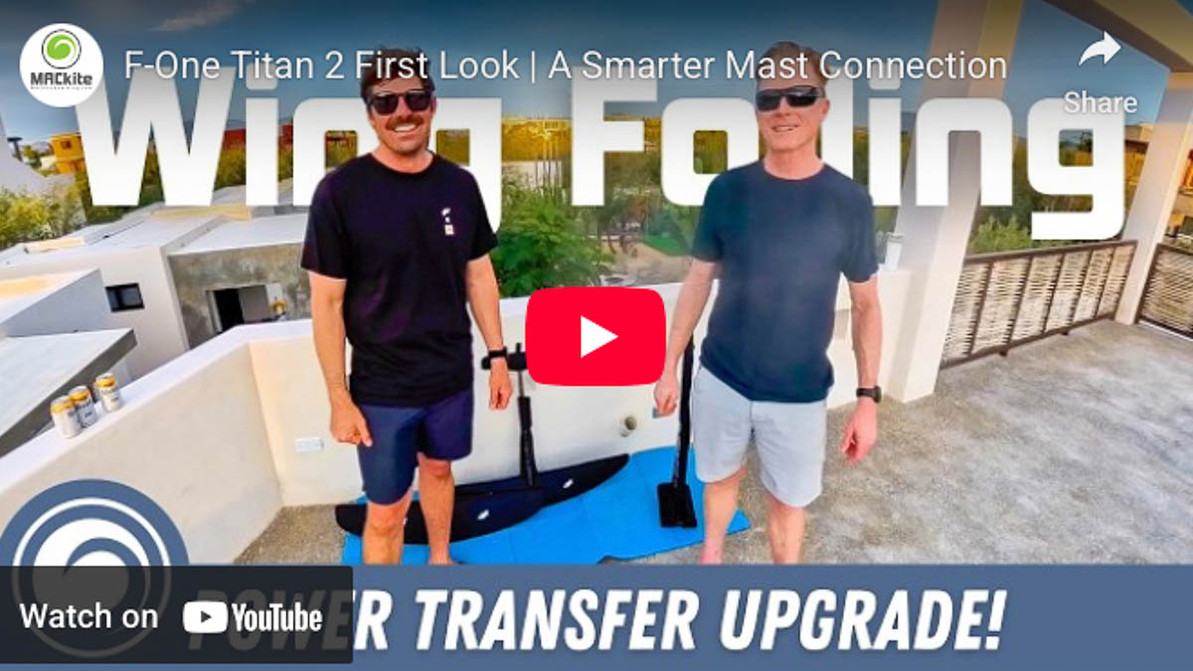
F-One Titan 2 Connection | Finally a True One-Piece Feel
F-One has officially introduced the biggest structural update to its foil system in six years. After a week of riding in La Ventana alongside the F-One crew, customers, and the MACkite team, one thing became clear — the new T2 connection is not a cosmetic tweak. It’s a foundational shift in how the front wing connects to the mast.
If you’ve been riding F-One for years, you already know the Titan T1 system has been incredibly reliable. Many riders have put serious miles on it without issue. But as foil speeds increase, aspect ratios climb, and riders demand more precision, even a great system can become the limiting factor.
The T2 connection is F-One’s answer to that ceiling.
What Changed | From T1 to T2
For six years, the Titan connection defined the F-One foil platform. It used three 32mm titanium screws to attach the front wing to the mast. It was solid, durable, and trusted worldwide. But performance evolution doesn’t stop.
The new T2 system introduces:
- A deeper, Tuttle-style mast insertion
- An angled front interface for load distribution
- Two M8 x 25mm screws instead of three 32mm titanium screws
- Reduced load concentration on hardware
- Increased structural rigidity across the system
This is not just a hardware swap. It’s a complete rethink of how force travels through the foil.
Why the T1 Became the Limiting Factor
The Titan T1 connection was strong. But as foil design pushed forward — higher aspect wings, thinner profiles, faster riding — forces increased dramatically.
When:
- Riders push harder at speed
- Smaller wings create higher leverage forces
- Aggressive carving increases torsional load
- Downwind and powered riding demand more stiffness
The connection between the mast and front wing becomes critical.
Over time, F-One recognized that the Titan interface was the bottleneck. Not unsafe. Not failing. Just the limiting factor preventing further performance gains. Innovation often starts where comfort ends.
Inside the T2 Connection
The defining feature of T2 is the Tuttle-like insertion. Instead of relying primarily on bolt tension to hold the wing and mast together, the mast now sits much deeper inside a socketed interface. The geometry itself handles more of the load.
Here’s what that accomplishes:
Deeper Mast Engagement
- The mast inserts further into the fuselage
- Increased surface contact area
- Load is distributed across the structure rather than the screws
Angled Front Interface
- The forward angle locks the mast into place under forward pressure
- Reduces micro-movement at high speeds
- Improves rigidity under acceleration
Reduced Hardware Load
- Screws are no longer bearing the majority of torsional stress
- Less strain over time
- More consistent long-term performance
This is structural engineering applied to hydrofoils.
Two M8 Screws | Why Fewer Can Be Better
The shift from three 32mm titanium screws to two M8 x 25mm screws might sound like a downgrade on paper. It isn’t.
Because the new geometry carries more load, the screws are no longer the primary load-bearing elements. They secure alignment rather than absorb force.
This results in:
- Cleaner assembly
- More consistent torque loading
- Less hardware fatigue
- Reduced long-term play in the system
The strength comes from design, not just fasteners.
On-Water Feel | What Riders Noticed Immediately
During the La Ventana trip, multiple riders swapped from their existing setups onto the new T2 system mid-session. The feedback was consistent.
Increased Rigidity
The most obvious difference was stiffness. There was less flex under load, especially:
- During hard carving
- At higher speeds
- When pumping smaller wings
- In powered wing sessions
That rigidity translates into more direct feedback.
More Connected Feel
The foil felt like a single, unified structure rather than components bolted together. Power transfer was immediate.
Riders described:
- Cleaner rail-to-rail transitions
- More predictable lift at speed
- Increased confidence, pushing harder
When a foil feels locked-in, riders naturally go bigger and faster.
High-Aspect Wings and the Need for Stiffness
The evolution of hydrofoiling has shifted toward:
- Higher aspect ratios
- Thinner profiles
- Faster glide speeds
- Longer fuselages
These wings generate more leverage force on the mast connection. Any micro-flex becomes amplified. The T2 system is built with this progression in mind.
As F-One continues to develop faster and more performance-oriented wings, the foundation must be stronger. T2 future-proofs the platform.
Long-Term Durability | Built for Progression
One of the most important aspects of T2 is longevity. Because:
- Structural surfaces handle more load
- Screws bear less stress
- Deeper engagement reduces micro-movement
The system is designed to withstand years of heavy use. That matters for:
- Riders traveling with gear
- Downwind specialists
- Larger riders pushing power
- Anyone riding frequently
This is not just a performance upgrade. It’s a long-term durability investment.
Is T1 Still Good?
Yes. The Titan T1 system remains an incredible platform. If you’re currently riding it:
- You’re not suddenly outdated
- You’re not unsafe
- You’re not under-equipped
T1 has proven itself for years. T2 simply represents the next step forward. If you’re pushing high-performance wings or looking to upgrade into newer-generation F-One designs, T2 will be the direction moving forward.
Travel and Protection | Keep Those Covers On
A quick but important note from the beach — protective covers matter. When traveling, especially to destinations like La Ventana:
- Keep mast covers on
- Protect wing edges
- Avoid stacking exposed carbon
The new T2 connection doesn’t change that. Foils are precision tools. Treat them like it.
Who Should Consider Upgrading
T2 makes the biggest difference for riders who:
- Push high speeds
- Ride smaller high-aspect wings
- Value maximum stiffness
- Feel subtle flex in their current setup
- Want the newest-generation platform
More casual riders may not immediately “need” the upgrade. Performance-focused riders will appreciate it instantly.
Engineering Direction | Where Foiling Is Headed
The T2 connection reflects a broader trend in hydrofoil design:
- Integrated structural interfaces
- Reduced reliance on hardware
- Greater torsional stiffness
- Cleaner force pathways
As gear becomes more specialized, connection systems become more critical. The weakest link in a foil system is often not the wing or mast. It’s how they connect. F-One addressed that directly.
Key Takeaways
- T2 is F-One’s first major mast-to-front-wing redesign in six years
- The Titan T1 system was strong, but it became the performance ceiling
- The new Tuttle-style connection increases rigidity dramatically
- Load is distributed through the structure, not just the screws
- Riders noticed immediate stiffness and feedback improvements
- The system is built for higher speeds and future wing evolution
- T1 remains solid, but T2 is the future platform
Final Thoughts | Evolution Without Compromise
Innovation in foiling doesn’t always show up in flashy graphics or dramatic shape changes. Sometimes it’s hidden in the connection points. The T2 system is exactly that.
It’s an engineering evolution designed to:
- Support faster wings
- Deliver cleaner feedback
- Improve long-term durability
- Create a more unified ride feel
If you’re serious about performance, this upgrade makes sense. If you’re riding and loving your current F-One setup, you’re still in a great place. But the future direction is clear. F-One built this connection for the long term.
We’re Happy to Help!
If you have questions about compatibility, upgrading from T1, or choosing the right F-One foil setup, feel free to reach out to the crew at Kiteboarder@MACkite.com.
We’re always happy to talk through setups and make sure you’re dialed!
Recent Posts
-

Reedin SnackPack | Why Kiters Are Calling it the Funnest Board in Years!
At the 2025 King of the Great Lakes event on Lake Michigan, the MACkiteboarding crew got an early …20th Mar 2026 -
Airush Ultra Team V5 Kite Review
The Ultra Team V5 from Airush takes the concept of kite foiling efficiency further, introducing a …19th Mar 2026 -

2026 F-One UHM Mast, T2 Connection, SK8 V3, and Eagle V2
The 2026 F-One hydrofoil lineup introduces meaningful upgrades aimed at improving stiffness, effic …11th Mar 2026