
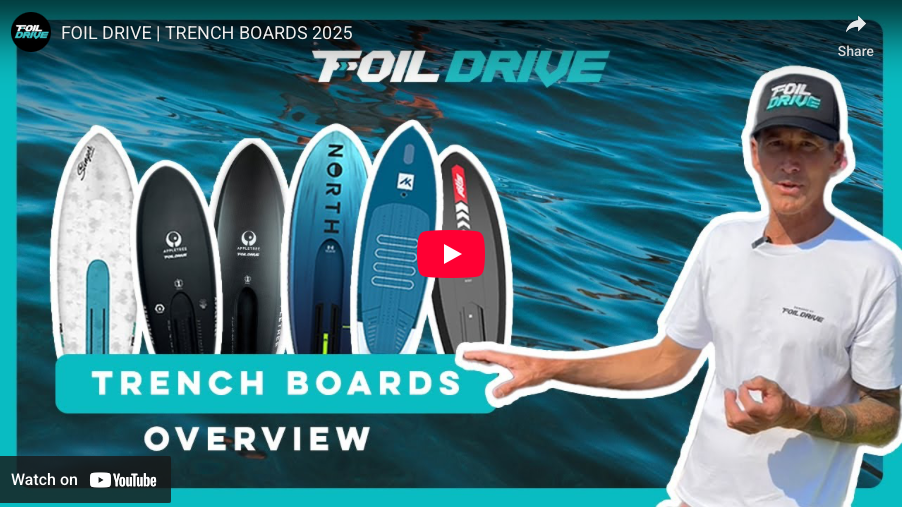
Top 6 Foil Drive Trench Boards Explained
SHOP Foil Drive Trench Boards!
Foil Drive has reshaped the way riders approach foiling, opening the door to smaller boards and foils, and enabling dramatically longer flights. As Dominic from Foil Drive Europe explains, the system is a full-on cheat code in the best possible way.
The next evolution in the Foil Drive ecosystem is the rise of dedicated trench boards—board designs that integrate the Foil Drive unit into the deck for improved balance, reduced drag, and higher performance.
In this blog, the focus is on what makes each trench board unique, how each brand approaches the concept, and how these design decisions impact a rider’s experience on the water.
What Trench Boards Do for Foil Drive Riders
Trench boards take Foil Drive’s assisted foiling benefits and sharpen them even further. With the unit partially recessed into the board, riders get:
- Lower drag
- Cleaner water flow
- Better balance
- Smoother acceleration
- Easier use of smaller foils
- Longer flights and more efficient gliding
The trenches themselves vary by width, length, depth, mounting hardware, and battery-change access, and each brand brings a unique take to the table.
The Boards | A Brand-by-Brand Breakdown
Below is a walkthrough of the main trench boards Dominic covered in the video, highlighting their design choices and the impact on performance and user experience.
Stinger Trench Board
A classic, narrow, purpose-built trench design.
The Stinger is the archetypal trench board: narrow, simple, and optimized for minimal water disturbance. Because the trench is cut very tightly around the Foil Drive, water can’t easily intrude into the gap, reducing turbulence and improving flow. Riders do need to remove the Foil Drive unit to access and change the battery, but newer split-bolt hardware keeps that process under two minutes.
Who it’s for: Riders who value clean hydrodynamics and don’t mind a quick battery removal as part of their routine.
AK Trench Board
Clean shaping with integrated hardware and a scooped trench profile.
AK’s collaboration with Foil Drive features a trench cut to the exact width of the unit, plus a scooped floor inside the channel that affects how water flows beneath the deck. It isn’t necessarily better or worse—just different. AK also embeds threaded inserts inside the trench, making bolt alignment easy and predictable.
Who it’s for: Riders who want a refined build with integrated inserts and a slightly different water-flow feel.
North Trench Board
Wider trench for faster battery swaps.
North takes a unique approach: a slightly wider trench that allows riders to loosen the bolts, slide the whole unit back an inch or two, and remove the battery without removing the unit—no more full removals or fumbling with tight clearances.
The trade-off is that the extra width could affect drag or water flow. But for riders who prioritize speed and ease of battery changes, North’s system is hard to beat.
Who it’s for: Anyone who wants quick mid-session battery swaps and doesn’t mind a wider trench footprint.
Appletree Zapple Series
Closed-cell foam, long trenches, and multiple board shapes.
Appletree was one of the first European brands to embrace trench designs fully, and their popularity shows why. Their boards use closed-cell foam, which means dings and cracks don’t instantly become waterlogged session-enders.
The original Zapple features an extended trench for added placement range. Like the Stinger, it’s open at the back, and battery changes are still quick thanks to split bolts. The board is well-balanced, predictable, and proven.
Who it’s for: Riders who want proven performance, durability, and foam that won’t soak water if damaged.
Appletree Zapple S
A more compact, surf-inspired variation.
The Zapple S is an evolution of the Zapple, available in a refined shape with updated graphics. The trench is cut precisely to the width of the Foil Drive unit, and battery swaps remain a quick two-minute job. The design caters to riders who enjoy compact, surfier outlines but still want Foil Drive integration.
Who it’s for: Riders wanting a smaller-feeling board that still nails trench integration and easy setup.
Axis Pocket Trench Board
A highly engineered design pushing trench performance forward.
Axis enters the trench game with one of the most detailed designs yet. Everything is built around minimizing drag and optimizing usability:
- Exact-width trench
- Battery slides under a molded nose pocket
- Purpose-built mast tracks
- T-nuts that lock into place and slide cleanly
- Unit removal that requires only a few turns of the bolts
- A mast plate that aligns perfectly with the deck and board contours
Axis aims for the cleanest water interaction possible, with a trench shape that integrates seamlessly with the Foil Drive Fusion profile.
Who it’s for: Riders who want the most advanced, drag-reduced, user-friendly trench system available.
What Really Matters When Choosing a Trench Board
Dominic emphasizes that while trenches differ, the board’s shape is the true deciding factor. Most designs now share similar mid-length outlines that provide:
- Excellent glide
- Strong acceleration
- Balanced pitch control
- Good efficiency for both assisted and non-assisted foiling
So what should riders actually prioritize?
- Length and width
- Volume
- Rocker and front-to-rear balance
- How the board interacts with the foil they already ride
- Where and how frequently they ride
- Battery swap preferences
- Durability and construction materials
Trench design matters only for how the Foil Drive sits on the board and how quickly the battery can be swapped. But as more brands evolve their systems, even those differences are becoming minor.
Key Takeaways
- Foil Drive allows riders to use smaller boards and foils while staying on foil longer. Trench boards refine that experience.
- Different brands approach trench design through width, length, drag reduction, and hardware integration.
- The fastest battery swaps come from wider trench openings or sliding-track systems.
- Closed-cell foam (like Appletree’s) is a significant durability advantage for riders who push their equipment hard.
- The biggest factor in choosing a trench board isn’t the trench—it’s the board shape, volume, and how it fits a rider’s style and conditions.
SHOP Foil Drive Trench Boards!

Recent Posts
-

Reedin Wing Foil Package Overview: Built to Learn, Designed to Progress
A Carefully-Crafted Entry Into Wing Foiling If you've been eyeing wing foiling but feel overwhelme …9th Apr 2026 -

Foil Drive's New Props Explained
For a long time, the black prop was just the prop. It came in the kit, it worked, and you rode it. …9th Apr 2026 -

Reedin SuperModel V6 Overview: Lightweight Aerolite Frame Upgrade on a Kite for Anyone
After more than five years on the market, the SuperModel has become the foundation of Reedin's lin …9th Apr 2026