
Ride with Blake | How To Transition on a Kiteboard
You've take a kiteboarding lesson and mastered the Waterstart that's awesome! However, there is one little problem... How do you go back the other way? Fear not, I've broken down the kiteboarding transition into five easy steps. The next time you hit the water give these a try and see if they help!
Step one
Practice on the beach with a trainer kite. Visualization goes a long way with learning anything. If you can get your hands on it that's even better. I recommend taking a day or two mimicking the motions in this video on the beach with a trainer kite. Just run to the left and the right. When you are ready to go the other way, bring the kite over your head shift your weight to your new back leg and run the other direction.
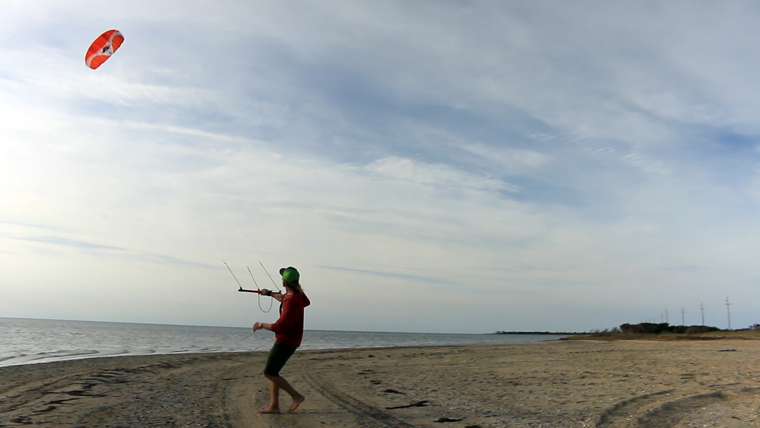
Visualization helps with every trick.
Step two
Don't just dive right into the transition. It's okay to sit down first and do a water start in the other direction. The reality is that you need to take time building up your kite and board skills. The more practice you get flying, the easier everything is going to become. Eventually, you can progressively sink less each tack. Before you know it, you will be doing a genuine transition without stoping.
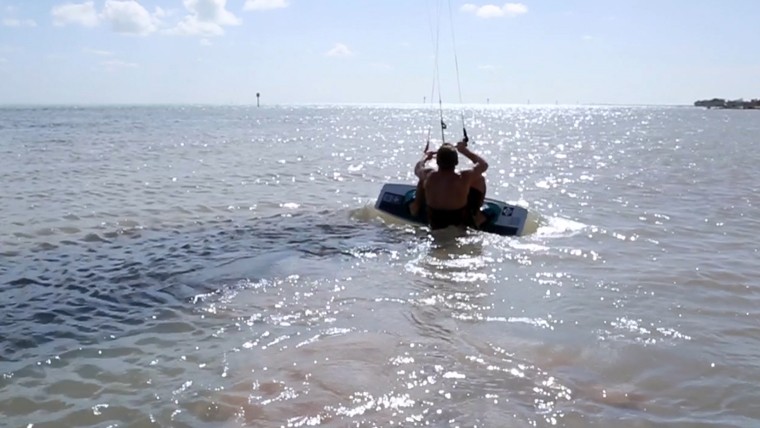
Progressively sink less over time
Step three.
You want to turn with the kite. Now, what I mean by this is that you don't want to send the kite to the other side of the window and try to catch up. Doing this, you're kite will shoot to the edge of the wind window and you will lose all board speed right before you sink. The trick is to commit to following your kite though out the entire turn.
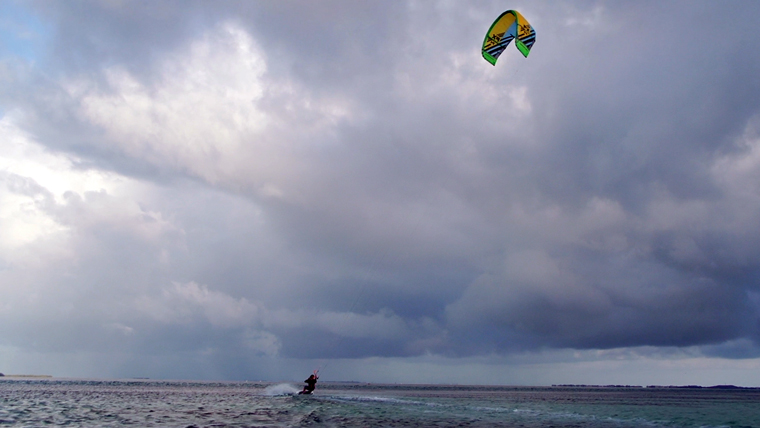
Turn with the kite
Step four
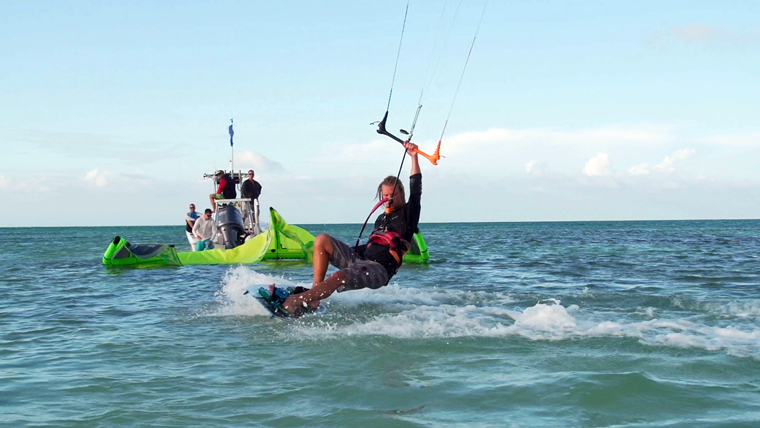
Ride slightly at the kite. You want to maintain some board speed in order to stay on a plane. As you start to bring your kite across the wind window, let off your edge and ride slightly at the kite. This paired with the upward pull of the kite will keep you from sinking. By the time the kite has reached the other side of the window you want to be riding in the other direction.
Step five
Shift your weight. When you are riding your weight should be centered over your back knee. You steer the board with your extended front leg and your hips. Now, right as the kite is above your head you want to shift your weight to your new back leg. Extend that new front leg and start riding the other way. Remember to ride slightly downwind first to build speed then progressively dig those heels, open up that body and ride up wind. If you don't know how to ride upwind I do have a video on that as well. You can check that out here!
Peace
-Blake
 Blake Olsen
A Michigan boy through and through (even though he was born in Saudi Arabia), Blake is a youth with a lifetime of experiences and adventures. Not only that, he's passionate about sharing his zest for life with others. He is proficient at many fields, including kiteboarding and acting as concierge to any who simply ask. Looking for an adventure? Well, Blake is your guy. From sailing the Gulf and the Caribbean to backpacking Hawaii and Southeast Asia, he knows his stuff and can make your vacation into an adventure.
Instagram: @BlakeTheOlsen
Face Book: BlakeOlsen
Recent Posts
-

Interview with Stig: Big Air, Naish Loyalty & Life Beyond Kiting
Rubens: What's up, guys? It's the Brazilian Bros from MACkiteboarding, and today we've got a very …26th Mar 2026 -
One Board, Every Session | Why We're Stoked on the Omen Emissary
If you've been searching for a single board that can handle light-wind winging, parawinging, prone …25th Mar 2026 -

Reedin HyperModel Kite Review: Fast Loops and Big Air Performance
The HyperModel was developed in collaboration between Reedin and Brainchild. Ralf Groesel, Damien …25th Mar 2026