
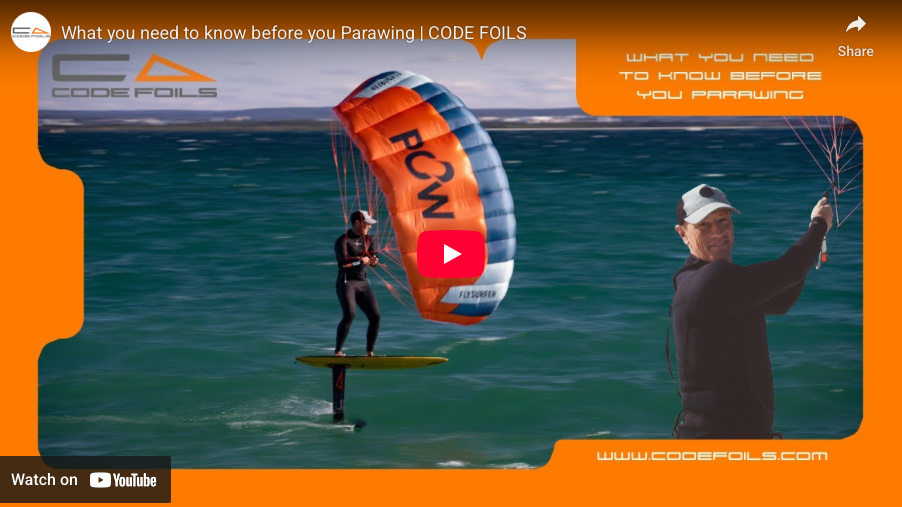
Parawinging Tips from Code Foils
Parawinging is rapidly emerging as the next big evolution in foiling sports. From the downwind runs of Hawaii to the iconic conditions of Hood River, more riders are discovering how this self-powered discipline unlocks the thrill of foiling without relying on perfect downwind conditions or shuttle logistics. In this comprehensive breakdown from Code Foils, we’ll walk through what parawinging is, why it’s taking off, and the ideal setup to get started—including wing size, foil choice, board selection, and key technique tips for early success.
What Is Parawinging?
At its core, parawinging combines elements of downwind SUP foiling and wing foiling, allowing riders to “self-position” and generate their own lift using a handheld parawing. The idea came from riders who loved the feeling of downwind glides but didn’t always have time—or conditions—to commit to a multi-hour shuttle run.
By using a parawing, riders can launch from almost anywhere, control their positioning on the water, and still capture the flowing, surf-like freedom of downwind foiling. It’s a natural progression for experienced foilers looking for independence, versatility, and that same endorphin rush—without the logistical hurdles.
Choosing the Right Parawing
When choosing your first parawing, simplicity and balance are key. The latest generation of wings from most major brands all perform well, offering smooth depower and consistent pull.
Ideal Parawing Size:
- Around 4 meters is the sweet spot.
- Larger wings generate more power but become cumbersome to manage.
- Smaller wings require higher wind speeds and can make early learning more difficult.
- A 4m wing strikes the perfect balance between power, handling, and portability.
The goal is easy water starts, stable flight, and predictable power delivery—all of which help shorten the learning curve.
Selecting Your Foil Setup
Just like with SUP or wing foiling, foil selection is crucial for stability and control. Code Foils’ lineup offers an excellent starting point:
Foil:
- The S Series is ideal for parawinging.
- It’s forgiving yet responsive, offering great glide and smooth turns.
- A 1300 cm² front wing is a versatile size for light wind and early sessions.
Mast:
- Around 80 cm is optimal.
- Shorter masts (around 75 cm) can cause tip breaches when going upwind.
- Longer masts (85+ cm) become inefficient and harder to control.
- The 80 cm mark hits the perfect balance for stability and performance.
Fuselage:
- Start with a medium-length fuse for added stability and leverage when pumping out of the water.
Stabilizer:
- Pair the S-Series with an AR150 for a stable, controlled feel. Once confident, switch to the 120R for more speed and maneuverability.
This setup provides enough lift to learn efficiently while keeping handling responsive for turning and carving downwind.
The Ideal Board
Board choice plays a massive role in early success. While many downwinders can double as parawing boards, a mid-length shape provides better balance and maneuverability.
- Ideal Specs: Around 70 liters in volume and 20 inches wide.
- Avoid going too long or too skinny at first—excess length can make balance tricky, and narrow boards tend to feel unstable in crosswinds.
- A board like the Code Scyther is an excellent example—lightweight, stable, and forgiving for early takeoffs.
Remember: your board should float your body weight comfortably. Skip the sinker board until you’re fully confident.
Mastering Wing Control
Before hitting the water, spend time on the beach. Getting familiar with your wing’s feel, steering, and power management will dramatically reduce your learning curve.
Here are some progressions to learn on land:
- Practice launching and depowering.
- Understand the difference between sheeting in (powering) and sheeting out (depowering).
- Turning comes from subtle wrist rotation.
- Keep slight tension in the lines—if you’re fully depowered, the wing won’t steer.
- Keep the wing above your head (“zenith” position) when organizing gear or preparing to water start.
- For takeoff, bring the wing down to a 45° angle (around 11:00 or 1:00 position). Too high and you’ll lose pull; too low and it’ll touch the water.
Launching and Stowing the Wing
Launching technique can make or break your first sessions. Avoid simply tossing the wing or trying to launch it on the water.
To Launch:
Hold the leading edge in a “10 and 2 o’clock” grip with two fingers. Wait for a gust, then release smoothly—it will naturally lift and catch air.
To Stow:
Grab all the front lines, work toward the leading edge, and gather the canopy cloth. Once contained, roll it concertina-style (accordion fold). Secure the lines and bar next to the wing for a clean, tangle-free packdown.
Ideal Conditions for Learning
Your first few sessions should prioritize calm, controlled environments.
Wind:
- 15–20 knots is perfect.
- Below 15 knots, it’s tough to generate lift.
- Above 20 knots, the sea state becomes messy, and handling becomes difficult.
Water:
- Flat water, like a lake or sheltered bay, is best for progression.
Safety:
-
Always use a stash belt to carry your wing until you’re in position offshore. It frees your hands and prevents accidental inflation near the shore.
-
Avoid breaking surf or open-ocean downwinds until you’ve logged multiple flatwater sessions and can comfortably control power, direction, and wing handling.
Key Takeaways
- Wing: Modern 4m wing for ideal power-to-control balance.
- Board: Mid-length (around 70L), slightly over body weight in volume.
- Foil: Code Foils S-Series 1300, 80 cm mast, medium fuselage, AR150 or 120R stabilizer.
- Conditions: 15–20 knots of steady wind and flat water.
- Practice: Spend several hours on land before entering the water.
Final Thoughts
Parawinging delivers the joy of foiling anywhere, anytime, without the constraints of tides, shuttles, or group coordination. With the right setup and a few sessions under your belt, you’ll discover an entirely new way to chase that downwind flow.
The combination of Code Foils’ forgiving S-Series wings, a balanced 4m parawing, and a mid-length board creates a setup that’s not only beginner-friendly but endlessly rewarding as your skills grow.
As this sport continues to explode across the globe, from Hood River to Sydney, there’s never been a better time to join the movement.
MACkite Subscription Links:
YouTube | Instagram | Spotify Oddcasts
Contact MACkite Below:
800.622.4655 | Kiteboarder@MACkite.com | LIVE Chat Messenger
Recent Posts
-
Reedin SnackPack | Why Kiters Are Calling it the Funnest Board in Years!
At the 2025 King of the Great Lakes event on Lake Michigan, the MACkiteboarding crew got an early …20th Mar 2026 -
Airush Ultra Team V5 Kite Review
The Ultra Team V5 from Airush takes the concept of kite foiling efficiency further, introducing a …19th Mar 2026 -
2026 F-One UHM Mast, T2 Connection, SK8 V3, and Eagle V2
The 2026 F-One hydrofoil lineup introduces meaningful upgrades aimed at improving stiffness, effic …11th Mar 2026