
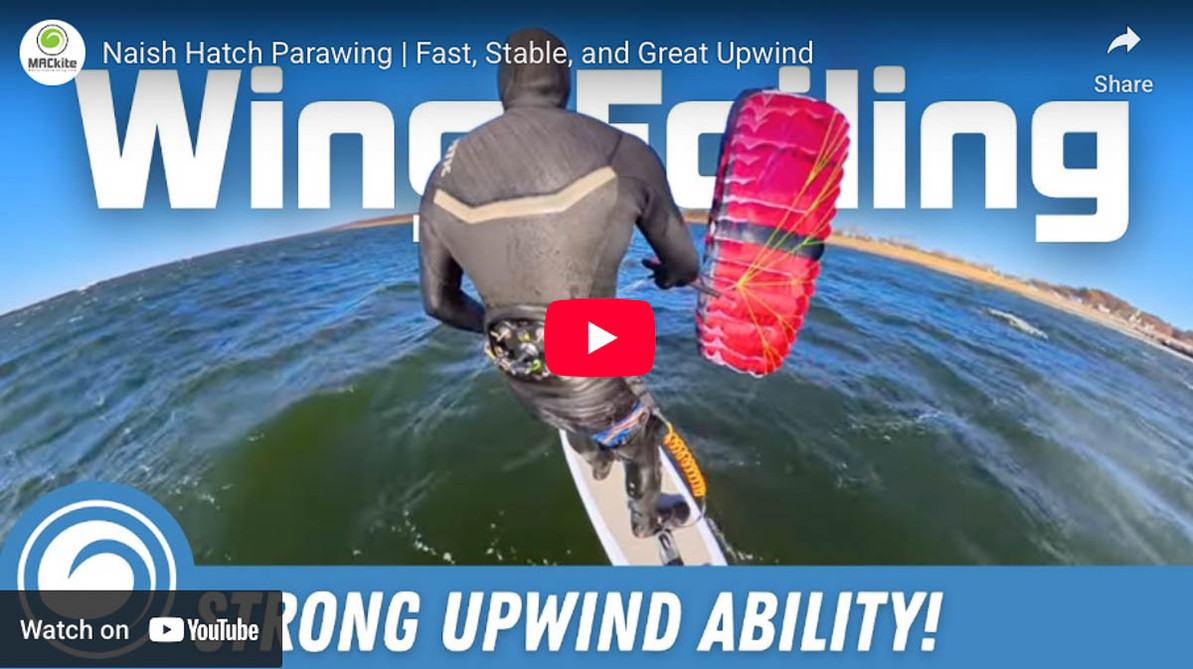
Naish Hatch Parawing | Upwind Power, Broad Range, and Smart Price
The Naish Hatch is Naish’s performance-driven entry into the evolving parawing category, positioned as a more upwind-capable, speed-oriented option compared to the brand’s earlier Morph model.
Where the Morph leaned toward a downwind glide and a beginner-friendly grunt, the Hatch shifts focus toward better upwind angles, a broader usable wind range, and a lighter, more refined feel.
If you’re building a multi-wing quiver or looking for strong price-to-performance value, the Hatch deserves a serious look.
Design Overview | Simple, Purpose-Built, Lightweight
At first glance, the Hatch features a clean, minimalist single-skin layout. There’s very little excess material, which keeps overall weight low and packability high.
Key Construction Features
-
Curved plastic battens in the leading edge
-
Minimal rib and baffle layout
-
Lightweight canopy material
-
Short bridles across the size range
-
Color-coded A/B/C bridles
-
Adjustable B-connection point
This is clearly a wing designed to give you what you need—without layering on features that inflate the price.
Bridles and Bar Feel | Clean and Manageable
One of the Hatch’s strengths is how uncomplicated the bridle system feels.
- Short bridle lines reduce visual clutter and tangling.
- A horizontal bridle across the front ribs helps maintain optimal curvature.
- Three bar connection points (A, B, C) allow adjustment.
- The forward “knob” on the bar gives extra leverage for controlled front-line pressure.
In flight, the Hatch prefers to be flown with forward pressure on the A lines, keeping the wing driving efficiently without backstalling. Two-handed flying remains stable and balanced.
For riders who are frequently switching wings on the water—especially during downwinders—the simplified bridle layout is a major plus.
Performance | Upwind Drive and Controlled Power
The Hatch’s defining characteristic is forward drive.
Compared to the Morph:
- The Morph = grunty, downwind-biased, easy foil pop.
- The Hatch = more forward flying, stronger upwind angle, broader top-end control.
Upwind Performance
This is where the Hatch shines. Once powered correctly, it tracks upwind quickly and efficiently, allowing riders to:
- Gain ground faster
- Expand session range
- Push longer downwind returns
It feels comfortable being flown powered rather than underpowered.
Wind Range | Size It Up
One important takeaway—the Hatch likes power. Compared to many other wings in the market:
- You may want to size up one size.
- If most riders are on a 4m, you may want a 4.5m–4.7m equivalent.
Why? Because the Hatch:
- Trades some low-end grunt for forward efficiency.
- Handles top-end exceptionally well.
- Stays stable and controlled when fully powered.
For example, the 2.7m has been ridden comfortably in winds up to 35 knots—and potentially even higher. The wing tip structure and double battening help keep things locked in, even in strong conditions.
Who Doesn’t Need to Size Up?
- Riders on efficient downwind boards
- Highly experienced foil riders
- Those comfortable generating their own apparent wind
If you’re on a shorter board or newer to parawinging, sizing up will make life easier.
Wingtip Design | Stability in a Single Skin
The wingtip features:
- A pressure-retaining outer structure
- Double batten reinforcement
For a single-skin wing, tip stability is impressive. Even in small sizes, control remains predictable and calm—something that can’t be said for every wing in this category.
Price-to-Performance | Where It Really Wins
The Hatch may not be the absolute highest-performing parawing on the market, but that’s not the point. Its biggest strength is value.
You get:
- Strong upwind performance
- Wide usable wind range
- Clean bridle management
- Lightweight packability
- Minimalistic, purpose-built construction
At a price point that makes owning two or three sizes more realistic. In a category where premium performance wings can get expensive quickly, that matters.
What Could Be Better?
There aren’t any major red flags, but here are realistic considerations:
-
More low-end grunt would help beginners.
-
Pure performance seekers may want more.
That said, any lack of bottom-end can be mitigated by simply sizing appropriately.
Who Is the Hatch For?
The Naish Hatch is ideal for:
- Riders building a 2–3 wing quiver
- Those wanting strong upwind capability
- Budget-conscious parawingers
- Intermediate to advanced riders who prefer powered riding
- Anyone who values simplicity and packability
If you’re entering the sport and want something capable without overspending, this is a compelling choice.
Final Thoughts
The Naish Hatch delivers exactly what it promises:
- Forward-flying efficiency
- Controlled top-end power
- Simple, clean construction
- Solid value
It’s not overloaded with features. It’s not trying to reinvent the category. It simply offers a balanced blend of performance and affordability in a sport that’s evolving fast.
If you're testing multiple parawings and trying to stretch your budget across a full quiver, the Hatch is absolutely worth serious consideration.
We’re Happy to Help!
Please email us with any questions you may have about parawings. Let’s get you out there on the water!
Email: Kiteboarder@MACkite.com
Recent Posts
-
How to Fix a Sticky Waydoo EVO Remote Trigger
If your Waydoo EVO remote trigger starts sticking or losing responsiveness, it’s usually not a maj …31st Mar 2026 -

Omen Flux V2 Review: The True One-Board Quiver Killer
If you've spent any time around the shop listening to the crew or watching our videos, you already …31st Mar 2026 -

Le Poisson - A Cabrinha Films Production
Video Synopsis Theo Demanez was born and raised in St.Marten, an island in the Caribbean. At an ea …31st Mar 2026