
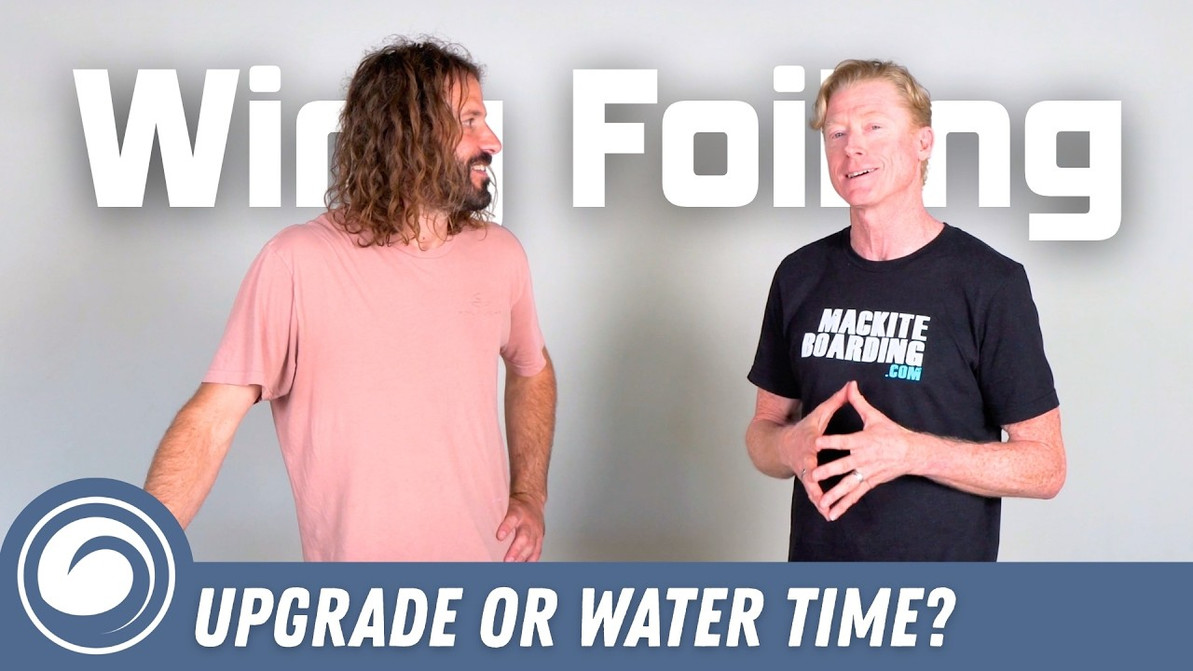
Three Wing Foil Quiver Upgrades to Level Up Your Riding
Tucker and Jeff are here to walk through a few upgrades you can put into your quiver to help you become a better wing foiler. Winging has seen a massive boom over the last three years, and a lot of riders now have a couple of years under their belt riding the exact same gear they learned on. At some point, the conversation needs to shift to where your skill starts getting limited by the gear itself.
You can have fun on any gear you buy, but based on the guys' experience, there are three main areas worth dialing in. You don't have to tackle all three in one big swoop. Your budget, your time on the water, and your local conditions will dictate the pace. But if you're ready to make a change, here's where to start.
Foil Upgrades: Moving to Mid-High Aspect
When riders are ready to upgrade, the foil is usually the right first move. The foil is the piece that shapes your experience on the water more than any other component. As riders get comfortable on their starter gear, they naturally want to push into bigger conditions, ride waves longer, pump efficiently, and handle more speed — and that's when the beginner foil starts to hold you back.
A lot of riders starting out grab a huge foil just to make getting up easier. That's a great way to start, but it's also one of the things you progress out of the quickest as your technique and confidence build. Sizing down to a mid to higher-aspect foil that's sleeker and more efficient makes a real difference. You don't need to go crazy with a massive glider or a race foil, but a more efficient foil broadens your speed range, gives you more glide to make jibes easier, and lets you keep up with waves so you aren't falling off the back.
For intermediate riders eyeing a second foil, listen to the feedback your gear is giving you. Are you riding waves and feeling like you can't control the foil? Does it have too much lift? Do you feel like you can't tame the speed and you're barely hanging on when things get big? If you're pushing yourself into bigger conditions and getting that feedback, it might be time for a smaller foil dedicated to those conditions.
Jeff's own progression is a good example: he kept sizing down and getting more efficient, and eventually landed comfortably in the 800 range (around an 8 to 10 aspect ratio). That size gives him a broad range without holding him back in either direction.
The Light Wind Foil Misconception
There's a common misconception that light wind requires a massive 1100 or 1200 foil. In reality, you can get up on more efficient 800, 900, or 1000 higher-aspect foils with a little technique. Once you're up, they're far more efficient than the bigger options.
One important note: whenever you buy a new foil, ride it in decent, semi-powered wind first. Don't take it out when it's super light and try to figure it out. Learning a new foil is hard enough without stacking marginal conditions on top of it, especially if it's smaller than what you're used to.
Board Upgrades: The Rise of the Mid-Length
If you're going fast but your board is too short and chunky, the drag of the board itself is going to limit you. You don't need to jump straight to something super tiny and high-performance, but going sleeker, a little narrower, and adding some length broadens the application of the board significantly. A board built for speed and release helps you get faster foils up more easily with less effort, and gives you less board to swing around during touchdowns.
Mid-length boards have been one of the biggest improvements to hit the market for getting riders out in a broader range of wind with more efficiency. People often assume a bigger board will feel clunkier, but that isn't necessarily true. Once you're positioned in the middle of a mid-length board, you have great balance and weight distribution — often more than you had on the shorter, chunkier board.
It isn't a race to the smallest board anymore. The current landscape breaks down into three categories:
- Standard learning boards: Wider and stubbier — great for learning, but limiting once you're up and riding.
- Mid-lengths: Longer and narrower — the sweet spot for most intermediate riders.
- Downwind boards: Really long and narrow — a specialized option for a specific style of riding.
For about 80% of riders, stepping to a mid-length board will massively improve overall performance. It pairs perfectly with a higher-aspect foil: it's like putting the right wheels on a race car so both components complement each other.
Because there's a huge range of sizes, shapes, and displacements in mid-length boards, this is a great place to talk to someone who knows the design intent, the rocker lines, and the rail shapes of what's on the market.
If you want to keep your big chunky board for light wind days, you can go smaller and sleeker for your performance board. If you want a board specifically dialed for light wind days, you'll want something bigger and longer.
Width matters too: standard boards often run 22 to 25+ inches wide, while mid-lengths drop to 21, 22, or under. Don't be afraid of the added length on a mid-length board. You get the stability you need, and paired with the right foil, it keeps the board from nose-diving and stays flat to gain speed.
Wing Upgrades: Maximizing Water Time
The more you ride, the better you get. So how do you get more ride time? A lot of locations don't see 40 knots very frequently, but they get plenty of unused light wind days. Getting a bigger wing — a 6, 7, or 8-meter depending on your wind, weight, and gear — is a great way to unlock those days.
Jeff has actually gotten more light wind sessions over the years than moderate or high wind sessions. Those light wind days are the perfect time to focus on core skills in a non-threatening environment. You can practice your foot placement, board speed, wing positioning, transitions, tacks, and jibes. All that body and wing awareness transfers directly over when you get out in higher winds and bigger waves.
Manufacturers have gotten much closer in performance across the larger wing sizes, making them more efficient and less unwieldy than they used to be. For most riders, a 6 to 7-meter wing paired with an efficient board and foil is a really nice place to land. Once you get up to an 8-meter, wings can start feeling pretty big and unwieldy, which can limit your upwind ability and maneuverability. Bigger doesn't always mean better if it adds unnecessary drag: you want to pair the wing size appropriately with your weight, your board, and your foil so the whole setup works together.
The MACkite Take
Three levers, one goal: match your gear to the rider you've become. Here's the quick-scan version of Tucker and Jeff's upgrade framework for anyone still riding the exact setup they learned on two seasons ago.
- Upgrade the foil first — it shapes your ride more than anything else. Move away from that big, easy beginner foil and into a mid-to-high aspect foil in the 800 range with an 8 to 10 aspect ratio. You'll get broader speed range, more glide for jibes, and enough efficiency to keep up with waves.
- The "bigger foil for light wind" idea is a myth. You can get up on efficient 800, 900, or 1000 higher-aspect foils in light wind with a little technique, and they'll ride way better than the massive 1100 or 1200 once you're on foil. Just don't test a new foil on the lightest day of the year: give it semi-powered conditions first.
- Mid-length boards are the sweet spot for 80% of riders. Sleeker, a little narrower, more length: the drag drops, faster foils get up easier, and touchdown recoveries are cleaner. Standard boards run 22 to 25+ inches wide; mid-lengths drop to 21, 22, or under. Pair one with a higher-aspect foil and it's the equivalent of putting race wheels on the right chassis.
- A bigger wing unlocks the light wind days your calendar keeps wasting. A 6 to 7-meter is where most riders should land. Those extra sessions are the best place to drill foot placement, wing positioning, transitions, tacks, and jibes (aka, skills that transfer directly to bigger conditions).
- The whole system has to work together. Don't chase specs in isolation. A small performance foil under a chunky learning board or an 8-meter wing on a mid-length setup fights against itself. If you're not sure which piece to tackle first, the shop can help match the whole setup to your skill level.
MACkite Subscription Links:
YouTube | Instagram | Spotify Oddcasts
Contact MACkite Below:
800.622.4655 | Kiteboarder@MACkite.com | LIVE Chat Messenger

Recent Posts
-

Code Aluminum Mast Review
Tucker is here with a look at a brand new product: the Code Aluminum Mast. In the past, Code has o …30th Jul 2026 -
Five Ways to Jibe a Parawing
Tucker and Jeff dive into a parawing tip video focusing on the easiest ways to handle your parawin …30th Jul 2026 -

Three Wing Foil Quiver Upgrades to Level Up Your Riding
Tucker and Jeff are here to walk through a few upgrades you can put into your quiver to help you b …30th Jul 2026