
Code Aluminum Mast Review
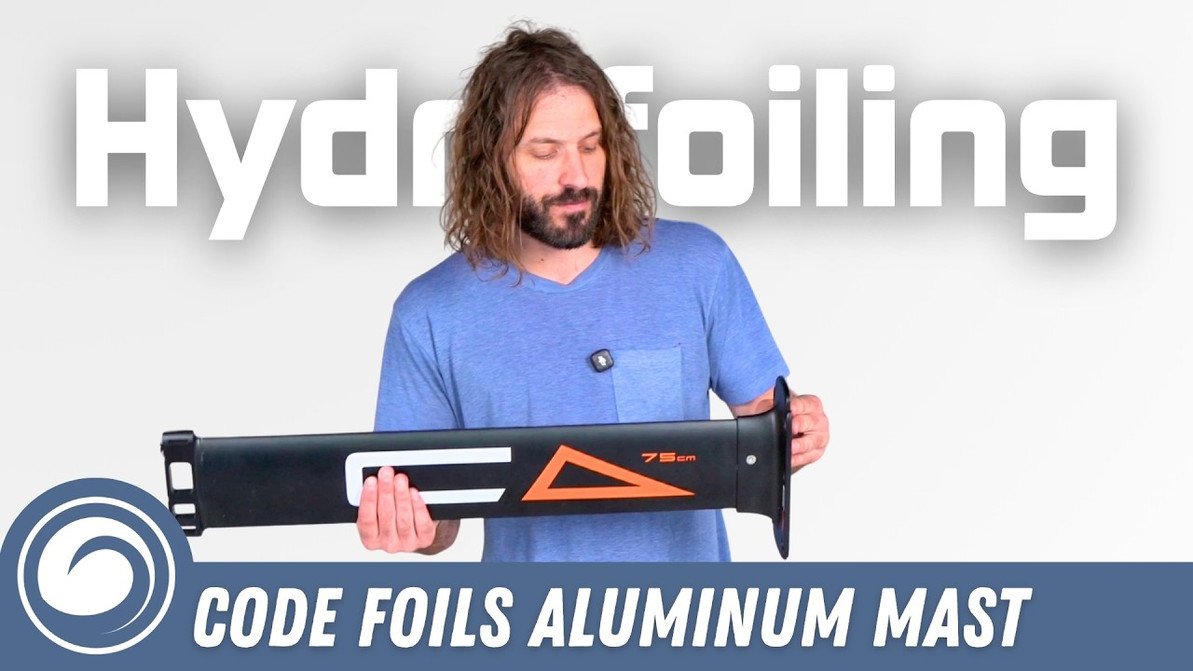
Tucker is here with a look at a brand new product: the Code Aluminum Mast. In the past, Code has only offered carbon fiber and high-modulus carbon fiber options. With this new release, they're reaching down to make their kits more affordable, accessible, and durable for riders who are hard on their gear. We've been hoping for this one for a long time, and Tucker walks through all the finer points of the mast, plus why you might want to choose it over shelling out the cash for carbon.
Stiffness and Durability
The Code Aluminum Mast is very robust and incredibly stiff. Compared to some other aluminum offerings on the market, which tend to be a little lighter and more flexible, this one has been engineered around the latest high-aspect designs. It has the stiffness to ride the biggest Code foils in the lineup, all the way up to the 1725, handling them with ease.
For new beginner riders and progressing riders on bigger foils, having a really stiff setup is a lot more important than having the absolute lightest or sleekest setup. Code has managed to create an extraordinarily durable, stiff, and high-performance setup here.
Top Plate Details and Foil Drive Integration
Starting at the top plate, Code uses a two-bolt connection vertically through the top, plus a horizontal bolt to really snug up the plate and keep it extra stiff. That's crucial to make sure the mast acts as one solid piece. A lot of aluminum masts only connect through the top or are just potted in, which can lead to flex, cracking, or breaking off over time. This top plate is extremely stiff and low-drag for an aluminum setup, providing support you can rely on for high performance into the future.
Another great feature is that the top plate is removable for travel. Aluminum masts break down a little further than carbon masts, letting you pack them flatter when you're on the road.
The plate features drop-in slots using M8 bolts in the front and back. You might be wondering about the two holes right in the middle of the plate, though. Those are actually for Foil Drive. You can connect this mast directly to your Foil Drive unit, and it acts as one piece. Usually you only see this capability on integrated mast options, but Code built it right into their aluminum setup knowing a lot of riders will want that feature. It makes the assembly and handling of the whole unit so much easier.
The Aluminum Extrusion
The aluminum extrusion itself is quite robust, measuring roughly 19mm thick. It maintains a very sleek profile given that wider thickness, and it's incredibly stiff. Tucker notes he can't flex it by hand at all, whereas with most carbon masts, you can get a little flex. It's an incredibly stiff setup, and in terms of stiffness compared to their carbon masts, there's no compromise here.
Where the compromise does come in is the thicker foil section, which matters most at high speeds and for glide efficiency. In the low-speed range, the efficiency and glide of a thicker mast are mostly unchanged. At high speeds, though, you'll start to notice that additional thickness. This mast is best used for beginner to intermediate riders, or riders simply using a larger, slightly slower foil. If you're going to ride the fastest foils in the Code lineup, you can certainly do it on this aluminum mast, but you'll be sacrificing a little top-end efficiency and high-speed glide. If you want the absolute pinnacle of speed and efficiency, that's where the carbon masts come in.
Mast Foot and Fuselage Adapter
Moving down to the mast foot, this is a separate piece from the extrusion that integrates into the fuselage. Having this built correctly is super important for energy transfer and the stiffness of the total system, and Code absolutely nailed it. There are fingers that go up into the extrusion to help stabilize it, creating a very tight tolerance fit.
Two M8 bolts secure the adapter to the mast extrusion, and then you have your typical M6 bolts for the fuselage connection, just like any Code foil. That means the aluminum mast will plug and play perfectly with the Code carbon fuselage, exactly like the carbon masts do.

Modularity and Upgrading
You can buy these parts separately, or they're sold as a complete kit. The beauty of this modularity is that if you start with a 75cm mast and eventually want to progress to an 80cm, there's no need to buy another top plate and foot. You can just use your existing top plate and foot on a different size mast extrusion and be ready to go. It's a great way to progress to a bigger size or have multiple size options without a lot of extra spend.
Optional Cover
Code also offers a black cover for the aluminum mast, which you might recognize from their carbon masts. These covers are optional and don't come included with the aluminum mast. Because the aluminum is a bit more robust, you don't have to worry as much about micro-scratches. If you're semi-careful with your gear, you can just use the mast as is. If you want a protective coating for travel, the cover is a nice add-on available on the website. It even features a handy little pocket to store your hardware and tools.
Who's It For? Aluminum vs. Carbon
The big question for a lot of riders will be: do I go for the aluminum, spring for the carbon, or go all out for the high-modulus plus mast? That decision comes down to where you are in your progression, what size wings you're riding, your attitude toward durability, and your budget.
- New Riders: The aluminum mast is a very attractive option. It's affordable, incredibly durable, and gives you all the stability you need. Tucker is actually a fan of brand new riders having a little more momentum and ballast on their kit, which the aluminum provides. It also offers a bit more side-to-side stability because the chord thickness is relatively long throughout the whole extension of the mast, whereas the carbon masts are more tapered at the bottom.
- Heavy Riders: If you're a heavier rider, it makes a lot of sense to go with either the aluminum or the high-modulus plus mast—they'll provide the most stiffness.
- Lightweight Riders: Lighter riders can probably forgo the high-modulus plus and be really happy with a regular carbon mast or the aluminum option with a minimum spend, saving that money for other add-ons like different fuselages, front wings, or stabilizers.
- High-Performance Riders: If you progress quickly, want to ride bigger waves, ride faster, or use smaller wings at a high level of speed, then it might make sense to jump up to a carbon or carbon plus mast.
The MACkite Take
Code's Aluminum Mast is the first non-carbon mast in the lineup, and Tucker's take is that it's more than a budget alternative — it's a genuinely stiff, durable, Foil-Drive-ready mast with the same modular design that made the carbon masts easy to upgrade over time.
- Carbon-level stiffness, handles up to the 1725. Tucker can't flex this mast by hand at all, and it's engineered specifically around Code's latest high-aspect foils. The compromise isn't stiffness: it's that the thicker 19mm section trades a little top-end efficiency and high-speed glide for that durability. In the low-speed range, glide is basically unchanged.
- Foil Drive integration is built into the top plate. Two dedicated Foil Drive holes in the middle of the plate let you bolt the drive unit directly to the mast so it acts as one piece — a feature you'd normally only see on integrated masts. Big win for anyone running a Foil Drive setup.
- Engineered top plate connection is what makes the stiffness real. Two vertical bolts plus a horizontal bolt through the top plate, not just potted in or single-bolted like most aluminum offerings. That's what keeps aluminum from flexing, cracking, or breaking off at the top over time.
- Modular design saves money on future upgrades. Top plate and mast foot are separate pieces. Going from a 75cm to an 80cm later? Just buy the new extrusion — your existing top plate and foot transfer over. Same modularity as the carbon line.
- Who buys aluminum: new riders (durability + ballast for stability), heavy riders (stiffness), budget-conscious progressing riders (save spend for wings and stabs), and anyone hard on their gear. The step up to carbon is really about high-speed efficiency and lighter weight: if you aren't chasing that, aluminum wins on value.
MACkite Subscription Links:
YouTube | Instagram | Spotify Oddcasts
Contact MACkite Below:
800.622.4655 | Kiteboarder@MACkite.com | LIVE Chat Messenger

Recent Posts
-

Ride Engine Air Box Mini Review
The Brazilian Brothers are back to bring you a review of the brand new Ride Engine Air Box Mini. T …30th Sep 2026 -

Foil Drive MAX+ Review
Ryan and Hunter have been testing the all-new Foil Drive MAX+. This new unit is officially replaci …24th Sep 2026 -
Foil Drive MAX+ Overview: 650Wh Battery and V3 Remote
Ryan has an exciting delivery from Foil Drive: the all-new Foil Drive Assist MAX+. He is unboxing …23rd Sep 2026