
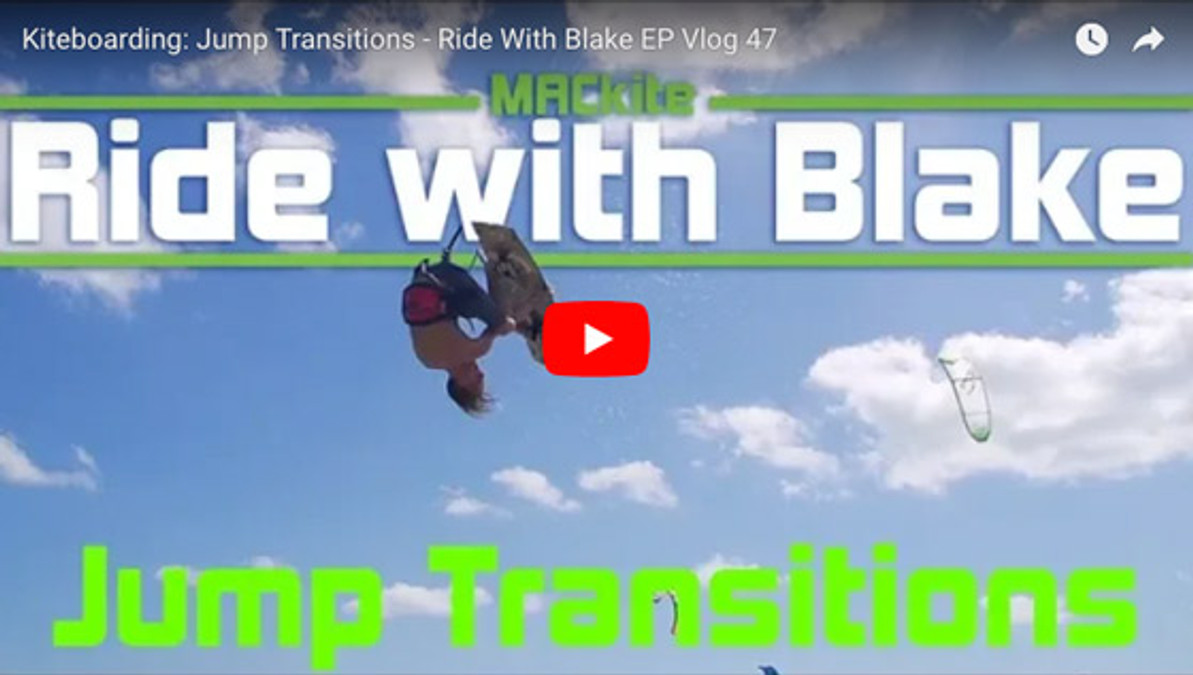
Kiteboarding Jumping Transition - Ride with Blake
If you can do a transition and jump, then you are ready for this trick!
4 Printable Steps for the Beach
Step One: Start Small
The smaller you go at first, the easier this trick is. It should feel similar to a regular transition except your doing it a few inches or feet off the water. This is going to help you build a good foundation to progress this trick into bigger variations that require more height and time.
Step Two: Pop Hard & Early
You will want to stomp your back foot down hard and almost jump off the water for this one. You stomp down right as you are sending your kite towards noon. Sometimes people over send their kite on jumps, yet for this trick, you need to keep the kite steady at noon throughout the jump. This will help with not only your body position but the timing of the trick in the next step.
Tip:
- Keep Both Hands on the center of the bar and pay attention to where your kite is in the sky.
Step Three: Timing
Right as you reach the apex of your jump, your kite should still be at noon. You'll feel yourself starting your decent. this is when you want to pull hard on your bar in the direction you would like to go. The kite will dive down and pull your body forward. Basically reorienting you to your new direction of travel.
Tips:
- Stay compact, keep those knees bend and pulled up.
Step Four: Body Positioning
This step is part of the timing of the trick. Right as you come to the apex of your jump, unlike many tricks, you want to point your new front leg forward and bring your back knee into your chest. Just like when doing a transition on the water but exaggerated in the air. When you dive the kite and it pulls you forward, you will be positioned to land correctly and ride in the other direction.
Tips:
- Bring your new back leg into your chest.
- Point your board downwind towards your kite as it pulls you through. This will give you a smooth transition.
Step Five: Go Bigger
Now that you've put your time in and have the trick dialed, it's time to go big. Go into the trick with more speed, send the kite harder, pop harder. Just remember you need to exaggerate everything more when going big. The biggest difference here is you may have to actively fly the kite now rather than parking it at noon.
Tips:
- Pay attention to the kite and fly as necessary
Step Six: Add Tricks
Save this step until you've mastered the trick. Now all you have to do is incorporate tricks you already know. It could be a grab, and inverted grab, any variation of the rolls. You can even incorporate downloops to really stylize the trick.
If you don't know any tricks, give our Ride with Blake Playlist a watch on youtube and learn a few. All you have to do is add these steps to the trick. It's as simple as that!
Blake's Gear Picks
Many of you have been asking about my 2018 Gear picks so I'm going to include a few links.
KITES
Cabrinha Switchblade | Cabrinha Contra
BOARD
HARNESS
 Blake Olsen
A Michigan boy through and through (even though he was born in Saudi Arabia), Blake is a youth with a lifetime of experiences and adventures. Not only that, he's passionate about sharing his zest for life with others. He is proficient at many fields, including kiteboarding and acting as concierge to any who simply ask. Looking for an adventure? Well, Blake is your guy. From sailing the Gulf and the Caribbean to backpacking Hawaii and Southeast Asia, he knows his stuff and can make your vacation into an adventure.
Instagram: @BlakeTheOlsen
Facebook: BlakeOlsen
Recent Posts
-

Interview with Stig: Big Air, Naish Loyalty & Life Beyond Kiting
Rubens: What's up, guys? It's the Brazilian Bros from MACkiteboarding, and today we've got a very …26th Mar 2026 -
One Board, Every Session | Why We're Stoked on the Omen Emissary
If you've been searching for a single board that can handle light-wind winging, parawinging, prone …25th Mar 2026 -

Reedin HyperModel Kite Review: Fast Loops and Big Air Performance
The HyperModel was developed in collaboration between Reedin and Brainchild. Ralf Groesel, Damien …25th Mar 2026