
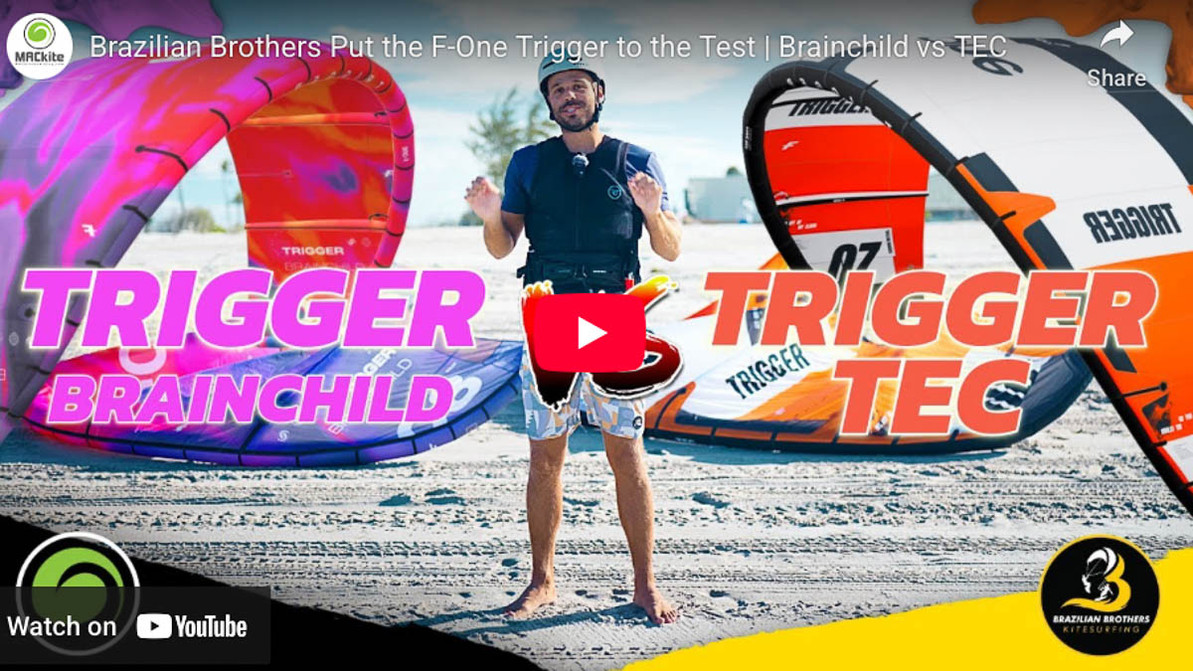
F-One Trigger TEC vs Brainchild | Performance Tested in Brazil
When two kites share the same name, the same designer, and the same big air DNA, but are built on completely different platforms, it’s worth slowing down and taking a deeper look.
After spending weeks riding both models in strong Brazilian conditions, the Brazilian Brothers set out to answer one key question: “Which version of the Trigger truly delivers when it comes to big air, hang time, and kite loop progression?”
In this detailed breakdown, we’ll unpack the differences between the F-One Trigger Brainchild and the F-One Trigger TEC, explore how they feel on the water, and help you determine which model best suits your riding level and progression goals.
Same Name | Completely Different Platforms
At first glance, both kites carry the “Trigger” name and are designed by legendary kite designer Ralf Gröesel. That’s where the similarities largely end.
Trigger Brainchild
- Manufactured at Brainchild Production in North Macedonia
- Built using ProWeld technology
- Significantly reduced leading edge diameter
- 8m weight: 2.56kg
Trigger TEC
- Produced at the F-One factory
- Does not use ProWeld
- Built with DL1 140 canopy material
- 8m weight: 2.84kg
That 280g weight difference in the same size kite may not sound dramatic on paper—but in the air, it’s noticeable.
Construction Differences | Why Weight Matters
The Brainchild’s ProWeld construction allows for:
- Smaller leading edge diameter
- Reduced Dacron usage
- Lower overall weight
- Increased responsiveness
The result is one of the lightest five-strut big air kites on the market in its class.
By contrast, the Trigger TEC follows a more traditional construction approach. It’s still a performance five-strut platform—but with more structure, more material, and more bar feedback.
Neither construction is inherently “better.” The real question is how those philosophies translate into riding characteristics.
Bar Feel | Light and Reactive vs Stable and Feedback-Rich
One of the most immediate differences between the two kites is bar pressure.
Trigger Brainchild
- Light bar pressure
- Highly reactive
- Extremely fast turning
- Small inputs create an immediate response
This kite feels alive in your hands. It moves quickly across the window and reacts instantly to steering inputs.
Trigger TEC
- Heavier bar pressure
- Slower turning speed
- Strong positional feedback
- More planted feel in the window
The added bar pressure makes it easier for developing riders to feel exactly where the kite is at all times. That extra feedback can build confidence during rotations and board-offs.
For experienced riders chasing performance, the lighter feel of the Brainchild creates less fatigue and allows quicker input during loops and redirects.
Jumping Performance | A Surprisingly Even Match
In terms of pure vertical lift and hang time, both kites deliver.
The Brazilian Brothers scored them essentially even in:
- Explosive vertical pop
- Float
- Second lift after loops
- Controlled landings
Both kites generate excellent height and extended glide. Where they differ is in how they get you there.
Trigger TEC | Larger Sweet Spot
The TEC’s slightly slower turning and larger sweet spot make it:
- More forgiving
- Easier to time takeoffs
- Less punishing on imperfect technique
Even if your send isn’t perfectly dialed, the TEC helps you get vertical and floaty.
Trigger Brainchild | Precision and Speed
The Brainchild requires cleaner input, but rewards it with:
- Faster window travel
- More aggressive send
- Snappier response
For riders with solid timing, it feels sharper and more dynamic.
Hang Time and Loops | Where the Gap Widens
When the conversation shifts to looping, the difference becomes clear.
Trigger Brainchild | The Loop Progression Machine
- Faster pivot
- Quick recovery
- Minimal yank through the loop
- Fast climb back overhead
This combination makes it extremely friendly for kite loop progression. You get speed and power without excessive pull, and the kite recovers quickly above you.
For riders working on:
- First kite loops
- Higher loops
- Controlled heli loops
- Combining loops into big air runs
The Brainchild stands out as the stronger tool.
Trigger TEC | Stable but Slower
The TEC loops predictably, but:
- Turns slower
- Takes longer to climb back overhead
- Feels less reactive
It still offers low yank through the loop, which makes it approachable—but it doesn’t deliver the same quick recovery that aggressive progression riders want.
Ease of Use | Who Feels More Comfortable
Interestingly, both kites were rated equally in overall ease of use, but for different reasons.
Why the TEC Feels Easier
- Larger jumping sweet spot
- More bar feedback
- Smoother takeoffs
- Forgiving rotation timing
This makes it an excellent option for riders who are:
- Not yet consistently hitting 10m jumps
- Working on controlled rotations
- Dialing board-offs
- Building big air fundamentals
Why the Brainchild Feels Easier for Progression
- Lighter on the arms
- Faster turning
- Faster loop recovery
- More dynamic response
If you’re already comfortable boosting near or above 10m and want to level up your looping game, the Brainchild simplifies advanced progression.
Weight Breakdown | Real-World Impact
8m Trigger Brainchild: 2.56kg
8m Trigger TEC: 2.84kg
That 280g difference:
- Reduces swing weight
- Increases turning speed
- Improves responsiveness
- Makes the kite feel more agile
In stronger wind—like the Brazilian test conditions—lighter weight translates directly into quicker movement and less inertia through loops.
For advanced riders, that responsiveness feels significant.
Who Should Choose Each Kite
Choose the Trigger Brainchild If
- You’re already jumping around 10m or higher
- You want to improve kite loops
- You value lighter bar pressure
- You prefer fast, reactive handling
- You want top-end performance
Choose the Trigger TEC If
- You’re building your big air foundation
- You prefer stronger bar feedback
- You want a forgiving jumping sweet spot
- You’re working on board-offs and rotations
- You value stability over speed
Both kites are excellent in their own lane. The choice depends entirely on your current level and where you want to go next.
Final Verdict | Which One Wins
For the Brazilian Brothers, the winner was clear. The Trigger Brainchild is their favorite. The lighter bar pressure, faster turning speed, and superior loop recovery make it a true progression tool for riders pushing their limits.
That said, the Trigger TEC remains an excellent option—especially for riders not yet consistently boosting into double-digit meters.
This isn’t about one kite being good and the other being bad. It’s about choosing the right platform for your stage of progression.
Key Takeaways
- Same designer, completely different construction platforms
- Brainchild is lighter and faster
- TEC offers more bar feedback and forgiveness
- Both jump exceptionally well
- Brainchild excels in looping and recovery
- TEC is ideal for developing big air riders
- Rider level determines the right choice
We’re Happy to Help!
If you’re still unsure which Trigger fits your riding style, send us a quick email, and we’ll help you dial it in.
Email: Kiteboarder@MACkite.com
Recent Posts
-

One Board, Every Session | Why We're Stoked on the Omen Emissary
If you've been searching for a single board that can handle light-wind winging, parawinging, prone …25th Mar 2026 -

Reedin HyperModel Kite Review: Fast Loops and Big Air Performance
The HyperModel was developed in collaboration between Reedin and Brainchild. Ralf Groesel, Damien …25th Mar 2026 -

Prepping Your Waydoo eFoil After Winter Storage
After a long winter, your eFoil might have sat untouched for a few months. Before you rush to the …25th Mar 2026