
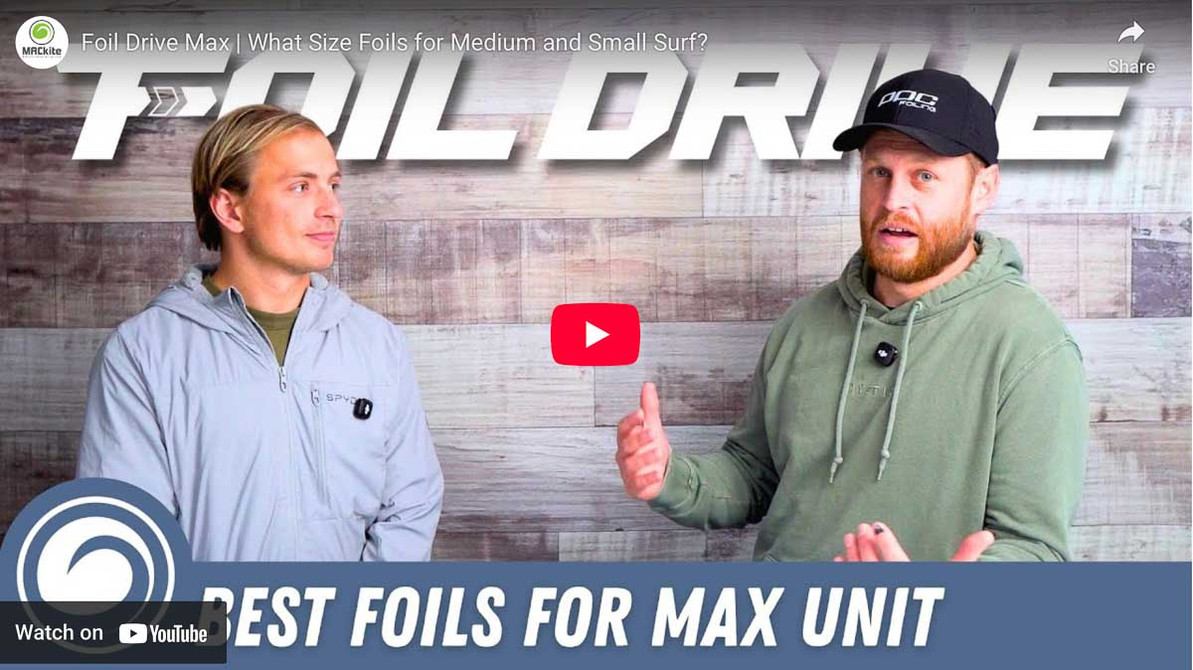
Foil Drive Max | Best Foil Sizes for Every Condition
Riding the Foil Drive Max opens up an entirely different way to approach foiling—especially in a place like the Great Lakes, where conditions can swing wildly from glassy summer days to fast-moving, overhead windswell. In this discussion, Ryan and Hunter break down how they think about foil selection based on real sessions on Lake Michigan, covering everything from one-foil solutions to full quiver setups.
Rather than chasing theory, this guide is rooted in what actually works when you’re dealing with tight wave periods, fast-moving swell, cold-water wetsuits, and the added weight and power of a motorized foil system.
Understanding Great Lakes Foil Conditions
Before discussing specific foil types, it’s important to understand the environment that drives these choices.
Great Lakes foiling is defined by:
- Short-period, fast-moving windswell
- Frequent knee-high to shoulder-high days
- Occasional overhead, powerful conditions
- Many marginal days where nothing else works
Unlike long-period ocean swell, Lake Michigan waves often move quickly and lack push. That puts a premium on efficiency, glide, and the ability to keep speed between bumps—especially when riding a Foil Drive.
Why Downwind Foils Are the Foundation
For both Ryan and Hunter, the first foil in any Foil Drive Max quiver is a high-aspect downwind foil.
What Makes Downwind Foils Work So Well
Downwind-style foils shine in Great Lakes conditions because they:
- Generate speed easily
- Maintain glide through weak sections
- Pump efficiently between bumps
- Track well in fast-moving swell
Ryan points to the North Foils Downwind 900 as his go-to “do-everything” foil. In Lake Michigan, it’s capable of handling knee-high days with almost no push, while still being stable enough to drop into shoulder-high waves when conditions improve.
These foils can feel fast—sometimes uncomfortably fast, but that speed is exactly what keeps you connected to rolling swell that would otherwise outrun you.
One-Foil Solution | High-Aspect Around 860–900cm²
If forced to choose just one foil, Hunter leans toward something slightly smaller but still high-aspect, like the Code Foils 860R.
Why This Size Range Works
Foils in the 860–900cm² range offer:
- Enough surface area to get up easily with the motor
- Excellent glide for small, weak days
- Manageable turning compared to massive high-aspect wings
- Confidence on steeper faces without blowing out
Hunter notes that this size can be dock-started for lighter riders while remaining playful enough to carve and pump. It’s a rare balance of speed, maneuverability, and forgiveness—especially valuable when conditions change mid-session.
Weight, Wetsuits, and Real-World Takeoff
One key factor often overlooked is rider weight plus winter gear.
Ryan (about 180lbs) and Hunter (about 160lbs) both emphasize that with thicker wetsuits and cold-water setups, a foil around 900cm² still gets up reliably using the Foil Drive Max.
Dropping much smaller than that:
- Makes flat-water starts harder
- Often requires wave assistance
- Reduces upwind ability
This is a major reason they avoid going too small on their primary foils, even on days that feel powerful.
When Surf-Style Foils Make Sense
While downwind foils dominate most sessions, there’s a clear place for lower-aspect surf foils—especially when conditions turn on.
Ideal Conditions for Surf Foils
Surf-style foils come out when:
- Waves are shoulder-high or bigger
- There’s plenty of power in the swell
- Turning and carving matter more than gliding
Ryan references the North SF Series, while Hunter mentions the Code 810X and 850S as examples of surf-oriented wings they trust on bigger days.
These foils trade glide for:
- Faster rail-to-rail response
- Tighter turning radius
- Better control on steep drops
On high-energy days, the loss of glide doesn’t matter—there’s more than enough wave power to keep you moving.
Why Surf Foils Aren’t Everyday Foils
Despite how fun surf foils are, both riders are clear: they’re not ideal for most Foil Drive Max sessions.
Limitations include:
- Harder flat-water takeoffs
- Less efficient pumping
- More reliance on wave energy
In Great Lakes conditions, where many sessions start in marginal swell, that efficiency gap matters. Surf foils shine on the right day—but they’re specialists, not daily drivers.
Going Big: Foils Above 1000cm²
There’s also a strong case for large, high-aspect foils in the quiver, especially during summer.
Hunter spends time on the Code 1130S, while Ryan bumps up even larger on ultra-flat days.
Why Bigger Foils Exist
Large foils are perfect when:
- It’s nearly flat with occasional bumps
- You want long, relaxed sessions
- You’re conserving battery life
- Pumping every wave sounds miserable
These foils:
- Lift effortlessly
- Stay on foil at lower throttle
- Extend ride time significantly
On days when there’s not enough wind for a kite or wing, the Foil Drive paired with a big foil unlocks sessions that otherwise wouldn’t happen.
Battery Efficiency and Session Length
One underrated benefit of larger foils is battery management.
Because big foils require:
- Less throttle to stay flying
- Fewer hard accelerations
- Less constant pumping
You end up using less battery overall. That means longer sessions and less stress about range—especially valuable when you’re far from shore.
The Ideal Three-Foil Quiver for Foil Drive Max
By the end of the conversation, Ryan and Hunter land on a simple but highly effective three-foil quiver.
1. High-Aspect Downwind Foil (≈860–900cm²)
- Primary foil for most sessions
- Best for small to medium conditions
- Fast, efficient, and versatile
2. Surf-Style Foil (≈800–850cm²)
- Reserved for big, powerful days
- Better carving and control
- Less glide, more responsiveness
3. Large High-Aspect Foil (≈1130–1300cm²)
- Flat or near-flat summer days
- Maximum efficiency and ease
- Long, relaxed sessions
This setup covers everything from glassy summer mornings to head-high fall swell without forcing compromises.
Key Takeaways
- Downwind foils are the backbone of Foil Drive Max riding
- Around 900cm² is a sweet spot for versatility and takeoff reliability
- Surf foils shine on powerful days but aren’t everyday tools
- Larger foils dramatically improve efficiency and session length
- A three-foil quiver offers the best balance for changing conditions
Final Thoughts
Foil selection for the Foil Drive Max isn’t about chasing the smallest or fastest wing—it’s about matching efficiency to real conditions. In places like Lake Michigan, where speed, glide, and adaptability matter more than raw power, the right foil can turn marginal days into unforgettable sessions.
If you’re unsure which foil makes sense for your weight, local conditions, or riding style, the team at MACkite has firsthand experience across the entire spectrum.
Have Questions?
If you’re trying to dial in your Foil Drive Max setup and want help choosing the right foil, feel free to reach out.
A quick email to Kiteboarder@MACkite.com can save you months of trial and error and get you on the water with confidence.
See you on the water!
Recent Posts
-

Reedin SnackPack | Why Kiters Are Calling it the Funnest Board in Years!
At the 2025 King of the Great Lakes event on Lake Michigan, the MACkiteboarding crew got an early …20th Mar 2026 -
Airush Ultra Team V5 Kite Review
The Ultra Team V5 from Airush takes the concept of kite foiling efficiency further, introducing a …19th Mar 2026 -

2026 F-One UHM Mast, T2 Connection, SK8 V3, and Eagle V2
The 2026 F-One hydrofoil lineup introduces meaningful upgrades aimed at improving stiffness, effic …11th Mar 2026