
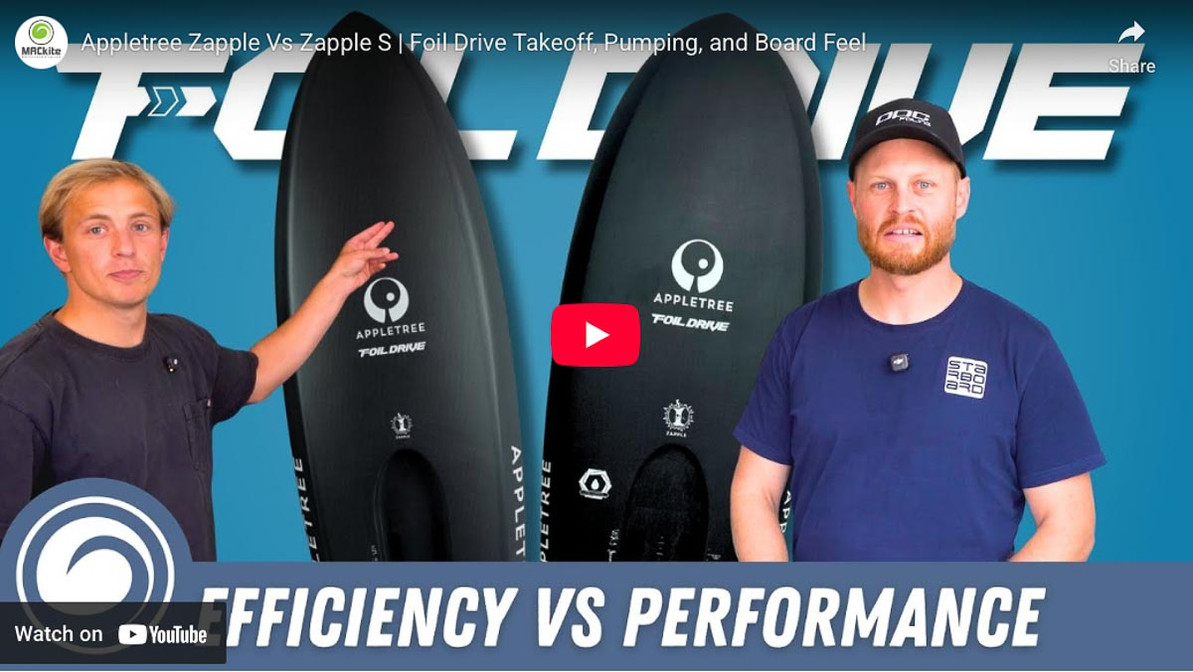
Appletree Zapple vs Zapple S | Which Foil Drive Board Fits You Best?
Foil Drive riding has pushed board design in a very specific direction. Efficiency, foil feel, and clean integration now matter more than ever, and few brands have leaned into that reality as effectively as Appletree Surfboards.
After riding both the Appletree Zapple and the Appletree Zapple S back-to-back for a full season, Ryan and Hunter from MACkiteboarding break down where these two boards overlap, where they clearly diverge, and, most importantly, who each board is actually for.
This is not a spec-sheet comparison. This is based on time on the water, real takeoffs, real pumping, and real Foil Drive sessions.
Shared Design DNA | What Both Boards Do Exceptionally Well
Before getting into size, performance, and rider skill level, it’s important to understand how similar these boards are at their core. The Zapple and Zapple S share several critical design elements that define their ride quality.
Foil Drive Trench Integration
Both boards feature a dedicated Foil Drive trench, which means the motor unit is recessed into the bottom of the board.
Key benefits of this design include:
- The Foil Drive unit sits closer to the rider’s feet
- Improved foil feedback and control
- Cleaner water flow across the bottom of the board
- Less drag compared to bolt-on motor configurations
From a ride perspective, both boards feel extremely connected to the foil. There’s no need to shim, pad, or modify the tracks to get a solid setup.
Closed-Cell Foam Construction
Appletree’s closed-cell foam construction is a major differentiator.
Practical advantages include:
- No vent plug required
- No water absorption if the board gets dinged
- You can ding the board and still ride it in the same session
- Consistent flex and performance over time
For Foil Drive riders launching from parking lots, rocky beaches, or less-than-perfect access points, this is not a small detail.
Traction, Leash, and Connectivity
Both boards feature:
- The same diamond-grip traction pad
- Integrated leash plug for surf and swell use
- Excellent mast track connectivity with no foam inserts required
From a setup standpoint, both boards are clean, simple, and hassle-free.
Size and Volume | Where the Boards Clearly Separate
This is the most obvious difference—and the one that drives almost every performance characteristic.
Zapple S Size Range
The Zapple S is offered in three compact sizes:
- 4’4”
- 4’6”
- 4’8”
The 46, which Ryan and Hunter spent most of their time on, sits around 30L. This places the Zapple S firmly in the performance-oriented category.
Zapple Size Range
The standard Zapple comes in four larger sizes:
- 5’0”
- 5’5”
- 6’0” (largest)
Mid-range sizes are roughly 45–50L, with the largest reaching up to 60L.
The takeaway is simple:
- The Zapple is a mid-length Foil Drive board
- The Zapple S is a compact, advanced-leaning board
Strap Inserts | A Key Zapple S Advantage
One notable feature exclusive to the Zapple S is strap inserts.
This opens the door to:
- Strapped riding
- More aggressive maneuvers
- Airtime and higher-energy riding styles
For riders who want to push beyond pure surf-style Foil Drive sessions, this is a meaningful upgrade.
Tail Shape and Rocker | Subtle but Intentional Differences
Visually, the boards share a similar rocker line and identical width in the sizes tested (18.5in), but there are small differences worth noting.
- The Zapple features a more pintail-inspired shape
- The Zapple S leans toward a squash-style tail
In practice, with Foil Drive installed, the tail shape is less influential than overall length and volume. Still, both boards feel balanced and predictable at speed.
Takeoff Performance | Efficiency vs Precision
This is where the riding experience truly separates.
Zapple | Fast, Easy, Forgiving
The Zapple’s larger size and longer profile make it noticeably easier to get on foil.
Key characteristics:
- Quicker takeoffs
- Less finesse required
- More forgiving in chop
- Easier standing transitions
When you squeeze the trigger, the Zapple rises onto foil quickly and smoothly, even in less-than-ideal conditions.
Zapple S | Demands Better Technique
The Zapple S is not difficult—but it is less forgiving.
Expect:
- More precise weight placement
- Better timing required on takeoff
- More sensitivity to surface conditions
In flat water or clean swell, it shines. In heavy chop, it asks more from the rider.
Pumping and Maneuverability | Where the Zapple S Shines
Shorter boards almost always pump better, and the Zapple S is no exception.
Zapple S Pumping Feel
- More responsive
- Less effort per pump
- Easier wave-to-wave connections
- Stronger “board feel” once flying
For riders focused on linking waves and minimizing motor use, the Zapple S has a clear edge.
Zapple Pumping Feel
The standard Zapple can absolutely pump, but:
- It requires more effort
- It feels more like a mid-length board
- It favors efficiency over quick cadence
This tradeoff is intentional and aligns with its role as a more accessible platform.
Overall Ride Character | How Each Board Feels Underfoot
After a full season of riding both boards, the differences become very clear.
Zapple Ride Summary
- More efficient overall
- Easier takeoffs
- More forgiving
- Ideal for learning trench boards
- Excellent first or second Foil Drive board
Zapple S Ride Summary
- Higher performance feel
- More maneuverable
- Better pumping efficiency
- Requires a cleaner technique
- Designed for experienced Foil Drive riders
Who Should Ride Each Board
Choose the Zapple If:
- You’re newer to Foil Drive
- You want easier takeoffs
- You ride in choppier conditions
- You want a versatile, confidence-building platform
- You’re looking for a first or second Foil Drive board
Choose the Zapple S If:
- You’re already efficient getting on foil
- You want better pumping and wave linking
- You ride cleaner swell or flatwater regularly
- You want more maneuverability and board feedback
- You’re progressing toward strapped or high-performance riding
Final Thoughts | Two Boards, Two Clear Roles
The Zapple and Zapple S are not competitors—they’re complementary tools.
The Zapple excels as a forgiving, efficient Foil Drive platform, making sessions easier and more consistent. The Zapple S rewards refined technique with better pumping, tighter turns, and a more direct connection to the foil.
Choosing between them isn’t about which board is “better.” It’s about where you are in your Foil Drive journey and what kind of riding you want to prioritize.
If you’re unsure which direction to go, please send us an email. We’re always happy to help you dial in the right setup based on your experience, conditions, and goals.
Email: Kiteboarder@MACkite.com
Recent Posts
-
Reedin Wing Foil Package Overview: Built to Learn, Designed to Progress
A Carefully-Crafted Entry Into Wing Foiling If you've been eyeing wing foiling but feel overwhelme …9th Apr 2026 -

Foil Drive's New Props Explained
For a long time, the black prop was just the prop. It came in the kit, it worked, and you rode it. …9th Apr 2026 -

Reedin SuperModel V6 Overview: Lightweight Aerolite Frame Upgrade on a Kite for Anyone
After more than five years on the market, the SuperModel has become the foundation of Reedin's lin …9th Apr 2026