
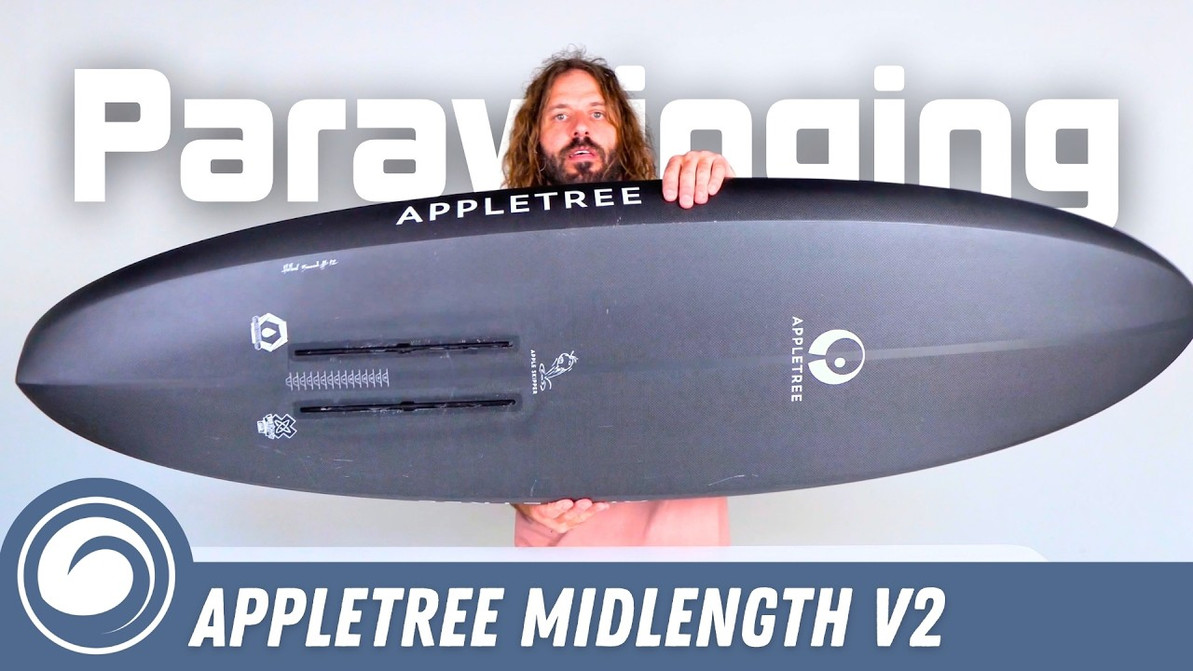
2026 Appletree Mid Length V2 Review
Tucker brings us a review on a highly anticipated new board from Appletree: the 2026 Appletree Mid Length V2 — the refined evolution of the original Skipper Midlength, now optimized for parawing and light-wind wing conditions. This specific review focuses on the 77L (6'1") model built in Appletree's new Hollow construction, breaking down the shape, features, and how it compares to their classic foam core build.
Construction Options: Hollow vs. High-Density Foam
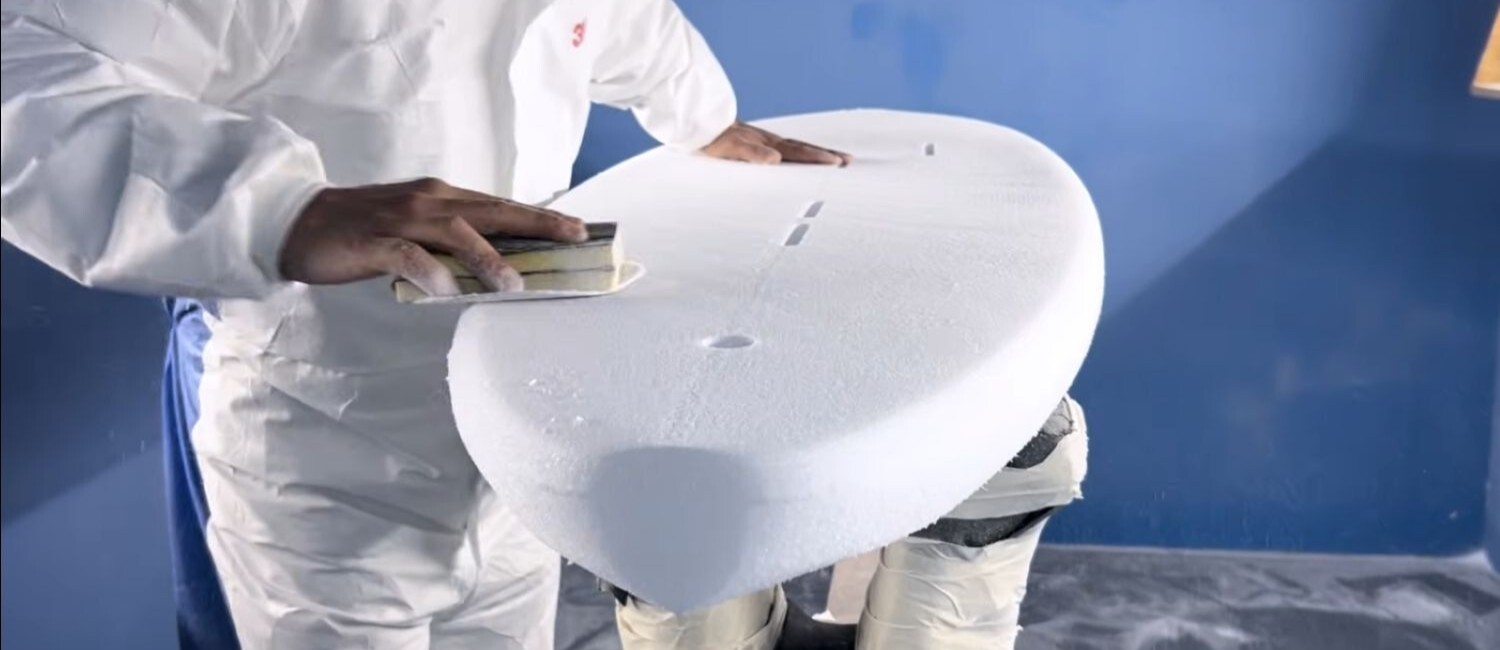
This board is available in two distinct constructions: the new Hollow construction and Appletree's traditional core, which uses their proprietary 50K closed-cell foam wrapped in 100% carbon fiber. Both options are completely waterproof. The hollow version has no core to absorb water, while the traditional version uses that closed-cell foam that won't take in water even in the heat.
The 77L Hollow construction board has a slightly different, more resonant sound to it. It's a bit lighter and extremely stiff compared to the standard construction. Appletree is expanding into new construction methods, and this hollow build offers an incredibly durable, stiff board that you can count on for a lot of longevity.
Shape and Design Breakdown
Hull and Rocker Line
The design is a true mid-length. It features a hull through the entirety of the board, with the exception of a flat space for your foil mounting. This hull design makes the board very forgiving on liftoff. It's smooth on takeoff and not sticky at all. When you're landing and redirecting, the board skips right back off the water and back onto the foil without putting on the brakes.
Looking at the rocker line, it has a fairly low entry for most of the board. Appletree describes the V2 as running a continuous rocker with a less pronounced nose kick compared to the original, which promotes steady speed and a consistent platform for adjusting your stance. There's a slight flip in the nose to ensure you aren't pearling as you pump, and out the tail, there's a bit of accelerated rocker that lets the board rock and pump up easily.
Chines and Directional Stability
The chines on this board are very hard and vertical throughout the entire length. Rather than creating lift, these vertical rails are designed to create deck width. Because of these hard rails, you get massive directional stability. The board doesn't slip and slide: it goes exactly where you point it, almost like a downwind board. That lets you gain a lot of speed and efficiency on your takeoff. Appletree also narrowed the outline by about an inch for V2 and pulled the bottom rail line inward by another inch on each side, reducing surface area to minimize drag for a cleaner release.
Intended Use: Wing and Parawing Crossover
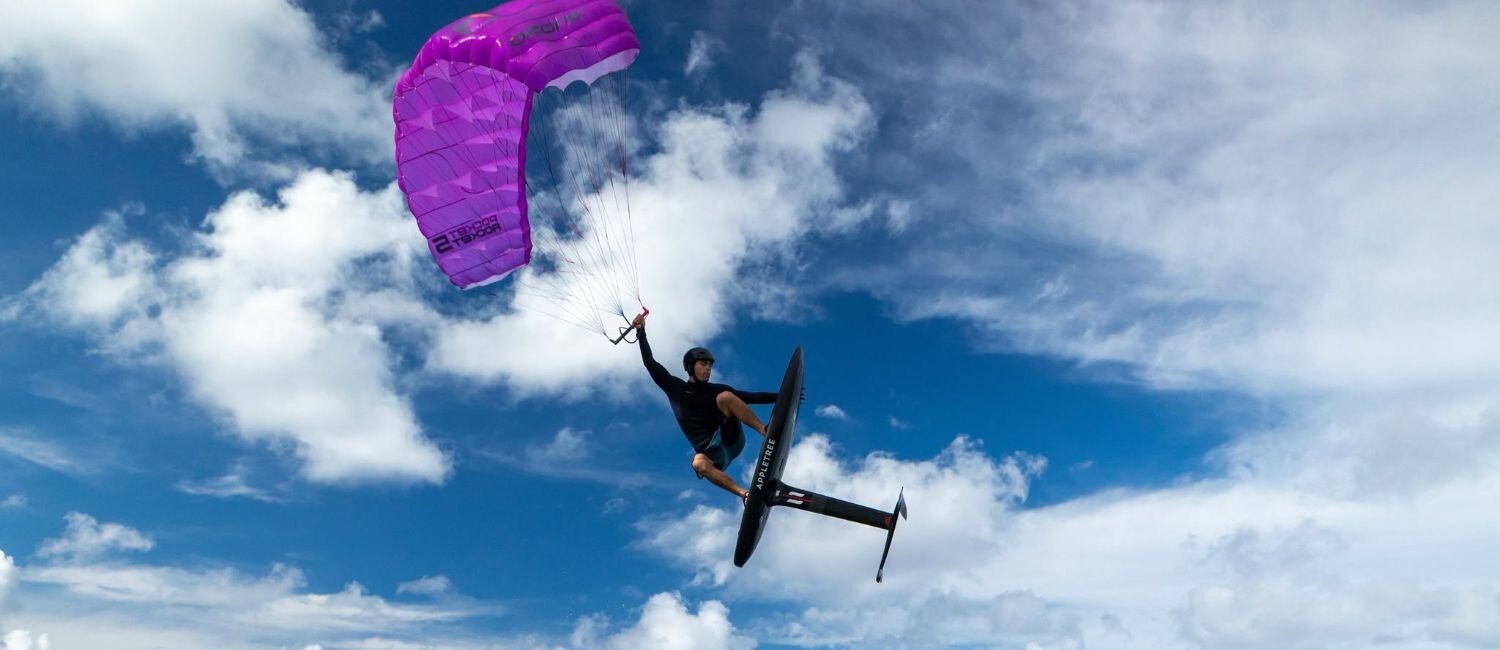
This board is designed around the intention of being a winging and parawing crossover. It makes a lot of sense for riders looking to get efficiency and easy pumpability off the water. When a parawing is pulling you more horizontally, rather than lifting you off the water like a standard wing would, this shape excels. It gives you the ability to pre-pump the board, get a rhythm going, and generate thrust before it even leaves the water, all without sinking the nose.
Deck Features and Traction Pad
The deck itself is quite flat, featuring a slightly recessed cockpit in the standing area that runs through the tail. There's a bit of doming in the nose to help shed water and put a little extra volume in front of your front foot. This is especially helpful for parawing, since as the wing pulls you over the nose, you can pump and rock without sinking the front end on takeoff. Appletree also repositioned the foil box on the V2 to create a natural nose-up trim, which pairs with that extra front-end volume for cleaner starts and more lift margin at speed.
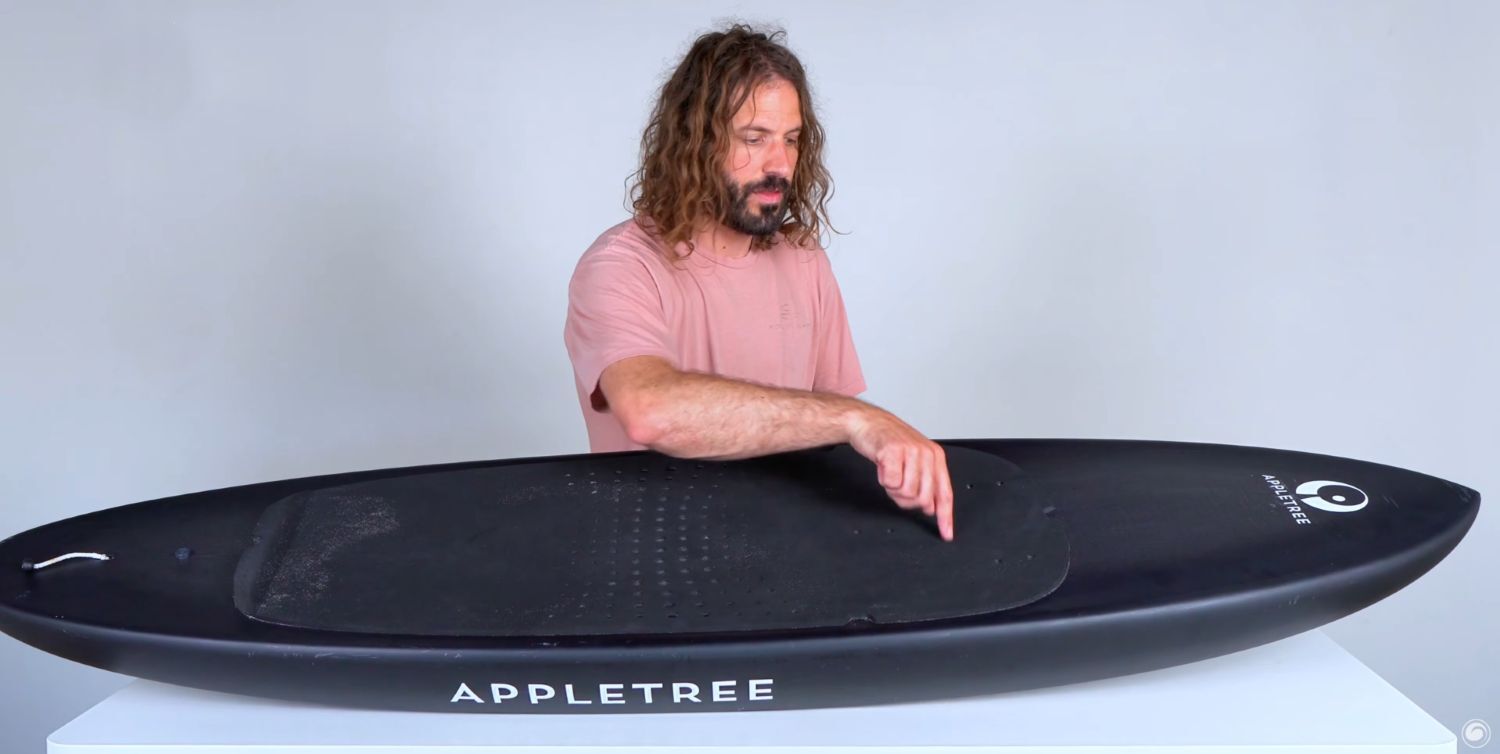
Appletree has included their new corduroy traction pad, which is really grippy and comfortable. It features dots down the middle that help reduce weight while providing a tactile reference for the center of your stance. The pad also includes a slight kick tail so your back foot doesn't slide too far back.
There are also subtle recesses on the deck near the strap inserts. These act as visual indicators for where your knees should go and mark the center line of the board, helping you set up perfectly rather than just staring at a blank canvas.
Hardware: Vents, Leash, and Straps
Because this is the hollow version, it features auto-venting plugs on the tail and the deck, along with a standard leash connection.
The board is quite lightweight and preserves that weight by eliminating rear strap options. It does offer one front strap option, allowing for a V-strap or a single strap, with two inserts for each. Important note: these inserts require M6 machine screws only. Do not use self-tapping screws on this board—it uses M6 machine screws similar to a twin-tip kiteboard or a snowboard.
Overall Impressions and Performance
Tucker notes that this board is a fantastic option for a one-board quiver mentality. The 77L (6'1") size is a great balance between a bigger light-wind board and a smaller high-wind board. It's light, responsive, and lets you improve your performance.
The narrower profile and pulled-in tail give you plenty of room to carve without touching down. If you do touch down, the board rebounds beautifully thanks to that refined rounded V that blends into a subtle flat section near the boxes. While the board is quite thick to keep the volume compact, it doesn't feel disconnected from the foil. Appletree walked that line nicely. The extremely stiff construction transfers energy efficiently, meaning there are no missed opportunities when pumping or maneuvering—it responds quickly and directly.
Which Construction Should You Choose?
When comparing the Hollow construction to the classic foam core, the choice largely comes down to your budget. There isn't a clear-cut reason that everyone needs to upgrade to the hollow version. The standard construction is phenomenal, proven, and highly durable, and Appletree's 50K closed-cell foam won't soak up water like standard EPS.
If you have the extra budget and want to take your setup a step further, though, the hollow board is lighter. Because of that weight savings, you can actually size down a couple of liters and maintain the same buoyancy. For example, the 77L hollow board has a similar buoyancy feel to an 80 or 82L board in the normal construction. If you can justify the extra spend, it's a beautiful, high-performance piece of equipment.
Mid Length V2 vs. Appleslice V4
Worth knowing if you're choosing between Appletree's two wing board lines: the Appleslice V4 remains their more versatile progression board, with larger sizes that are stable and beginner-friendly and smaller sizes for high performance. The Mid Length V2, in contrast, is a more specialized performance tool refined specifically for parawing and maximum light-wind efficiency. If you're intermediate to advanced and know you want to spend less time struggling to get up and more time on the foil, the Mid Length V2 is the pick. If you're still in progression mode across multiple disciplines, the Appleslice V4 covers more ground.
Who Is This Board Not For?
There are a couple of riders who might want to look elsewhere:
- Brand new riders: This board is a bit narrow, and the hard, vertical rail shape isn't the most stable for standing when you're just learning to balance.
- Foil Drive users: Tucker notes there's likely too much carbon in this board for a Foil Drive system. The carbon will block the signal unless you're using an antenna accessory.
The MACkite Take
The 2026 Appletree Mid Length V2 is a specialized efficiency tool, not a do-everything board — and that focus is exactly what makes it work so well for parawing and light-wind winging. Here's what stood out from Tucker's review.
- Purpose-built for parawing and light-wind winging. The narrower, longer V2 outline (about an inch narrower than the V1 with bottom rails pulled in another inch each side) reduces drag for cleaner release and faster acceleration. Continuous rocker, repositioned foil box, and forward volume distribution all point at the same goal: getting up sooner with less effort.
- Hollow construction is Appletree's new premium option. Lighter, extremely stiff, and durable, with the payoff that you can size down 3 to 5 liters and match the buoyancy feel of the standard build (the 77L hollow rides like an 80–82L in the classic foam core). Standard 50K closed-cell foam construction is still phenomenal; the Hollow upgrade is budget-dependent, not necessary.
- Hard vertical chines are the sleeper design feature. They create deck width without adding lift, delivering downwind-board-level directional stability so the board goes exactly where you point it during pre-pump acceleration.
- Deck details actually help you ride. The corduroy traction pad's center dots act as a tactile stance reference, the recessed knee indicators mark board center, and the slight kick tail keeps your back foot from sliding too far. Small refinements, meaningful over a full session.
- Two important cautions: use M6 machine screws only for the front strap inserts (not self-tappers), and skip this board if you're running a Foil Drive — the carbon layup blocks signal without an antenna accessory. Brand new riders should also look at the wider Appleslice V4 instead.
MACkite Subscription Links:
YouTube | Instagram | Spotify Oddcasts
Contact MACkite Below:
800.622.4655 | Kiteboarder@MACkite.com | LIVE Chat Messenger
Recent Posts
-

Foil Drive MAX+ Review
Ryan and Hunter have been testing the all-new Foil Drive MAX+. This new unit is officially replaci …24th Sep 2026 -
Foil Drive MAX+ Overview: 650Wh Battery and V3 Remote
Ryan has an exciting delivery from Foil Drive: the all-new Foil Drive Assist MAX+. He is unboxing …23rd Sep 2026 -

Wind Chasers Pt. 4: Nick Jacobsen Jumps From Tatajuba's Biggest Dune
When Nick Jacobsen rolls into Tatajuba, you know things are probably going to get interesting. The …22nd Sep 2026