
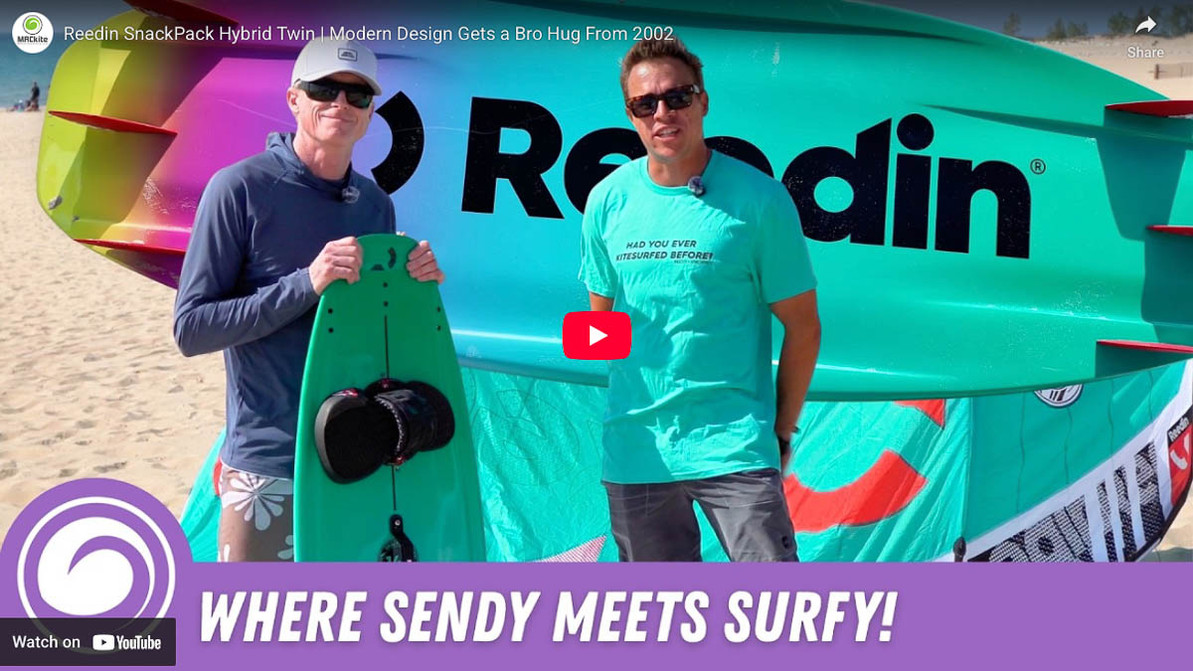
Reedin SnackPack | Why Kiters Are Calling it the Funnest Board in Years!
At the 2025 King of the Great Lakes event on Lake Michigan, the MACkiteboarding crew got an early look at one of the most interesting new concepts to hit kiteboarding in a while—the Reedin SnackPack. On paper, it sounds almost too simple to be compelling—combine a surfboard and a twin tip into one board. But once you start digging into the “why” behind it, and more importantly, how it rides, it becomes clear this is something different.
The SnackPack isn’t trying to replace your go-to gear. It’s trying to unlock a different kind of session altogether.
The Idea Behind the SnackPack
The origin of the SnackPack is pretty relatable. Most riders fall into one of two categories on any given day. You’re either on a twin tip, boosting, sending it, and maybe cruising back in without much going on. Or you’re on a surfboard, carving waves, but giving up that ability to load and pop, edge hard, and jump with confidence.
Kevin Langeree explains it simply: “Why not remove that trade-off?”
Instead of choosing your discipline before you hit the water, the SnackPack lets you decide in the moment. Ride out, hit a kicker, send a jump. Turn around, drop into a wave, and carve it back in. No gear change, no compromise in mindset—just one continuous, creative session.
That’s really the heart of this board. It’s not about doing one thing better than anything else. It’s about doing more things, in more conditions, with less friction.
How It Actually Rides
Concept boards can sound great in theory, but everything comes down to how they feel under your feet. And this is where the SnackPack starts to make a lot more sense.
On a wave, the board leans heavily into its surf-inspired design. The six-fin setup, three fins per side, creates a ton of grip through turns. Combined with a slightly thicker rail, it gives you that locked-in, carving sensation you’d expect from a directional. Bottom turns feel planted, and you can push through a carve without the board feeling loose or unpredictable.
Then you flip the switch.
Point it back out, edge into the water, and it starts behaving much more like a twin tip. It holds an edge well, releases cleanly, and gives you the confidence to load up and jump. That’s the surprising part—it doesn’t feel like a compromise when you go to boost. It feels familiar.
There’s definitely an adjustment period. Kevin even mentions that his first impression was a bit confusing. It didn’t immediately click what the board wanted to be. But once he got it into the right kind of session, especially on a downwinder with some swell, it all came together. That’s when it shifted from “interesting idea” to “this is what I want to ride.”
Not a Replacement—An Addition
It’s important to frame this board correctly. The SnackPack is not here to replace your twin tip or your surfboard.
If you’re a dedicated freestyle rider, you’re still going to want your proper twin tip. If you’re chasing clean, lined-up swell and pure surf performance, your directional is still going to be the call.
What the SnackPack does is fill a gap that many riders don’t even realize exists. Those in-between days. Mixed conditions. Sessions where you want to do a bit of everything but don’t want to overthink it or swap gear.
It’s a “grab it and go have fun” board.
And for a lot of riders, especially those not living in perfect wave zones, that might actually make it one of the most used boards in the quiver.
Sizing and What to Expect
One of the key things to understand with the SnackPack is sizing. You’re not going to ride your normal twin tip size.
The general rule of thumb is to go about 8–12cm larger than your standard twin tip. So if you typically ride something in the 133–136cm range, you’re likely looking at the 142cm or 146cm SnackPack.
That extra length helps in a few ways. It improves planing, gives you more stability when carving waves, and smooths out the ride in mixed conditions. It also helps bridge the gap between twin-tip efficiency and surfboard flow.
The available sizes 142cm, 146cm, and 150cm cover a wide range of riders, but all lean slightly bigger than what you might be used to.
Where This Board Really Shines
The SnackPack comes alive in fun conditions, but not perfect ones. Think:
- Onshore wind with some lump and bump
- Small to medium waves
- Days where there are kickers on the outside and rideable swell on the inside
These are the sessions where you’d normally feel like you’re compromising, no matter what board you choose. With the SnackPack, those trade-offs start to disappear.
It’s also a standout option for downwinders. The ability to carve swell, stay nimble, and still throw in a few jumps along the way turns what could be a mellow cruise into something a lot more engaging.
Kevin specifically calls this out as one of his favorite use cases, and it makes sense. The board encourages movement, creativity, and just messing around with whatever the ocean gives you.
Design Details That Make It Work
There are a few key design elements that really bring the concept together.
The six-fin setup is probably the most important. Having three fins per side gives the board the grip it needs to function like a surfboard when you’re on rail. It’s what allows you to commit to turns without sliding out.
At the same time, it still uses standard twin tip-style fins (50mm), and the setup process is familiar and straightforward. No complicated tuning required—just set it up and ride it as intended.
There’s also a moderate rocker line, which helps balance speed with control. Enough rocker to handle chop and allow for carving, but still efficient enough to get going and maintain speed.
Add in features like a grab rail and a handle, and you can tell there’s a bit of old-school influence baked in too. Board-offs, playful tricks, and mixing styles—it all fits the board’s personality.
Old School Meets New School
One of the more interesting themes that comes up around the SnackPack is this blend of old-school and new-school riding.
On one hand, you’ve got elements like board-offs, flowing carves, and just cruising with style. On the other hand, you’ve got powered riding, boosting, and using modern kite techniques.
The SnackPack doesn’t try to define itself as one or the other. It just gives you a platform to combine everything you’ve learned over the years into a single session.
That’s part of what makes it feel fresh. It’s not about progression in the traditional sense—it’s about rediscovering fun in a slightly different way.
Final Thoughts
The Reedin SnackPack is one of those products that might not make perfect sense until you actually ride it. It challenges the idea that you need to pick a lane every time you hit the water.
Instead, it invites you to do a bit of everything.
It’s not the most specialized board. It’s not trying to win in a single category. But it might end up being one of the most enjoyable boards to ride, especially on those everyday sessions where conditions are all over the place.
If your goal is to squeeze more fun out of your time on the water, the SnackPack is doing something very right.
Key Takeaways
- The SnackPack blends surfboard carving with twin tip jumping
- Best sized 8–12cm larger than your standard twin tip
- Excels in mixed conditions, onshore wind, and downwinders
- Not a replacement for your quiver, but a strong addition
- Built for riders who want versatility, creativity, and fun in every session
We’re Happy to Help!
If you’re thinking about adding the Reedin SnackPack to your quiver and want help dialing in the right size or setup, the team at MACkiteboarding is always happy to help.
Email: Kiteboarder@MACkite.com
Recent Posts
-
Wing Foiling Footwork: When (and Why) to Switch Stance for Better Riding
Your board stance can affect a lot of things when you're out on a wing and foil. Tucker and Jeff w …10th Apr 2026 -
Reedin Wing Foil Package Overview: Built to Learn, Designed to Progress
A Carefully-Crafted Entry Into Wing Foiling If you've been eyeing wing foiling but feel overwhelme …9th Apr 2026 -

Foil Drive's New Props Explained
For a long time, the black prop was just the prop. It came in the kit, it worked, and you rode it. …9th Apr 2026