
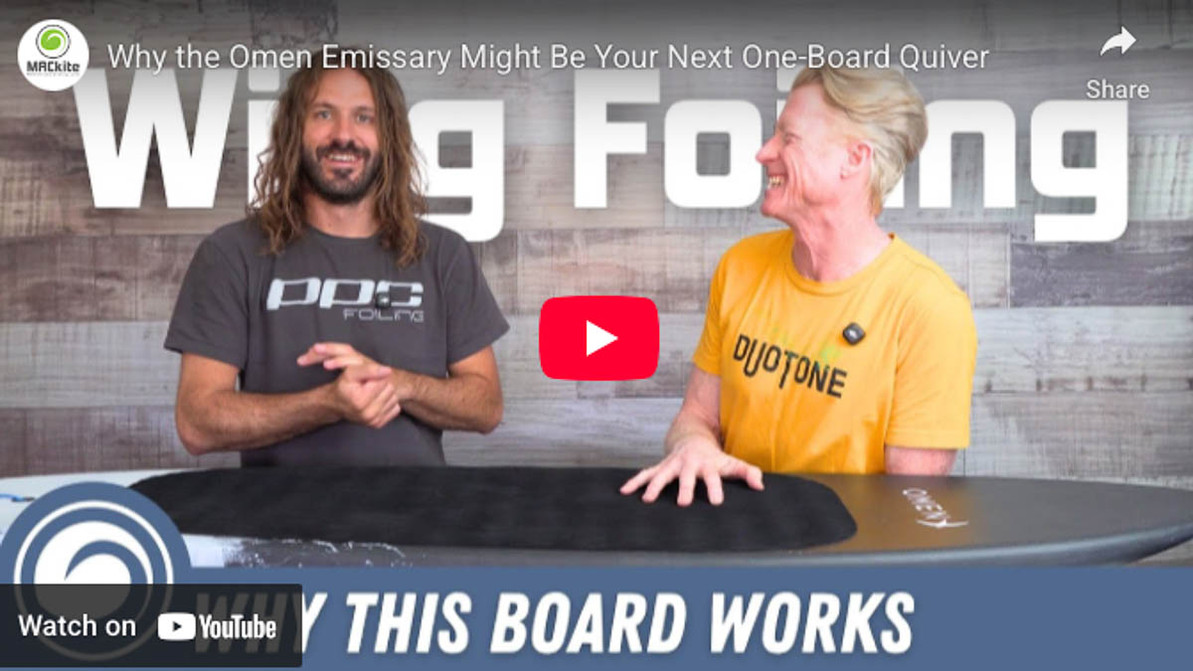
One Board, Every Session | Why We're Stoked on the Omen Emissary
If you've been searching for a single board that can handle light-wind winging, parawinging, prone foiling, and even Foil Drive sessions, the Omen Emissary deserves a serious look.
We've been putting it through its paces in a range of conditions, from glassy 9-knot summer sessions to overhead waves with 20-plus knots of breeze, and the results have been impressive enough to warrant a full breakdown.
What Is the Omen Emissary?
The Omen Emissary is a multi-discipline foil board built with a sleek, surf-inspired outline that leans toward efficiency without sacrificing feel. Manufactured at the AppleTree factory in Portugal, it's part of a lineup that now includes two new larger sizes—the 66L and 78L—expanding its appeal to a wider range of riders and conditions.
Think of it as the Swiss Army knife of the Omen lineup. It's drawn out, efficient, and designed to generate speed on the water whether you're underpowered on a wing or trying to pump into a wave on a prone setup.
How It Compares to the Omen Flux
If you've followed our previous content, you know we're big fans of the Omen Flux. The Emissary isn't meant to replace it, it's a different tool for different jobs:
- Omen Flux | Wider tail, more control of the foil, better leverage, and a surfy feel. A go-to for powered-up winging and prone when conditions cooperate.
- Omen Emissary | Longer, narrower, and more drawn-out. Designed to build speed efficiently in light wind or when parawinging demands more glide.
The Emissary essentially picks up where the Flux leaves off when winds drop or when you need that extra board speed to stay on foil.
Shape & Construction Breakdown
The Bottom Contours
The Emissary's hull is built for efficiency and control under load:
- Soft rails up front for smooth water entry and a forgiving feel
- Deep, wide chines that transition into harder rails through the back half
- Concave deck that keeps you connected to the foil with a locked-in feel
- Kicktail at the rear, useful for angling the board up during takeoff when your foil mast is positioned further forward
One thing we noticed immediately is that this board handles touchdowns well. The chines are aggressive enough that even when you catch a rail on a hard carve, it skims right off instead of catching and sending you over the nose.
Build Quality | AppleTree Construction
This is where Omen earns its reputation. Built at the AppleTree factory in Portugal, the Emissary features:
- High-density, closed-cell foam core that won't absorb water if you ding it
- A construction standard that lets you keep riding after a hit without worrying about waterlogging or core degradation
- Long-term durability—these are boards you can ride for decades, not seasons
When you're spending serious money on a foil board, you want to know it's going to hold up. The Emissary delivers on that front.
On-Water Performance
Light Wind & Efficiency
This is where the Emissary shines brightest. The longer, efficient outline generates board speed quickly, making it easier to get on foil early and stay there when the wind is marginal.
- Comfortable winging down to 9-10 knots on the 66L
- Gets up to speed fast and feels lighter than its size suggests
- That drawn-out shape "slings through the wind" cleanly, reducing drag as you accelerate
Wave Riding
You might expect a 6-foot board to feel cumbersome in waves, but the Emissary surprises here. Because you pilot it from the middle rather than the tail, the swing weight is manageable:
- The board swings around with less effort than expected
- Soft entry rails make it forgiving in choppy or breaking conditions
Parawinging
For parawinging, size matters more with this shape. The deeper chines and narrower profile mean the board will sink more readily when you're trying to hold the surface and hunt gusts:
- The 78L is better suited for parawinging in lighter or more variable conditions
- The 66L works for parawinging but wants more consistent power—roughly 16-17 knots minimum
- If you're regularly parawinging in 14-15 knots, go bigger
Foil Drive Compatibility
Yes, the Emissary works for Foil Drive sessions. The 66L is on the larger side for this discipline, but if you're building a one-board quiver that includes Foil Drive, it won't hold you back. The efficient shape and good board speed actually complement the Foil Drive well enough to justify the size.
Sizing Guide | Which Emissary Is Right for You?
This is where it gets nuanced, and honestly, where we see the most questions from riders. The Emissary lineup currently runs from 35L up to the newly added 78L, and each size serves a meaningfully different rider profile. Here's how we think about it:
Emissary 35L & 44L | Powered-Up Performance
These smaller sizes are purpose-built for riders who live in consistent, strong wind and aren't interested in compromising for light-air sessions. If you're already sorted on a light-wind board and want something that rips in 20-plus knots without feeling like you're dragging a barge, the 35L and 44L deliver.
- Best for lighter riders (under 150 lbs) or experienced riders in reliably powered conditions
- Not a good fit as a one-board quiver unless you're riding somewhere with consistent strong wind year-round
- The narrower, drawn-out shape still provides excellent foil control—you're not sacrificing feel for volume reduction
Emissary 55L | The Performance Sweet Spot
The 55L is where the Emissary starts to become a genuine quiver option for a wider range of riders. It sits closest to the Omen Flux 60 in terms of character and feel, which makes it a natural comparison point for anyone already familiar with that board.
- Ideal for riders in the 150-170 lb range looking for a performance-oriented one-board setup
- Handles powered-up conditions confidently while still getting on foil in lighter winds
- More of a "mini" shape feel with snappier response than the larger sizes
- If you're debating between the 55L Emissary and the Flux 60, know that the Flux offers more width for foil control and leverage, the 55L Emissary trades some of that for length and glide efficiency
- A strong choice if you want occasional light-wind capability but predominantly ride in 15-plus knots
Emissary 66L | The One-Board Quiver for Most Riders
The 66L is the size we find ourselves recommending most often, and after extensive on-water time, it's easy to see why. It's genuinely versatile across disciplines without feeling like it's making too many compromises in any direction.
- Best fit for riders in the 160-190 lb range
- Comfortable winging down to 9-10 knots—a serious advantage on those marginal summer days
- Handles powered conditions and downwind swell without feeling sluggish or hard to manage
- Works well for prone foiling given its surf-inspired shape and sleek outline
- Compatible with Foil Drive setups—slightly large for pure Foil Drive use, but won't hold you back if it's one of several disciplines in your rotation
- For parawinging, expect to want 16-17 knots minimum to stay comfortable on the surface
- Riders coming from a board in the 70L range should consider sizing down to the 66L—it rides larger than the number suggests
Emissary 78L | Built for Glide, Lighter Wind, and Parawinging
The 78L is the newest addition to the lineup and the most specialized size in the range. It's not trying to be all things—it's optimized for riders who need maximum efficiency on the water, whether that's chasing light-wind sessions or logging serious parawinging time.
- Best for heavier riders (185+ lbs) or anyone who regularly parawings in variable, lighter conditions
- The extra surface area lets you hold at water level and hunt gusts without the board wanting to sink between puffs
- In parawinging, the difference between the 66L and 78L is significant—the 78L keeps you in the game when the wind is inconsistent—the 66L requires more commitment and consistent power
- Also a strong option for riders who want to push their light-wind winging floor as low as possible
- At this size, the swing weight and overall feel still impress—it doesn't ride like a log despite the volume
General sizing advice: If you're building a one-board quiver around the Emissary, size up rather than down. A touch of extra volume in light air saves sessions. Being slightly overpowered on a bigger board is manageable, while being underpowered on a board that's too small is just frustrating.
One Minor Critique | The Deck Pad
The one piece of feedback worth mentioning is the deck pad. It's large, grippy, and high quality. But it's all black, which makes it difficult to quickly find foot placement during active sessions:
- No color contrast, stripes, or visual cues to orient your feet at a glance
- In big waves or high-speed conditions, a quick look down needs to tell you something useful
- An easy fix would be a contrasting stripe or a slight gap in the pad to create reference points
That's a minor gripe on an otherwise excellent board, and it's fixable with a dab of surf wax if it bothers you.
Frequently Asked Questions | Omen Emissary
Is the Omen Emissary good for beginners?
Not ideally. The Emissary's narrower, drawn-out profile rewards riders who already have foil time under their belt. If you're new to wing foiling or foil boarding in general, a wider board with more stability will get you progressing faster. Once you've got your foil time dialed and you're comfortable in a range of conditions, the Emissary starts to make a lot of sense.
How does the Emissary compare to the Omen Flux?
They're complementary boards, not competitors. The Flux is wider, offers more foil control and leverage, and has a surfy, tail-driven feel that works beautifully in powered conditions. The Emissary is longer, narrower, and built to generate speed in lighter wind or when parawinging demands more glide. If you had to pick one, think about your most common wind window. Plenty of wind most of the time? The Flux. Light and variable with parawinging in the mix? The Emissary.
Can I use the Omen Emissary for prone foiling?
Yes, and it's actually well-suited for it. The surf-inspired shape and sleek outline make it easier to catch waves and build speed for takeoff than a lot of dedicated wing boards. If prone foiling is a regular part of your rotation, the Emissary handles it naturally without feeling like a compromise.
What size Emissary should I get if I want one board for everything?
Size up. If you're between two sizes, go bigger. The Emissary's shape means it rides more efficiently than its volume suggests, and having a bit of extra float on light-wind days is worth far more than the minor adjustment needed on powered days. For most riders in the 160-185 lb range, the 66L is that one-board answer. Heavier riders or those prioritizing parawinging should look seriously at the 78L.
Is the Emissary worth the price given AppleTree construction?
Yes. AppleTree-built boards from the Portugal factory are in a different category of durability than most production foil boards. The high-density, closed-cell foam core means a ding doesn't turn into a waterlogged, delaminating nightmare. These boards hold their performance characteristics for years—potentially decades. When you factor in the long-term value, the price per session starts looking very reasonable compared to boards that need replacing every few years.
What wind range does the Emissary cover for winging?
On the 66L, you're looking at comfortable winging from roughly 9-10 knots on the low end up through powered conditions in the mid-20s. The 78L pushes that low-end floor down even further. For parawinging specifically, plan on needing 14-15 knots minimum on the 78L and 16-17 knots on the 66L to stay comfortable at the surface.
Does the Emissary work with Foil Drive?
Yes. It's not the most purpose-built Foil Drive board given its length, but it works well and the efficient shape actually complements the assist nicely. If Foil Drive is one of several disciplines you're rotating through rather than your primary focus, the Emissary won't hold you back.
Key Takeaways
- The Omen Emissary is a genuine crossover board built for winging, parawinging, prone foiling, and Foil Drive
- Its sleek, efficient shape generates speed quickly in light winds and handles waves better than its length suggests
- AppleTree construction means serious long-term durability—this is a board you invest in once
- Size up if you're planning a one-board quiver, the extra volume on the low end is worth it
- The 66L is the sweet spot for most average-weight riders— the 78L makes more sense if parawinging in lighter air is a priority
- The Emissary and the Omen Flux are complementary, not competing—choose based on your wind window and riding style
- Minor feedback: the all-black deck pad could use better visual foot placement cues
Questions? We're Happy to Help!
Still working through which size or setup makes the most sense for your conditions and quiver? Drop us a line—we're happy to talk through it based on your weight, local wind, and what disciplines you're prioritizing.
Reach out at Kiteboarder@MACkite.com and let's figure out the right board for you.
Recent Posts
-
One Board, Every Session | Why We're Stoked on the Omen Emissary
If you've been searching for a single board that can handle light-wind winging, parawinging, prone …25th Mar 2026 -

Reedin HyperModel Kite Review: Fast Loops and Big Air Performance
The HyperModel was developed in collaboration between Reedin and Brainchild. Ralf Groesel, Damien …25th Mar 2026 -

Prepping Your Waydoo eFoil After Winter Storage
After a long winter, your eFoil might have sat untouched for a few months. Before you rush to the …25th Mar 2026