
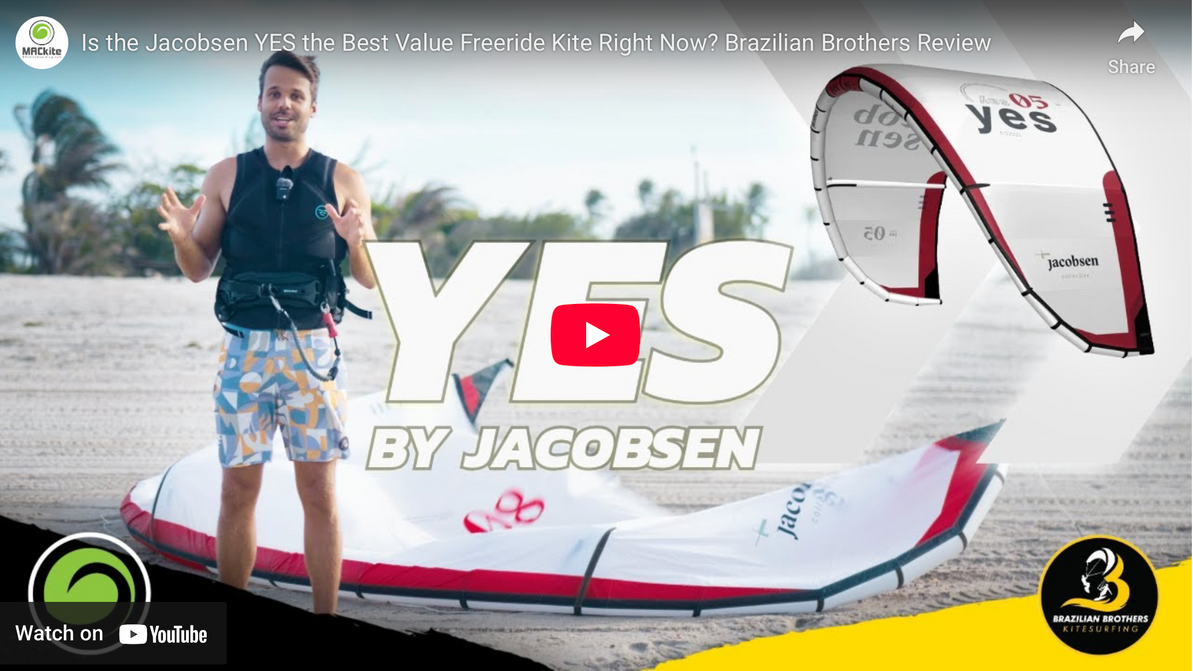
Jacobsen YES Kite | Jumping, Stability, and Value
Introduction
In this review, the Brazilian Brothers share their long-term impressions of the Jacobsen Project YES Kite after months of testing in Brazil. The focus is on the things riders actually care about—jumping, looping behavior, stability, ease of use, and overall value—so readers can quickly decide whether this kite fits their riding style and goals.
Who This Kite Is For
The YES Kite is positioned as a versatile, confidence-building freeride kite that punches above its weight in jumping while remaining approachable for progressing riders. It’s not aimed at extreme kiteloop specialists, but it offers enough performance to keep experienced riders entertained.
- Beginner to intermediate riders looking for stability and progression
- Riders focused on jumping and hangtime rather than pure freestyle
- Kiters who want strong performance without premium pricing
- Riders comfortable with some bar feedback
- Not ideal for riders seeking ultra-fast, low-yank loop kites
How It Rides
On the water, the YES Kite feels predictable and confidence-inspiring. The standout trait is how easy it is to jump and land smoothly, even when conditions aren’t perfect.
- Strong vertical lift with a noticeable “second lift” at jump apex
- Respectable hangtime for a three-strut freeride kite
- Soft, controlled landings
- Excellent low-end power helps generate height in lighter wind
- Large sweet spot makes timing jumps easier
Jumping Performance
Jumping is where the YES Kite truly separates itself from many other three-strut freeride kites. The testers were surprised by how well it performs in both height and hangtime.
- Outperforms many kites in its freeride category
- Consistent lift even when the wind is not fully powered
- Easy to boost without precise timing
- Encourages progression for riders working on bigger airs
Looping Characteristics
Looping performance is solid but comes with an important caveat. The YES Kite delivers noticeable yank, which can be thrilling—but also demanding.
- Loops are not as fast as some high-performance freestyle kites
- Generates strong pull through the loop
- Requires deliberate bar input for tighter loops
- Best suited for riders already comfortable with looping
- More technical feel compared to lighter, faster loop-focused kites
Stability and Ease of Use
Stability is one of the YES Kite’s biggest strengths. The kite remains composed even when pushed, making it easier for riders to focus on technique rather than kite management.
- Extremely resistant to front stalls
- Very stable in the air, even when oversheeted
- Builds confidence for riders learning new tricks
- Easy to control during jumps and landings
- Moderate bar pressure provides clear feedback
Strengths and Trade-Offs
The video closes with a clear-eyed look at where the YES Kite shines—and where riders should be aware of its limitations.
Key strengths
- Significantly lower price than comparable kites
- Exceptional stability
- Strong jumping and hangtime for a freeride kite
Potential trade-offs
- Looping requires experience due to the strong yank
- Moderate bar pressure may feel heavy to riders who prefer very light feedback
Specs (As Discussed in the Video)
The review focuses on ride feel, but several core design elements are clearly outlined.
- Three-strut, all-around freeride kite
- Moderate to high aspect ratio
- Designed for jumping, looping progression, and stability
- Positioned at a lower price point than comparable market options
Conclusion
The Jacobsen Project YES Kite is a compelling option for riders who want a stable, easy-to-jump freeride kite without paying top-tier prices. It delivers impressive lift and hangtime, excellent stability, and enough looping performance to keep progressing riders engaged. If saving money while still getting strong on-water performance matters to you, the YES Kite is well worth a look.
If you have questions about whether the Jacobsen Project YES Kite is right for you, reach out to us at Kiteboarder@MACkite.com.
Recent Posts
-

Reedin Wing Foil Package Overview: Built to Learn, Designed to Progress
A Carefully-Crafted Entry Into Wing Foiling If you've been eyeing wing foiling but feel overwhelme …9th Apr 2026 -

Foil Drive's New Props Explained
For a long time, the black prop was just the prop. It came in the kit, it worked, and you rode it. …9th Apr 2026 -

Reedin SuperModel V6 Overview: Lightweight Aerolite Frame Upgrade on a Kite for Anyone
After more than five years on the market, the SuperModel has become the foundation of Reedin's lin …9th Apr 2026