
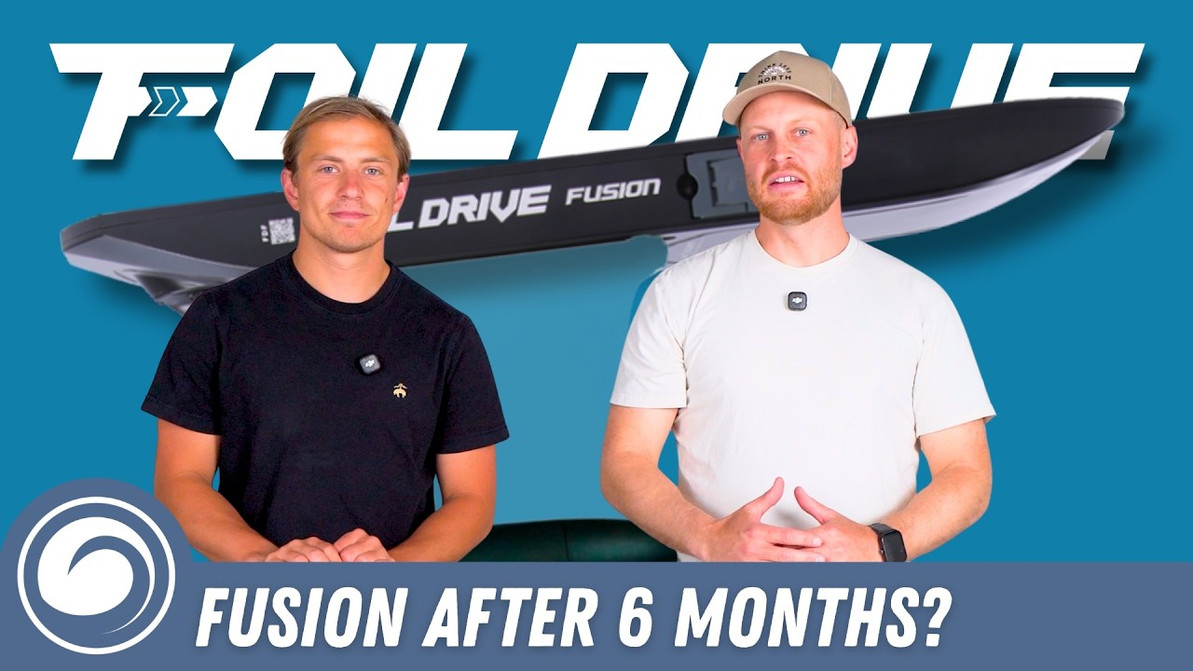
Foil Drive Fusion Review: Long-Term Impressions After Months in the Quiver
Ryan and Hunter have been riding the Foil Drive Fusion for a while now. Recently, they put it in their cars full-time, throwing it into the quiver to dedicate solid time to figuring out exactly where it shines and where it fits in compared to the Max unit. After months of testing, they have some solid thoughts to help you decide if the Fusion is the right choice for your setup.
Unmatched Run Time and Battery Life
The most obvious benefit of the Fusion is the run time. Because it's more powerful, you get to stay out there longer. Ryan was incredibly impressed the first time he took it out with a fully charged battery. Coming from a lot of sessions on the Max units (before the new props were available), he was used to getting 35 to 45 minutes on a typical windy, choppy day with a big battery. With the Fusion, after an hour of riding, his legs were burning and he was almost waiting to go back to shore before the unit ran out of juice.
High Wind and Upwind Performance
Hunter noted that in high-wind conditions, the Fusion is the best tool for the job. On days blowing 25 knots, unless you had a really big wing on the Max, you couldn't get upwind at all. The Fusion makes those sessions much better. You can motor upwind, find the exact waves you want to surf foil, and do a little downwind swell. Motoring upwind in those high-wind conditions is really only possible with the Fusion, and you're still getting over an hour of run time in 25-plus knots.
Light Wind and Long Downwinders
Ryan pushed the battery in light wind with barely rideable swell while doing long downwinders. Running through about half a battery, he was out for almost an hour. With less wind and less turbulence in the water, the battery life extends significantly. If you have a reef break a mile offshore, the Fusion will get you out there, give you a long session, and bring you back with plenty of juice left.
Hunter added that as someone still learning to downwind and read bumps, the Fusion is a great tool. The extra run time allows you to go further upwind, giving you more time downwind and in the bumps to learn. With the Max, he was constantly checking his battery to make sure he could make it back, but the Fusion eliminates that range anxiety. You can go five miles upwind and not have to worry about making it back if you have a bad run.
eFoiling and Teaching Friends
Hunter has become a big eFoiler in the summer months when it's flat and warm, using it to explore the big lake. The Fusion is the perfect tool for getting a lot of run time out of your own sessions, but it's also great for teaching friends. He took a group out and didn't have to worry about constantly bringing the board in and changing batteries — one Fusion battery got a few different people up on foil.
Ryan pointed out that the extra power of the 43-volt system is great for new riders starting in eFoil mode in flat water. Having enough power compensates for a lack of skills. You shouldn't start friends on a 30-liter board, but pairing an appropriately sized board and foil with the more powerful unit lets them mess up a bit more without falling, because they have that extra thrust.

Extra Power for Downsizing Gear
Ryan loves that the Fusion allows you to downsize your gear. Foil Drive's new props help with downsizing on the Max, but the Fusion is another great way to do it. Hunter easily got up on a 600cm2 front wing in flat water on a small board.
Ryan highlighted that Foil Drive products let you ride whatever board and foil you choose. Unlike winging or kite foiling, where you have a complicated math equation pairing wind and sail size, with the Fusion you just look at the conditions, pick the foil you want to ride, and go. It doesn't matter if it's blowing 10 or 20 knots — it simplifies everything when it comes to riding waves and swell.
The Downsides: Weight and Roll
The only downside Ryan noticed over the last few months is the weight. It is heavier, and you definitely notice it when pumping. You have to put more input into the board to pump it, especially in flat water or when climbing up the back of a wave. You have to throw your weight a little harder than you would with the Max or the Slim.
Ryan added that when you put the Fusion on a small foil, it rolls a little easier due to the extra swing weight. It wants to go outside of center. It's not hard to bring back around because you have the speed in better conditions, but the extra weight does help the foil roll.
Max vs. Fusion: Which Should You Choose?
When deciding between the two, Hunter mentioned that for cleaner swells where he wants to pump and connect waves, he might go with the Max.
But for rare no-wind days, high wind, or teaching, the Fusion is his go-to. Ryan agreed, noting that the Fusion is quickly becoming his go-to for the range. It does everything really well, except in sub-par conditions where you're doing a ton of pumping.
The MACkite Take
After months in the quiver, Ryan and Hunter's take on the Foil Drive Fusion is clear: it's the Foil Drive that opens up the most riding scenarios. The biggest gain is run time — over an hour even in challenging 25-plus knot conditions, with significantly more on lighter days.
That extra range translates into real-world benefits:
- motoring upwind in high wind to score the exact waves you want
- eliminating range anxiety on long downwinders so you can focus on reading bumps
- doubling down as an eFoil for teaching multiple friends off a single battery
- using the power to downsize foils that would otherwise be too small to comfortably get up on
Whether you're a wave hunter, a downwinder-in-progress, or someone passing the stoke along to friends, the Fusion handles all of it.
The trade-offs are mild but real. The Fusion is heavier than the Max or Slim, and you'll feel it when pumping — especially in flat water or climbing up the back of a wave. On smaller foils, the extra swing weight makes the foil roll a little easier outside of center. Those quirks are why Hunter still reaches for the Max when conditions line up for clean pumping and connecting waves. But for everything else — high wind, light wind, downwinders, teaching, downsizing — the Fusion is becoming Ryan's go-to. If your riding leans toward range and versatility rather than pure flat-water pump efficiency, the Fusion is the unit to grab.
MACkite Subscription Links:
YouTube | Instagram | Spotify Oddcasts
Contact MACkite Below:
800.622.4655 | Kiteboarder@MACkite.com | LIVE Chat Messenger

Recent Posts
-

2026 Cabrinha Unify Control Bar Review
The Brazilian Brothers are in windy Brazil to provide a thorough review of the brand-new 2026 Cabr …23rd Oct 2026 -

Naish Hatch V2 Parawing Overview
Jeff takes a few minutes out from the KoGL event to chat with Adam Carr from Naish about the Hatch …22nd Oct 2026 -

Flysurfer Soul 4 vs Sonic 5: Which Kite is for You?
Jeff is on the beach at KoGL with Marie-Eve from Flysurfer to discuss the growing excitement surro …20th Oct 2026