

Manta TakeOff Evo Review: Foil Assist & eFoil
Ryan from MACkite has been riding the Manta TakeOff Evo foil assist for a while now, and he is stoked to share his first impressions. From its massive power output to its travel-friendly battery options, this unit brings a lot of versatility to the water.
Setup and Maintenance
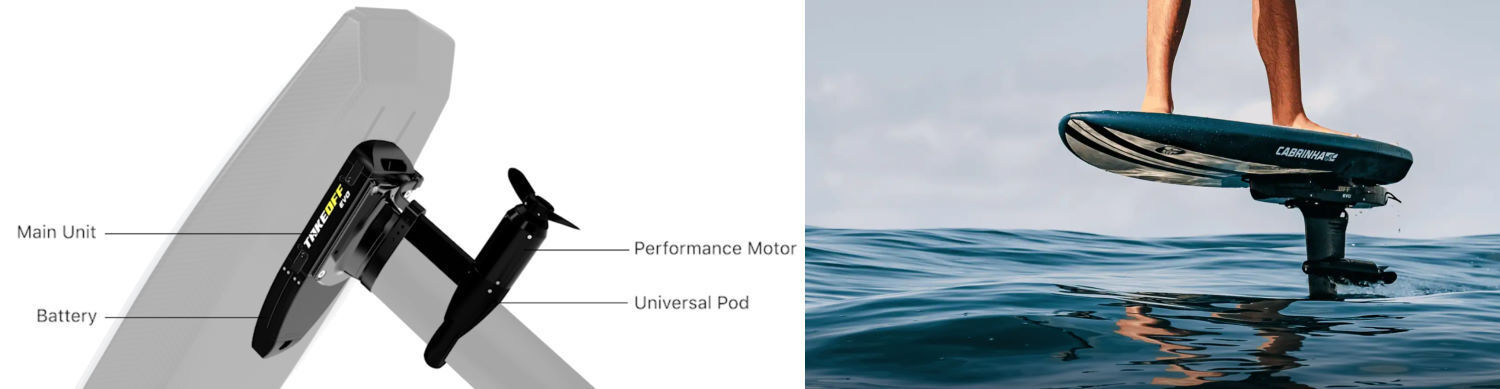
The setup on the Manta TakeOff Evo is fairly simple. You have a nose cone or nose guard that just slides into the back cone portion with a really easy connection using a few screws. The same goes for getting the motor onto the back half of the unit. When setting it up, you do want to run your cable first. Connect your cable to the unit, run it up to get your desired height, and then set the height of the motor. You can take up a little bit of the cable if you want it higher since it is a long enough cable to give you options for your height when you are in assist mode.
Moving on to the motor, it is fully enclosed, which means it is incredibly easy to maintain. All you have to do is give it a simple fresh water rinse at the end of your session. You don't have to take anything apart; just rinse it, throw it in your car, and you are good to go for your next session.
Motor Power and the Remote
This is a fairly large motor, and with that comes quite a bit of power. You are looking at 3,500 watts, which translates to about 35 kilograms of thrust. Because of this, Ryan has found it extremely helpful to use a lower gear, especially for new riders. The remote features gears from 0 through 10. Dialing that back prevents you from trying to run with all the power at once and makes the trigger a little less sensitive. You can run with the trigger fully pulled in, or close to it, without getting overwhelmed. If you run this all the way up to gear 10, it loads up more power than you'll need for most conditions.
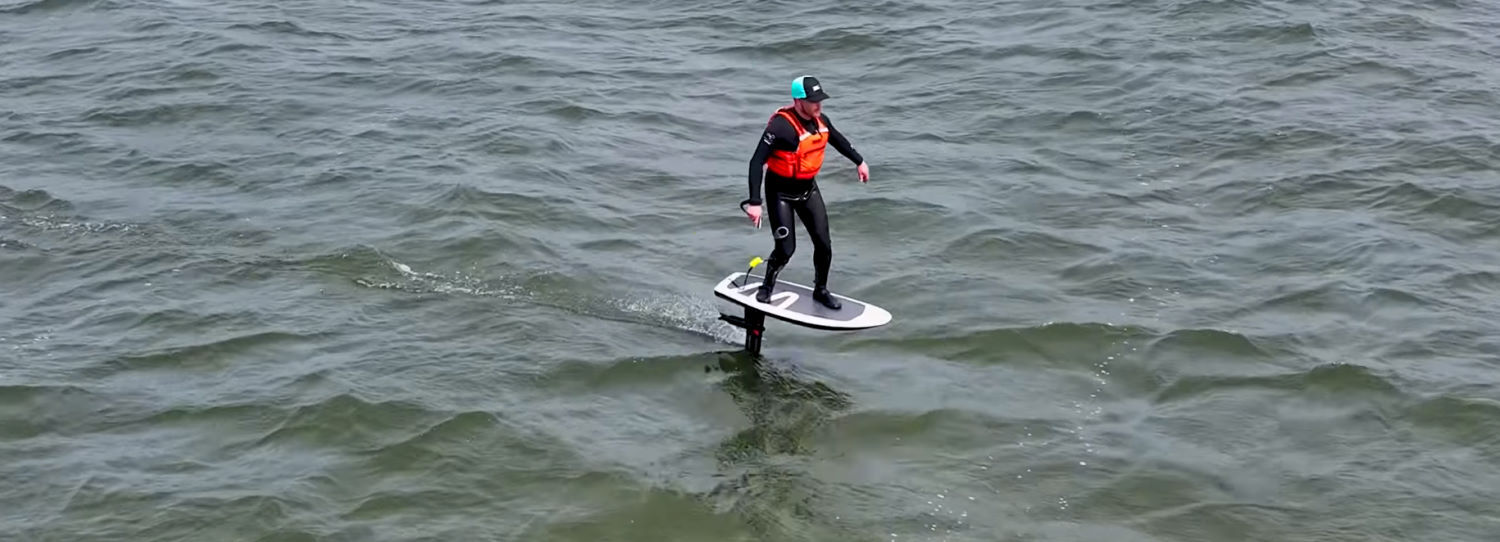
However, having that much power helps the unit excel in really windy conditions or if you are riding small gear. On days with high winds pushing 25+ knots and shoulder-to-head-high swells, you want to be on that small gear, and the amount of power this motor has makes it really easy to do that.
Remote Features and GPS
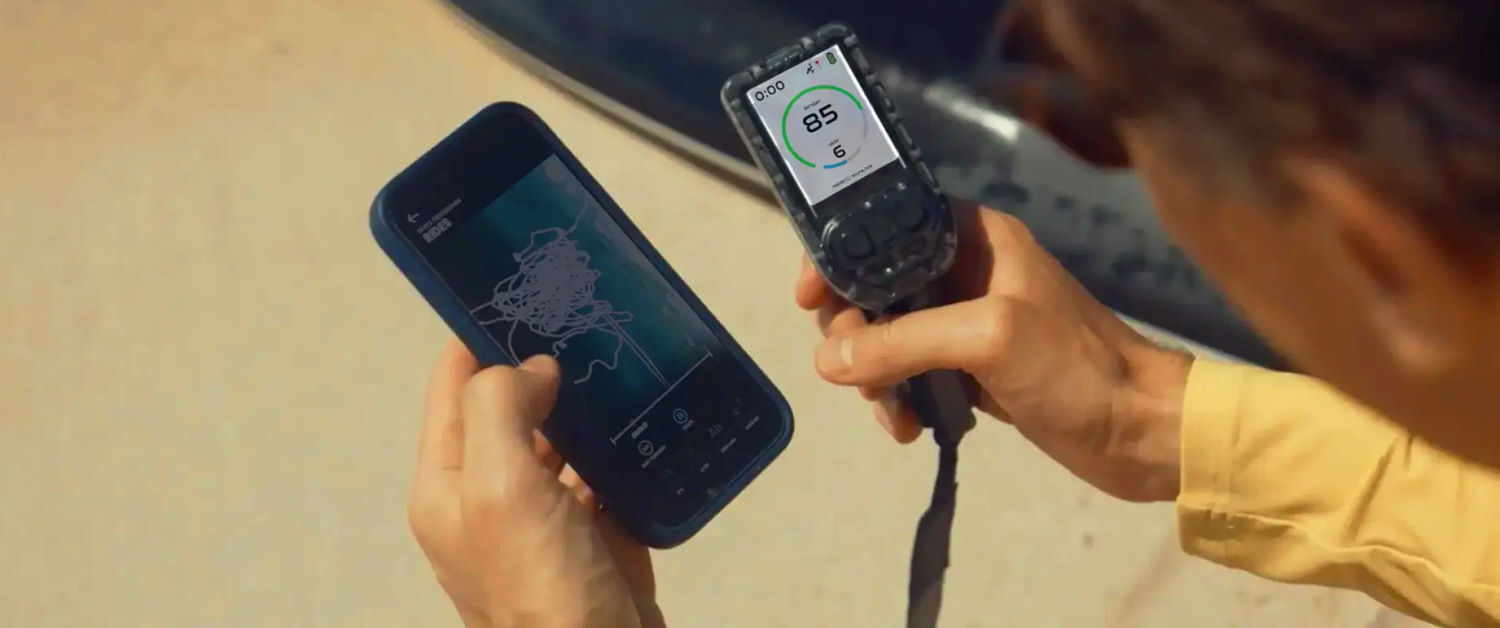
The remote requires a long hold down to turn on, which takes a little longer than you might expect. On the main screen, you have your gears, battery life, foil temperature, and power output. It also tracks your session time in the top left corner, your speed, and a few other stats.
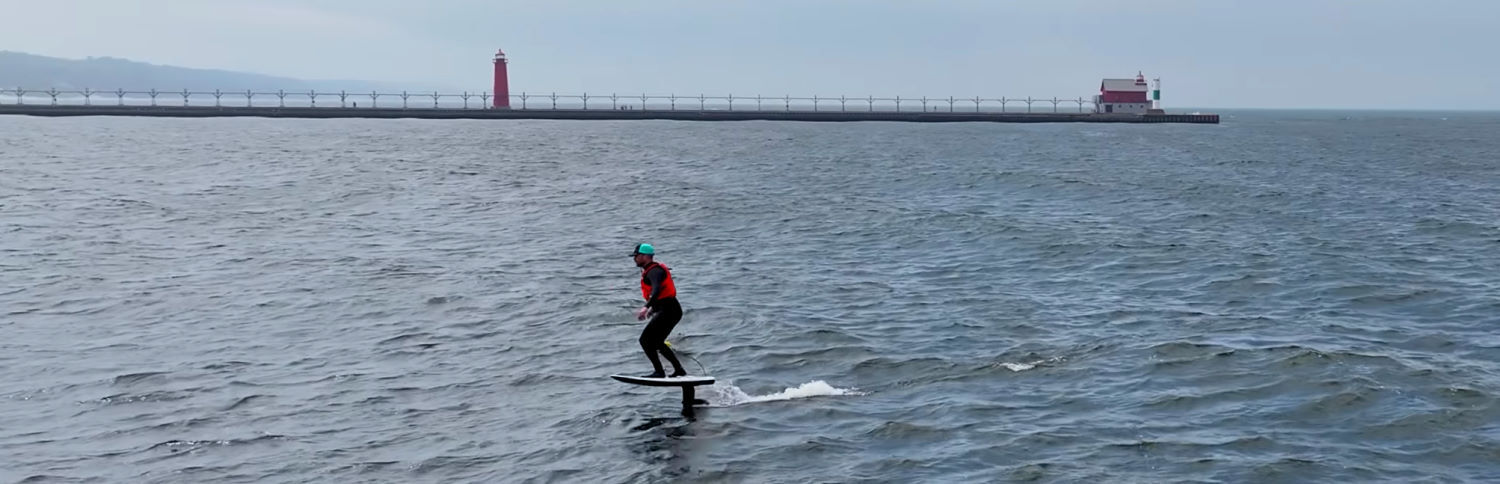
This remote has a built-in GPS, which saves a lot of data that you can download into the app. You can upload it to leaderboards, track your session for wave counts, and view a bunch of other cool stats. It is great to have that feedback after your session to see how it went.
The remote also features a lock function. If you let go of the trigger for a certain period of time, it locks and won't spin again until you unlock it. You can adjust the duration for the lock in the settings menu, along with several other fine-tuning options for your specific situation.
Propeller and eFoil Options
Manta offers a three-blade aluminum propeller option. For most assist units, people are picking up the three-blade option because it gives you a little more thrust and control as the props aerate. That seems to be the consensus for any unit out there, so the three-blade aluminum prop is the way to go for the Manta.
It also has an eFoil option. The unit comes with the standard assist cable, but there is a longer cable that allows you to mount the mast down by where your foil is positioned. If you want to go out and simply eFoil, you have that option. It is a pretty simple switch to go from one to the other. It takes a little bit of time because you have to take a few screws out, pop the motor off, swap the cables, and remount it down towards your foil.
Unlocking Small Boards
Because the motor has so much power, it unlocks a lot of opportunities for riding not only small foils but really small boards. Ryan has been riding some kite foilboards around 20 liters and about four feet in length, and the TakeOff Evo handles it with no problem. It has plenty of power to go as small as you want on a board.
While trench boards are a huge thing for foil assist right now, it isn't strictly necessary to have one with this unit because you have so much extra power. However, there are options for trench boards if you do want to have the whole unit up closer to your feet for a higher performance setup.
Battery Options and Air Travel
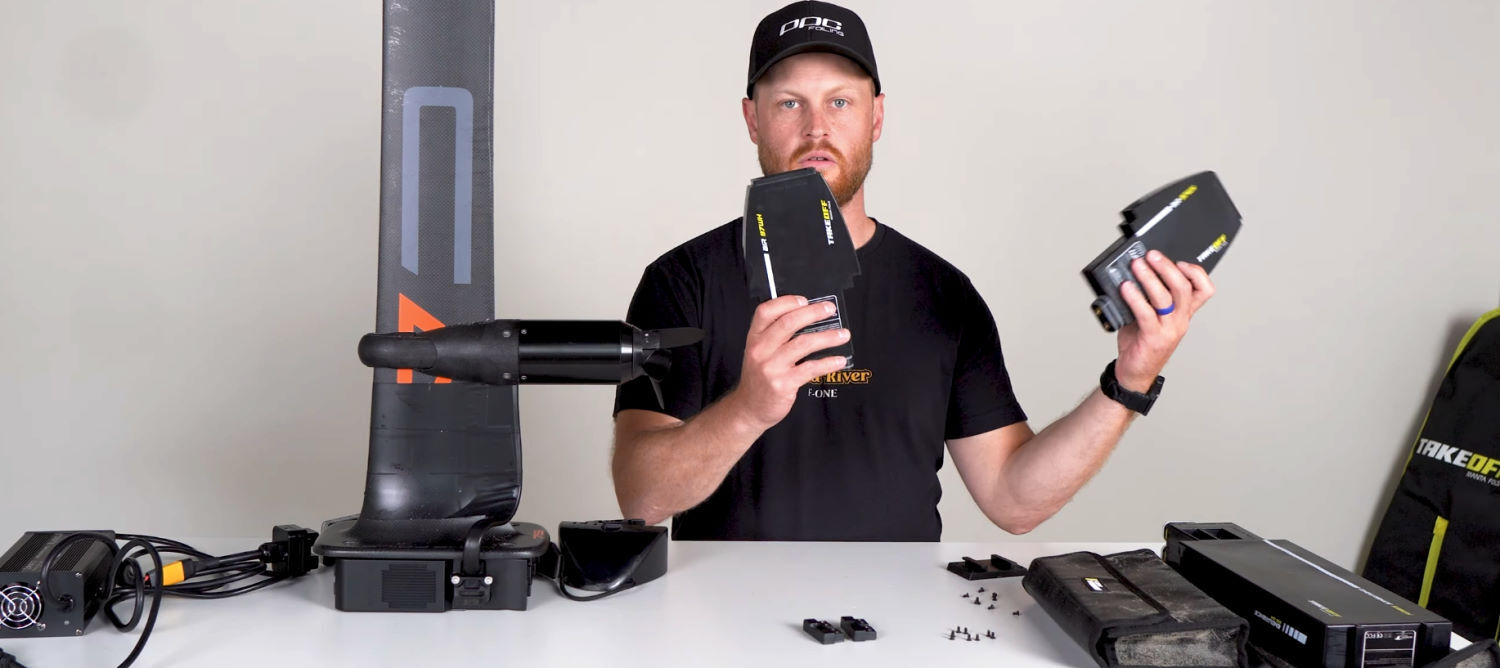
Manta offers essentially two types of batteries for the TakeOff Evo:
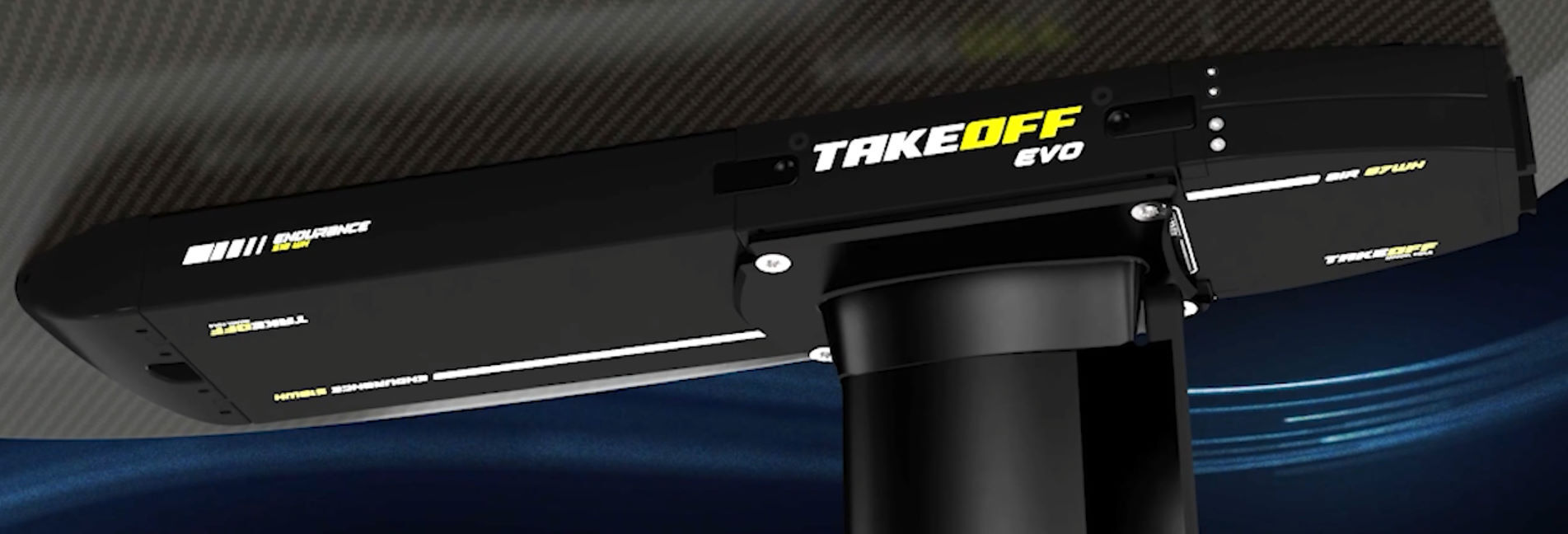
- Endurance Battery: A larger 518 watt-hour battery.
- Air Battery: A smaller 194 watt-hour battery, which is actually comprised of two separate 97 watt-hour batteries.
For air travel, the Air Battery is a game changer. By taking out a few screws on each side, the battery splits into two separate batteries that are under 100 watt-hours. If you have flown with batteries before, you know that TSA can be a bit all over the place, and you should always call your airline ahead of time. However, batteries under 100 watt-hours are much more likely to go through without any hassle. This design allows you to travel with multiple batteries. When you are under 100 watt-hours, you can often travel with quite a few of these 97 watt-hour batteries, giving you plenty of power for your trip. Just remember to reassemble them when you get to your final location!
Battery Configurations and Runtime
The TakeOff unit has a front and a back slot, allowing you to put batteries in both ends at the same time. This gives you a lot of different configurations while you are riding:
- You can run two sets of Air Batteries for a longer runtime (pushing just under 400 watt-hours).
- You can run just one Air Battery.
- You can run just one Endurance Battery.
- You can run an Endurance Battery plus an Air Battery.
For a 180-pound rider on smaller foils (800 to 900 square centimeters) doing upwind and downwind runs in decent winds, an Endurance Battery paired with an Air Battery yields close to an hour of runtime. If you put in a single Air Battery on a really lightweight setup, you can expect closer to 15 to 20 minutes of runtime.
The Backpack Option
Manta also offers a backpack that allows you to mount your batteries on your back. A leash connects to the board, and a cable connects to the unit. Once your batteries are mounted in the backpack, you take all that weight off the board and the whole setup becomes much more lively. This is a great option if you want to run the big Endurance battery for a long runtime but still want higher board performance.
Charging the System
The charger comes in a 4-amp and an 8-amp option. The Endurance battery takes right around an hour to charge with the 8-amp fast charger, while the Air battery takes closer to half an hour. Both batteries feature a dual connection coming off the end of the charger, so they both charge simultaneously. For the Air batteries, there is also a maintenance charger available that charges one half of the battery at a time to balance everything out in the cells.
Installing the Battery
On one end of the battery, you'll slide on a nose cone, and then you'll push the other end of the battery into the power unit. The connection is very snug so that it's watertight, so be sure to push until you hear the latch click. The front of the nose cone has a handle that is very useful for helping you to get the battery back out. If you also run with a battery in the back slot, the nose cone is optional.
Manta Trench Boards and Integrated Mast
Manta makes an integrated aluminum mast that has adapters for your particular brand of foil. This allows you to go with an integrated setup and avoid dealing with the external cord.
They also make their own closed-cell foam trench boards, which come with a nice carrying case. The trench is a little bit wider than some other trenches on the market, specifically to accept the Manta TakeOff Evo. The board features a traction pad clear up to the nose and all the way to the edges, with a little bit of a bevel on the rails so you know exactly where your feet are before your toes hang over. There is a leash attachment in the back and a slight raise towards the middle of the board to help with foot placement.
The 32-liter board is fairly small and has a decent amount of rocker for your touchdowns, allowing you to bounce off the waves and keep going. While all that rocker means it's not a very efficient shape, the motor has plenty of power to get the board up and riding like it's nothing.
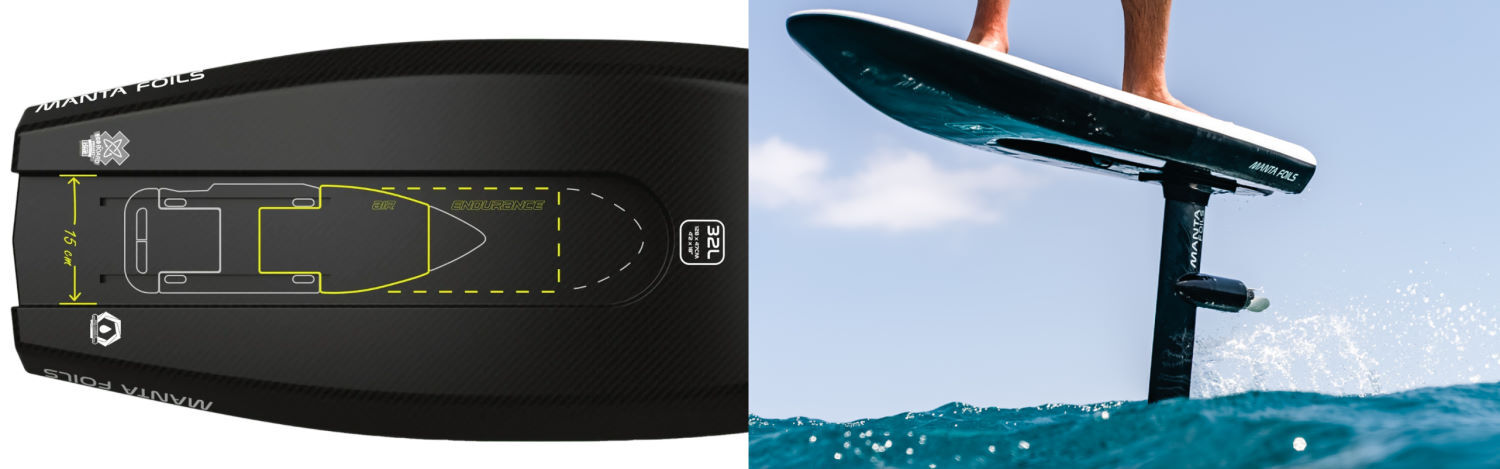
Tip: When putting the unit in and out of a trench board, it is always nice to be able to secure the mast to the unit if the motor needs to be affixed to the mast and taped up. This unit doesn't have a great way to do that. However, if you get foil mounting hardware that has posts (like the CWS screws), you can set your unit on, line it up, and adjust where those track nuts are before you have to put your mast on. Split bolts also work, but sit down a little lower and are harder to find and fine-tune.
Voltage Sag
Like any foil assist unit, you are going to experience voltage sag as you get down to the end of the battery. Ryan noticed that once the battery gets down to about 15 to 20 percent, it starts to sag. That is a good time to make your way back in if you are riding far from shore, so you don't run out of juice before you get back.
Who is the Manta TakeOff Evo For?
This system is for anyone who wants to eFoil or foil assist. It does both very well. Obviously, you are going to have a little less runtime than a traditional eFoil with a massive battery, but you are trading that for a much higher performance unit that can dual into the foil assist world.
It is great for someone who wants to learn how to foil, take an eFoil out on their lake to practice, share it with family and friends, or move into foil assist as you progress. Because of the massive power output, it is also fantastic for heavier riders. Anyone over 200 pounds will find that it has plenty of power. It is also perfect for riders who want to travel by air with the split Air batteries, or riders who want to push the limits on small gear in high wind situations.
MACkite Subscription Links:
YouTube | Instagram | Spotify Oddcasts
Contact MACkite Below:
800.622.4655 | Kiteboarder@MACkite.com | LIVE Chat Messenger
Recent Posts
-
Naish Hatch V2 Parawing Overview
Jeff takes a few minutes out from the KoGL event to chat with Adam Carr from Naish about the Hatch …22nd Oct 2026 -

Flysurfer Soul 4 vs Sonic 5: Which Kite is for You?
Jeff is on the beach at KoGL with Marie-Eve from Flysurfer to discuss the growing excitement surro …20th Oct 2026 -

2026 Duotone Rebel D/LAB Review: 30-Knot Test
The Brazilian Brothers are ready to provide honest feedback on the 2026 Rebel D/LAB by Duotone. Th …13th Oct 2026