
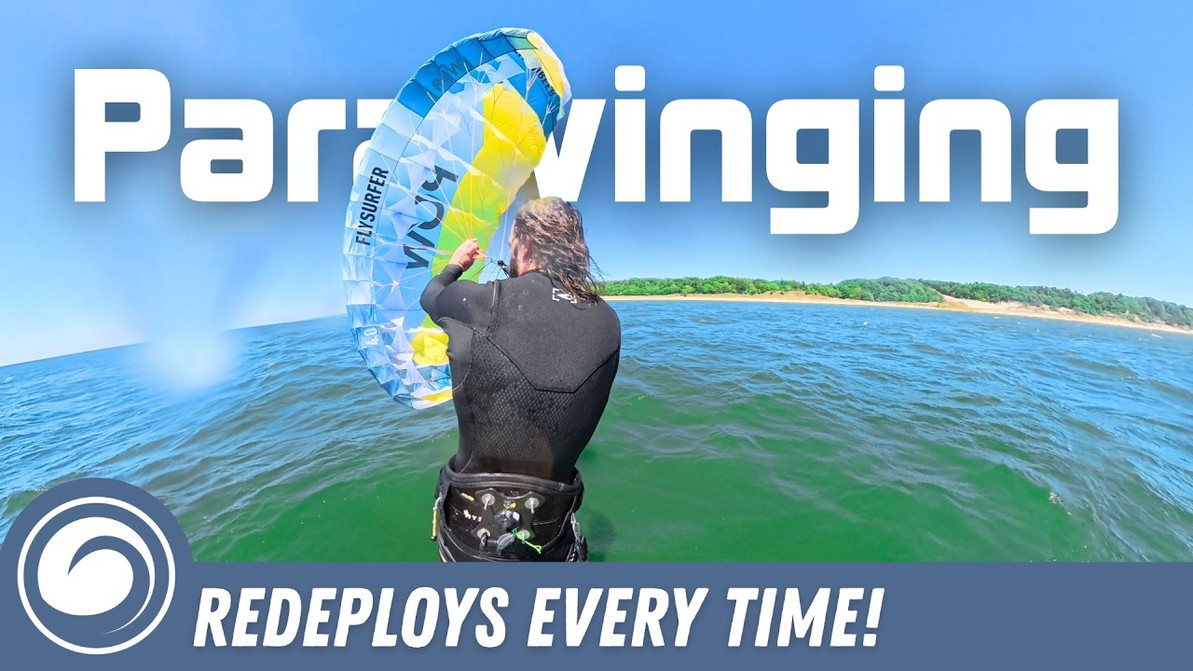
Flysurfer POW 2 Parawing Review
Flysurfer is a legacy brand known for dual-skin and single-skin kites, paragliders, and wingsuits, so they really know their way around bridled airfoils. For this review, Tucker tested the 4m size to see what the second version of the POW brings to the table.
The Bar and Bridle Setup
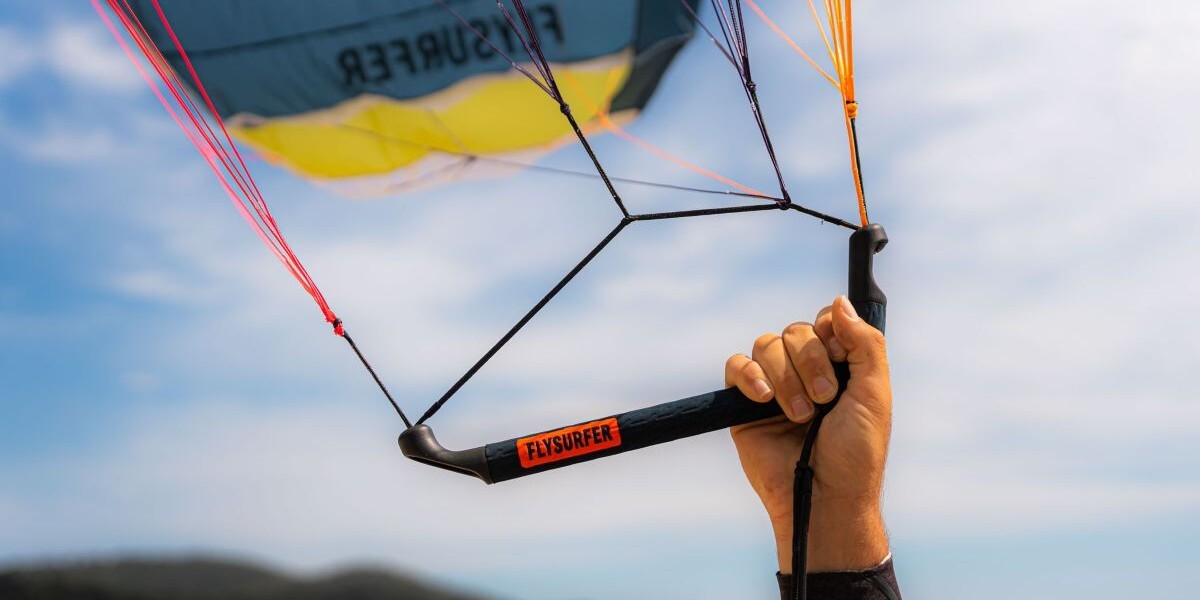
The POW 2 features the classic J-shaped bar. It's a flat bar with a kink at the end, giving you a comfortable end piece to crank on. The tail end is nicely tapered so the bridles just fall off if they happen to get caught. New for this version, Flysurfer eliminated the middle B-line connection in favor of a yoke. There are four stages of lines: orange for the front, purple for the middle, and pink for the trailing edge.
Off the front lines, there's an extension on the center lines grouped together. That gives you an easy spot to grab and collapse the center lines while omitting the pesky wingtip lines, allowing for a complete concertina on the center so it wads up nicely. The lines themselves are stiff enough not to fold and tangle, but smooth and straight. They slide through your hands comfortably and feature woven terminations that are silky and won't chew up your hands.
Tucker noted that removing the center B-line opens up the whole bar for hand placement. While he personally prefers placing a finger in front of the A-line for a teeter-totter effect, the J-shape works well and has nothing to snag on, which is great for avoiding tangles.
Included Harness Line
Flysurfer includes a unique harness line made of rope that cinches on with a stopper ball. It has lumps to adjust the length. Tucker noted that while the top lump is comfortable even with long arms, the line is floppy, making it a bit awkward to find and hook into. He found it easiest to put his hand in the loop, spread it, and then hook in. It's nice that it's included and adjustable up and down the bar, but it's more difficult to use than a traditional fixed harness line with stiffening material or a bungee.
Canopy Construction and Design
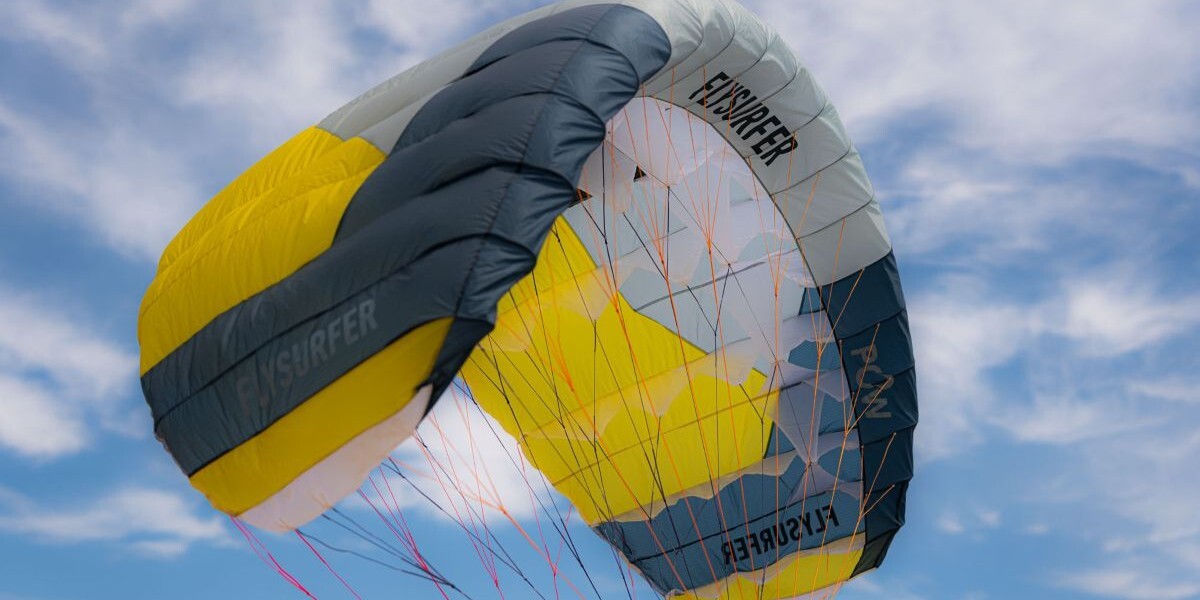
Flysurfer's paragliding pedigree shines in the canopy material. It uses an ultra-light double skin that's durable and hydrophobic, letting it stash down really small. The wing features D-ribs and reinforcements, with every detail well-finished, doubled up, and double-stitched back so it will last a long time without pulling a stitch.
The ribs on the leading edge are light but supportive, and Tucker didn't experience any issues with them collapsing. The deep leading edge creates a lot of power and structure. The wingtips are squared off and tapered, holding their shape nicely without collapsing. A horizontal line through the center apex also helps the wing hold its shape, and the trailing edge is simple, well-reinforced, and wads up super nice because it's so small and light.
Tucker tried pulling in on the yoke when overpowered to see if it helped collapse the wing and flatten the curve. It works a bit, but it puts a lot of tension on your fingers and is uncomfortable with a lot of power, so it isn't something he'd do regularly.
Included Downwind Backpack
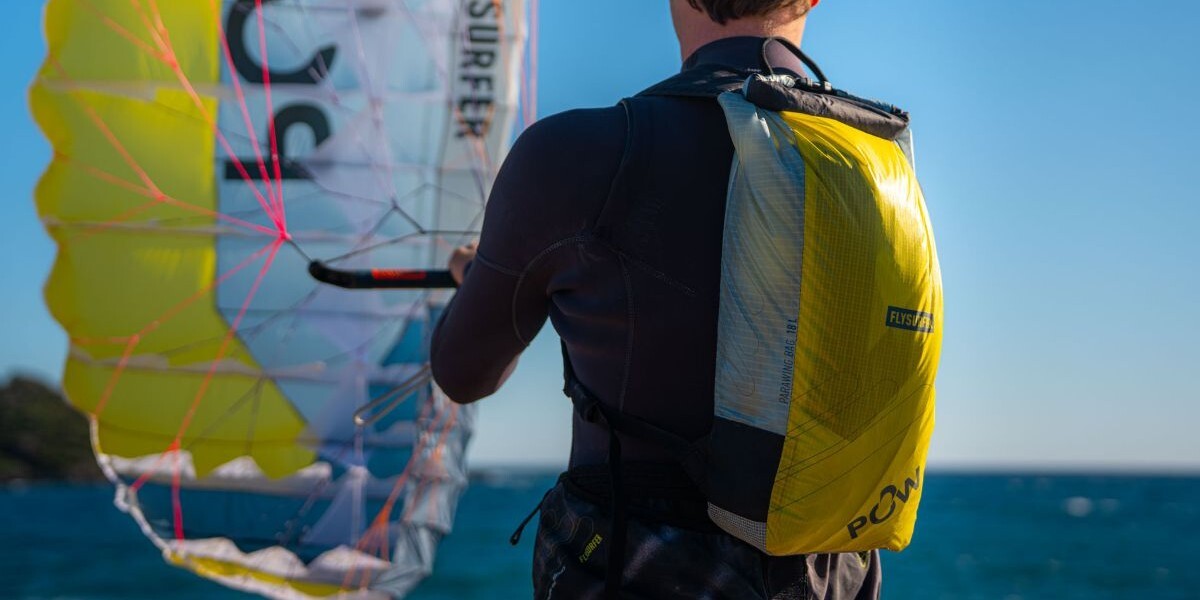
A major added value is the included backpack, which doubles as a downwind bag — normally a $100 to $150 accessory. It features a stuff sack design with a mesh bottom to let sand fall out, plus backpack straps. There's a back pouch for a manual or accessories, and a front pouch with inner pockets for tools, a phone, or a radio, along with straps for a hydration pack or antenna. The chest clip and bottom cinch straps are covered in neoprene so your bridles won't catch on them.
Bag Critiques
Tucker did point out a few flaws with the bag design:
- The vent on the bottom lets you squeeze air out, but it reflexes back and isn't completely watertight. If you put a wet wing inside, a second stowed wing will get soaking wet.
- It lacks a safety factor. If you break a leash and lose your board, a watertight bag can act as secondary flotation. This bag fills with water and becomes a sea anchor, making it harder to swim.
- The top stow sack is quite long. That's good for a longer bar, but it can fill with water and bang the back of your head if flipped over.
Despite these critiques, it's still a fantastic free inclusion that saves you from buying a dedicated downwind bag.
On-Water Performance and Sizing
The POW 2 stays true to its pedigree as a powerful, easy-to-fly, and stable wing. A major improvement over the V1 is the bridle length. The V1 had bridles longer than an arm span, but the V2 features some of the shortest bridles on the market. Even as a taller rider, Tucker couldn't reach the end of the 4m bridles.
The 4m has a massive amount of grunt. Tucker noted it has as much power as some 5m wings on the market, so he advises riders to treat the 4m almost like a 5m when sizing. He was shocked by the low end, easily getting up on the 4m on a day he was otherwise riding 5.0m and 5.6m wings.
He was less impressed by the high end, though. It has a respectable top end if you treat it like a 5m, but it falls short compared to faster, broader-range 4m wings. Because of that massive low-end grunt, you'll want to size down 0.5m to 1m compared to other wings on the market.
Who It's For
The Flysurfer POW 2 is a phenomenal wing for newer riders who need grunt and power to get up on foil. It has a broad sweet spot and is very easy to fly. It's also a favorite for riders doing downwind runs because of its quick power to get up and go. The downwind pull matches wave speed perfectly, dropping deep in the window to pull you down the wave face rather than across it. Plus, it packs down tiny and redeploys really well, making it an excellent tool for your downwind sessions.
The MACkite Take
The Flysurfer POW 2 leans on paraglider DNA to deliver a parawing that punches above its size and packs down smaller than most. The 4m has as much grunt as some 5m wings on the market, so sizing decisions are the single most important thing to get right before ordering.
- Size down 0.5m to 1m compared to other parawings. The 4m has a massive low-end grunt that trades against a shorter high end. Treat it like a 5m when sizing, and you'll unlock its best range without getting blown out on the top end.
- The new yoke-based bridle is a real upgrade. Removing the middle B-line opens up the whole L-bar for hand placement, and the redesigned front-line extension makes it easy to collapse just the center for a clean concertina. Bridles are also dramatically shorter than the V1 (they were longer than an arm span before) — even a taller rider can't reach the end of the 4m bridles now.
- Paraglider-grade canopy construction. Ultra-light double-skin material is durable and hydrophobic, packs down tiny, and everything is doubled up and double-stitched. The deep leading edge holds power and structure, and the D-ribs stay supportive without collapsing.
- Best for newer riders and downwinders. The broad sweet spot and easy flying make it forgiving for anyone still learning the parawing motion, and the deep, downwind-pulling power drops you onto the wave face rather than across it—exactly what you want on a downwinder run.
- The included downwind backpack is a $100 to $150 add-on for free — but do treat it as a bag, not a safety device. It's not watertight (a wet wing stowed inside will soak a dry backup wing), and it fills with water instead of floating, so don't count on it as a flotation Plan B if you lose your board.
MACkite Subscription Links:
YouTube | Instagram | Spotify Oddcasts
Contact MACkite Below:
800.622.4655 | Kiteboarder@MACkite.com | LIVE Chat Messenger

Recent Posts
-

2026 Cabrinha Unify Control Bar Review
The Brazilian Brothers are in windy Brazil to provide a thorough review of the brand-new 2026 Cabr …23rd Oct 2026 -
Naish Hatch V2 Parawing Overview
Jeff takes a few minutes out from the KoGL event to chat with Adam Carr from Naish about the Hatch …22nd Oct 2026 -

Flysurfer Soul 4 vs Sonic 5: Which Kite is for You?
Jeff is on the beach at KoGL with Marie-Eve from Flysurfer to discuss the growing excitement surro …20th Oct 2026