
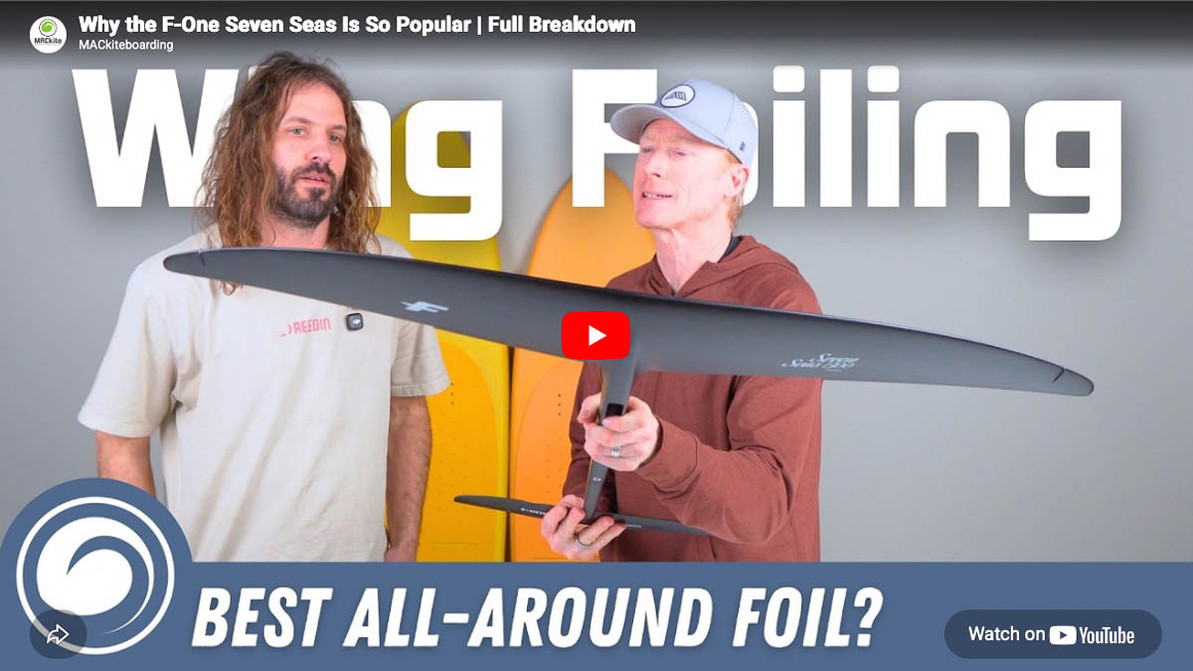
F-One Seven Seas | The All-Around Foil That Earns Its Place in Any Quiver
The F-One Seven Seas has been quietly doing its thing in the wing foil world for a few years now, and honestly, it doesn't get nearly enough credit. It's not flashy. It's not the foil that gets tagged in the big wave edits or the high-performance clips. But for a huge portion of wing foilers, from beginners still finding their sea legs to seasoned riders who just want to flow with the ocean on a mellow day, the Seven Seas might be the smartest foil in the quiver.
Tucker and Jeff from MACkite sat down to break down exactly what makes this foil tick, where it fits in the F-One lineup, and who should seriously consider adding it.
What Is the F-One Seven Seas?
The Seven Seas has gone through a meaningful evolution since its first release. When it launched, the name reflected its seven aspect ratio. In its second generation, F-One bumped the aspect ratio up to eight—a smart move that added efficiency and glide without sacrificing the foil's signature ease of use. The current generation also adopts F-One's Titan 2 connection point, which brings noticeably improved stiffness, control, and durability across the board. If you've ridden wider foils on older connection systems, you'll feel the difference immediately.
Where It Sits in the F-One Lineup
Think of the F-One lineup as a spectrum. On one end you've got surf-oriented, higher-performance foils like the Skate and the Eagle. On the other, beginner-friendly, lower-aspect options like the Gravity and the Phantom. The Seven Seas sits comfortably in the middle.
It's sleeker and more capable than those big, chunky entry-level foils, but it doesn't demand the speed and commitment that the Skate and Eagle require. That middle-ground positioning is exactly what makes it so versatile.
Who Is the Seven Seas Actually For?
This is where it gets interesting, because the answer is: a lot of people.
- Beginners with some water sports background – If you've taken a lesson and can get up on foil, the Seven Seas in the right size is a natural next step. It's forgiving, stable, and intuitive without being boring.
- Intermediate riders who want to ride smaller conditions – Waist-to-head-high waves, 12–18 knots of wind—this is the Seven Seas' home turf.
- Experienced riders building a light-wind quiver – If you're already a solid winger and want a dedicated light-wind weapon, this is near the top of the list.
- Parawinging enthusiasts – The Seven Seas is one of the best foils for parawinging, full stop. It glides effortlessly, pumps well, and has that natural surfy feel that makes parawinging sessions come alive.
- Wake foil riders – Jeff and Tucker called it probably the best in the F-One lineup for riding second, third, or fourth wake. Smooth, easy lift, and tons of fun behind the boat.
The Ride | What It Actually Feels Like
Tucker put it well: the Seven Seas is an "easy button." That's not a knock—it's a compliment.
Getting up on foil in 10–14 knots doesn't require pumping the board aggressively or coaxing the foil into the air. A few pumps of the wing and the foil lifts you cleanly and steadily, like an elevator. Once you're up, the drag that typically plagues big foils isn't the issue it used to be, thanks to that bump up to the eight aspect ratio. You get the easy lift of a large foil with enough efficiency to actually enjoy the ride once you're flying.
What really stands out is the stall speed. The Seven Seas has one of the most forgiving stall envelopes in the lineup. Riders can slow way down, nearly stall the foil, and it'll still recover cleanly—especially with a little help from incoming swell or wave energy. That characteristic opens up a style of riding that faster, higher-performance foils can't offer: slow, surfy, in-the-pocket turns where you're burning speed rather than chasing it.
For prone foiling in mushy, smaller surf, the smaller sizes of the Seven Seas are outstanding. It's the kind of foil that does exactly what you ask, when you ask it.
The Seven Seas for Wave Riding | More Capable Than You Think
One of the most interesting takeaways was the wave performance discussion. Experienced riders sometimes dismiss larger, lower-aspect foils as tools for beginners, but Jeff had an eye-opening experience on the Seven Seas in real swell conditions.
The foil matched wave speed almost perfectly, not because it's fast, but because it's well-matched to the pace of average swell. That's actually the advantage. Faster foils can slingshot you out to the shoulder when there's real power in the wave, and then you're scrambling to find speed again. The Seven Seas keeps you in the pocket, turning more actively, hitting the lip without overshooting it.
- Make tighter, more whippy turns because you're not traveling at Mach speed
- Blow the tail out a little and carve harder
- Slow down dramatically without stalling, then point the nose back down and accelerate instantly
- Flag out the wing and ride pure wave energy with confidence
For flagging out specifically, letting go of the wing and riding the wave on pure foil lift, the Seven Seas is one of the easier ways to learn that skill in the F-One lineup. The right amount of lift, the right ease of access, and a slow enough stall speed to actually give you time to settle into wave riding mode.
Tail Pairing | Dialing In the Ride
Tail selection matters here, so it's worth spending a minute on it.
The Seven Seas typically ships with a 198mm carve stabilizer (or 158mm for smaller sizes). Those pairings give you the bounce and roll between turns that a surfy foil craves—initiating that second turn quickly and naturally.
If you're pairing this foil with something like a 200mm pumping stabilizer, expect more drag, a flatter feel, and less snap between turns. Not ideal for surf performance, but potentially useful if you're teaching someone new or just want a calm, stable light-wind cruise.
For higher-level riders who want to liven things up, sizing down to the 158mm stabilizer is a legit option. You'll give up some stability but gain responsiveness and sharper turn initiation. The foil can absolutely handle it.
Can the Seven Seas Be a One-Foil Quiver?
Surprisingly, maybe.
It handles light-wind days with ease. In overhead, 30-knot conditions, it'll push its speed limits, but it keeps up with the waves and won't let you down on a big downwinder. You won't be setting speed records, but you'll be having a great time. For riders who want to simplify and cover the widest range of conditions with a single foil, the Seven Seas makes a compelling case.
Key Takeaways
- The F-One Seven Seas is a third-generation foil that has matured into a genuinely capable, versatile option—not just a beginner tool
- The upgrade to an eight aspect ratio added meaningful glide and efficiency while keeping the foil easy to use
- Titan 2 connection delivers improved stiffness and control, especially noticeable on wider foil platforms
- It excels in light wind (10–18 knots), average swell, parawinging, and wake foiling
- The forgiving stall speed allows surfy, in-the-pocket riding that faster foils simply can't replicate
- Experienced riders should seriously consider it as a light-wind quiver piece—it rewards skill without requiring it
- Tail pairing matters: the stock 198mm is great for most riders; the 158mm opens it up for more technical turns
- It could realistically serve as a one-foil quiver for many riders in a wide range of conditions
Talk to the Team at MACkite
Still figuring out which size or configuration is right for your weight, local conditions, and riding style? We're here for exactly that conversation.
Drop us a line at Kiteboarder@MACkite.com and we'll help you dial in the right foil setup for where you ride and where you want to go.
Recent Posts
-
F-One Seven Seas | The All-Around Foil That Earns Its Place in Any Quiver
The F-One Seven Seas has been quietly doing its thing in the wing foil world for a few years now, …2nd Apr 2026 -

Is the F-One Strike CWC the Best Light Wind Wing on the Market?
Light wind days are where a lot of sessions die before they even start, and that can be hella frus …2nd Apr 2026 -
F-One Free Surf vs Free Downwind: Which Foil Board Should You Choose?
F-One Free Surf vs Free Downwind boards—what’s the difference, and which one is right for your rid …2nd Apr 2026