
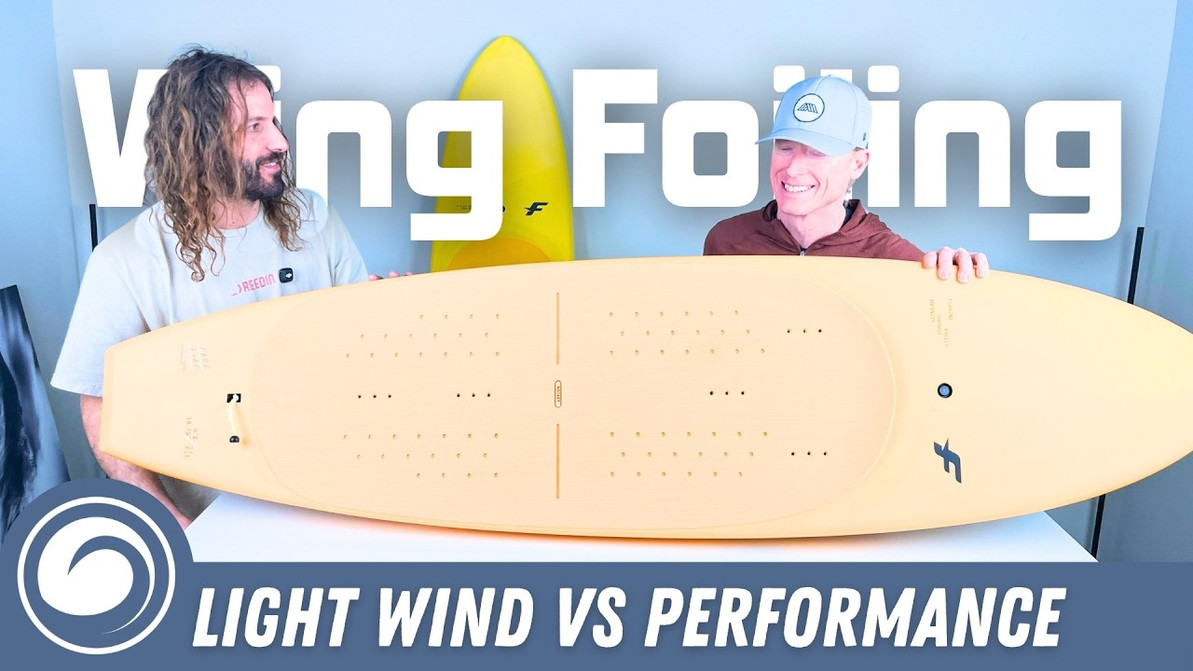
F-One Free Surf vs Free Downwind: Which Foil Board Should You Choose?
F-One Free Surf vs Free Downwind boards—what’s the difference, and which one is right for your riding style?
From volume distribution to board shape and real-world practice, Tucker and Jeff dive deep into how these boards perform to help settle the debate between a one-board quiver or a two-board setup.
TLDR;
Mid-length boards have filled the gap between compact sinkers and full downwind shapes. They’re longer, more efficient, and far more versatile than traditional wing boards.
The Free Surf and Free Downwind both come out of that evolution, blending DNA from earlier crossover shapes. But they diverge in a key way:
- The Free Downwind leans toward efficiency and lift in minimal wind
- The Free Surf leans toward performance and versatility across conditions
The Free Downwind has a longer, narrower, and thicker profile with volume packed through the center. This makes it tend towards better glide, earlier lift, and more efficient light wind performance.
The Free Surf, on the other hand, is slightly shorter and thinner with the same volume. With a more refind rail and deck feel, this board is built for control, carving, and all-around use.
The tricky part in your decision? Where they overlap in volume.
Volume, Width, and Length Explained
On paper, both boards might show similar volume numbers. On the water, they ride completely different. Here’s why that matters when you’re trying to get up, stay balanced, and actually enjoy the session.
Free Downwind: Stability and Lift Without Effort
- The extra thickness keeps you floating high, even when there’s barely any wind
- You don’t have to fight to stay on your feet while waiting for a gust
- When power comes in, the board builds speed easily and lifts onto foil with less technique
That means you spend less energy getting going and more time actually riding. If you’ve ever struggled to get up in light wind, this board smooths that out. It’s especially noticeable when learning parawing, where balance and patience matter.
Free Surf: Control, Connection, and Better Riding Once You’re Up
- The thinner profile puts you closer to the foil
- The added width gives you leverage when you’re turning or controlling power
- The longer outline still helps you build speed, but with more precision
Once you’re on foil, everything feels more responsive. You can push harder into turns, recover touchdowns more cleanly, and stay in control when the wind picks up. It feels less like balancing on top of something and more like being connected to it.
Free Downwind: A Light Wind Machine?
This is the board you grab when you’re not even sure it’s worth rigging. As a result, its characteristics on the water are noticeable:
- You stand up and immediately feel stable, even before there’s real power
- You’re not sinking, wobbling, or constantly adjusting your feet
- When a puff hits, the board builds speed smoothly instead of stalling out
Because its stability comes from its buoyancy, the board feels predictable and tracks straight without much input.
Where It Shines & Its Limitations
- Light wind doesn’t feel like a handicap anymore
- You can stand comfortably while managing a parawing or big wing
- You’re not burning energy just trying to stay balanced
On the other hand, if you transition to a more aggressive riding style, you might outgrow this board. While it doesn't necessarily focus on making you a better rider, it does make it easier to ride more often.
When to Choose the Free Downwind
If you ride under 15 knots often and want to maximize your water time, this is it. In addition, if you're learning how to parawing or prioritize easy takeoffs, the Free Downwind is a solid choice.
Free Surf: The One-Board Quiver
This is the board that makes good days feel even better and opens the door to progressing. You’re not just getting on foil, you’re riding the foil. Carves feel intentional, not accidental.
- When you stand up, it feels more planted and connected, not floaty
- As you gain speed, it comes alive instead of just lifting you up
- Small inputs through your feet actually translate into movement on foil
You're able to push harder into turns, recovery is easier, and you're able to conquer light wind and powered conditions without feeling out of place. You can cruise, carve, and push speed without feeling like the board is limiting you.
Some Tradeoffs
The Free Surf rewards skill. If you’re progressing, this board grows with you. If you’re brand new or underpowered, it can feel less forgiving than the Downwind.
- In very light wind, you’ll need better technique to get up
- You can’t rely on volume to save you if you lose balance
- It asks a bit more from you as a rider
When to Choose the Free Surf
If you're looking for one board to cover as many disciplines as possible, the Free Surf is your go-to. This board is also a good option if you ride 12-20+ knots regularly, value turning and control, or are progressing into higher performance foils.
Which One Should You Actually Buy?
This isn’t about liters, it’s about how the board helps you succeed.
- Free Downwind helps you get up easier and ride in less wind
- Free Surf helps you ride better once you’re up and keep progressing
If your sessions are limited by getting on foil, volume distribution matters one way.
If your sessions are about improving turns, speed, and control, it matters the other way.
MACkite Subscription Links:
YouTube | Instagram | Spotify Oddcasts
Contact MACkite Below:
800.622.4655 | Kiteboarder@MACkite.com | LIVE Chat Messenger

Recent Posts
-

F-One Seven Seas | The All-Around Foil That Earns Its Place in Any Quiver
The F-One Seven Seas has been quietly doing its thing in the wing foil world for a few years now, …2nd Apr 2026 -

Is the F-One Strike CWC the Best Light Wind Wing on the Market?
Light wind days are where a lot of sessions die before they even start, and that can be hella frus …2nd Apr 2026 -
F-One Free Surf vs Free Downwind: Which Foil Board Should You Choose?
F-One Free Surf vs Free Downwind boards—what’s the difference, and which one is right for your rid …2nd Apr 2026